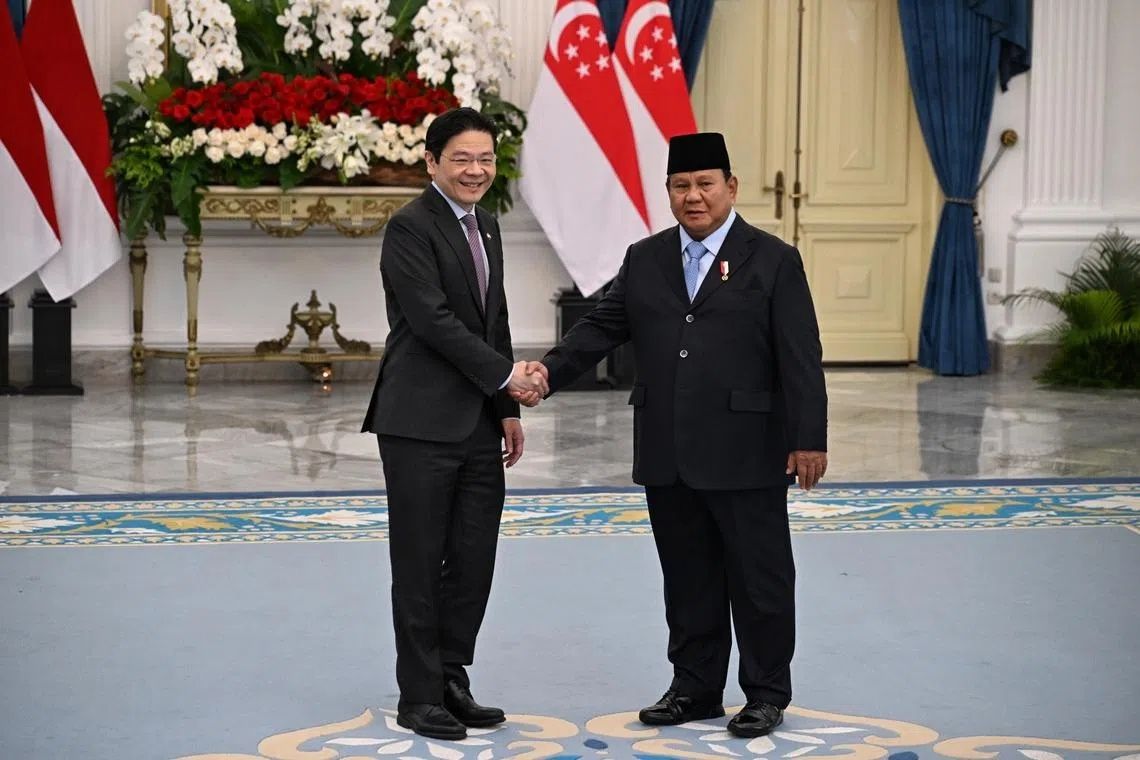
Singapore and Indonesia have reaffirmed their shared commitment to keeping the Strait of Malacca accessible to all maritime traffic, placing maritime security at the centre of their bilateral agenda as the two neighbours prepare to commemorate six decades of formal relations in 2027. The declaration followed high-level discussions on July 6 between Prime Minister Lawrence Wong and President Prabowo Subianto at their annual Leaders' Retreat, where both governments signalled growing recognition that safeguarding one of the world's most critical shipping thoroughfares is essential to regional prosperity and geopolitical equilibrium.
The Strait of Malacca represents far more than a geographical waterway; it functions as the arterial system through which a substantial portion of global maritime commerce flows. Connecting the Indian Ocean to the South China Sea, this narrow passage handles enormous volumes of petroleum, liquefied natural gas, manufactured goods, and other commodities destined for markets across Asia, Europe, and beyond. For Malaysia, Singapore, and other Southeast Asian economies, the strait's functionality directly influences everything from port operations to refineries to manufacturing competitiveness. Disruptions to traffic through this route, whether from piracy, environmental incidents, or geopolitical conflicts, send immediate ripples through regional supply chains and energy markets.
President Prabowo emphasised Indonesia's principled stance on the matter, noting that both countries occupy unique geographical positions along the strait's boundaries. He underscored that Indonesia would persist in coordinating with Malaysia and Thailand to ensure compliance with international maritime law, particularly the United Nations Convention on the Law of the Sea, which guarantees freedom of navigation. The Indonesian leader identified specific threats requiring management: piracy, pollution, and maritime accidents. His remarks reflected growing concerns across the region about security challenges that have periodically threatened shipping lanes, from armed robbery against vessels to environmental hazards.
Prime Minister Wong contextualised the commitment within broader global developments, drawing explicit parallels to recent disruptions in other critical waterways. He referenced the impact of Middle Eastern tensions on the Strait of Hormuz, where geopolitical instability has periodically choked maritime traffic and destabilised global energy supplies. This comparison carries particular weight for Southeast Asia, whose economies depend heavily on unimpeded access to global markets and steady energy flows. Wong's framing suggested that Singapore and Indonesia view their stewardship of the Malacca Strait not merely as a regional responsibility but as a contribution to global economic stability during an era of intensifying geopolitical uncertainty.
Beyond maritime security declarations, the retreat signalled a fundamental broadening of Singapore-Indonesia cooperation into transformative sectors that will shape both economies over the coming decade. Cross-border electricity trade emerged as perhaps the most consequential development, with both governments identifying it as a cornerstone for future energy collaboration. Indonesia's sovereign investment fund Danantara was designated to lead implementation efforts, signalling serious political commitment and institutional capacity. Singapore's participation, through partnerships with established firms including Keppel Electric, Sembcorp Industries, and Singapore Energy Interconnections, indicates concrete moves toward establishing the technical and commercial frameworks necessary for electricity exports.
The electricity initiative carries implications extending well beyond bilateral relations. Prime Minister Wong characterised the venture as a prototype for a broader ASEAN Power Grid, a more ambitious vision that could fundamentally alter how Southeast Asian nations source, distribute, and price energy. Such a grid would leverage Indonesia's renewable energy potential while addressing Singapore's constrained geographical circumstances and energy import dependence. For Malaysia and other regional players, a functioning ASEAN Power Grid represents both opportunity and competitive challenge, potentially lowering energy costs while requiring substantial infrastructure investment and regulatory harmonisation across the bloc.
The two leaders also identified supply chain resilience, cybersecurity, and digital infrastructure as critical cooperation areas. These sectors reflect recognition that future economic competition depends less on traditional manufacturing advantages and more on digital capabilities, data security, and integrated production networks insulated from external shocks. President Prabowo noted that discussions on digital ecosystems and cybersecurity had yielded substantive outcomes, though the retreat communiqué did not disclose specific technological cooperation arrangements. For Malaysian observers, Singapore-Indonesia advances in these areas suggest that regional economic integration is accelerating along dimensions that will require comparable Malaysian engagement.
Prime Minister Wong's repeated emphasis on Singapore's confidence in Indonesia's economic trajectory served a dual diplomatic purpose: reassuring international investors about Indonesia's stability and prospects while signalling Singapore's strategic interest in Indonesia's continued development. His reference to Singapore's investment footprint across Indonesia—from the Batam, Bintan, and Karimun region to the Kendal Industrial Park in central Java—underscored that bilateral economic ties already run deep. The Kendal facility, marking its tenth anniversary in 2026 at full capacity, exemplifies how Singaporean capital and expertise have contributed to Indonesia's manufacturing expansion. Plans to expand the park by a thousand hectares suggest continued Singapore confidence in Indonesia as an investment destination, particularly for industries requiring stable political conditions and reliable infrastructure.
The bilateral relationship's evolution reflects broader regional dynamics. Both governments have positioned themselves as advocates for rules-based international maritime order at a moment when great power competition threatens to undermine established norms. Their joint commitment to Strait of Malacca security implicitly counters pressures that might arise from external powers seeking to restrict or weaponise access to critical sea lanes. This stance aligns with ASEAN's professed commitment to maintaining regional autonomy, though the degree to which Indonesia and Singapore can sustain navigational freedom amid intensifying geopolitical pressures remains an open question.
The diplomatic language around the Leaders' Retreat masks genuine complexities in managing the strait. Piracy and maritime robbery persist despite international naval coordination efforts. Environmental threats from shipping accidents, oil spills, and climate-driven challenges mount annually. Balancing commercial shipping interests, naval security operations, and environmental protection requires continuous coordination among all littoral states. Indonesia's mention of ongoing consultation with Malaysia and Thailand suggests these coordination mechanisms are functioning, yet incidents of piracy and vessel hijackings periodically demonstrate the limitations of current arrangements.
Looking forward, the 2027 milestone marking sixty years of Singapore-Indonesia diplomatic relations will provide an opportunity to assess whether the commitments articulated at the July retreat translate into institutional change and tangible economic gains. The electricity trade initiative, if successful, could establish a template for other transnational infrastructure projects addressing regional challenges. Success depends on navigating complex regulatory environments, ensuring commercial viability, and securing sufficient political continuity through potential leadership transitions in both countries.
For Malaysia and the broader Southeast Asian region, the Singapore-Indonesia strategic alignment represents both reassurance and challenge. Reassurance comes from the explicit commitment to maintaining open maritime passages upon which regional economies depend. Challenge emerges from the possibility that deepening Singapore-Indonesia ties might reshape regional economic geography, potentially drawing manufacturing and investment flows toward their initiatives at the expense of other ASEAN members. Malaysian policymakers, observing this bilateral dynamism, face pressure to strengthen domestic infrastructure, regulatory frameworks, and cross-border cooperation to remain competitive within an increasingly integrated Southeast Asian economic space.

