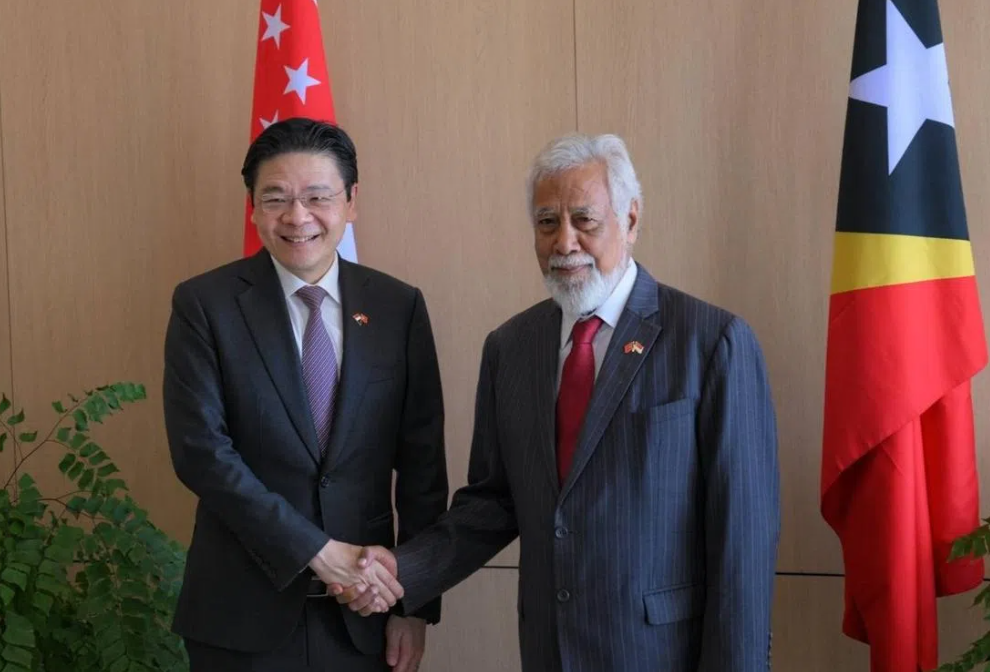
Prime Minister Lawrence Wong has concluded the first visit by a Singapore prime minister to Timor-Leste, marking a significant moment in the island nation's relationship with its Southeast Asian partner. During his two-day trip to Dili, Wong and Timor-Leste Prime Minister Xanana Gusmao signed a comprehensive bilateral cooperation agreement on July 3 at the Government Palace, establishing formal mechanisms for regular dialogue between their respective foreign ministries. The pact creates a structured platform for addressing not only bilateral matters but also broader regional, international and strategic issues of mutual concern, reflecting both governments' commitment to deepening engagement beyond traditional diplomatic channels.
The agreement represents a watershed for Timor-Leste, which formally joined ASEAN as the organisation's eleventh member state on October 26, 2025, just months before Wong's visit. Singapore's support for the newly independent nation's integration into the regional bloc has been substantial and multifaceted. Through the Singapore-Timor-Leste ASEAN Readiness Support (Stars) package, initially launched in December 2022 and subsequently enhanced in July 2025, Singapore has provided practical training and institutional knowledge to equip Timorese officials for ASEAN participation. Wong announced during the visit that this package would be further expanded to include additional ASEAN-focused programmes, recognising that Timor-Leste now faces the immediate challenge of preparing to assume the ASEAN chairmanship in 2029.
Economic cooperation forms the cornerstone of Singapore's engagement with Timor-Leste. Singapore currently ranks among the country's largest investors, with companies active across diverse sectors ranging from wholesale trade to renewable energy projects. This investment momentum reflects growing confidence in Timor-Leste's economic potential and development trajectory. Wong emphasised that bilateral business cooperation offers mutual advantages, creating fresh opportunities for Singaporean enterprises while positioning Timor-Leste for diversified, sustainable economic expansion. The framing of commerce as a vehicle for shared prosperity resonates with Singapore's broader regional strategy of using economic interdependence to strengthen diplomatic relationships.
A particularly innovative development is Singapore's decision to extend its foreign worker recruitment framework to include Timorese nationals from 2027 onwards. Construction firms, marine shipyard operators, and other sectors facing labour constraints in Singapore will be permitted to hire Timorese work permit holders, a move that expands the non-traditional labour source pool beyond established arrangements. Singapore's Manpower Ministry has already observed preliminary interest from construction companies and other employers, suggesting the initiative addresses genuine workforce gaps. This labour mobility initiative serves dual purposes: it generates income and employment opportunities for Timorese workers while providing Singapore businesses with access to a broader and more diverse labour supply, with implementation commencing in the second half of 2027.
Healthcare collaboration represents another pillar of deepening ties. The National University Hospital (NUH) and Timor-Leste's Health Ministry plan to sign a framework agreement later in July 2024, establishing a five-year partnership focused on health workforce development, clinical training systems, public health capacity-building, and broader health systems strengthening. This cooperation targets specific areas Timor-Leste's health ministry has identified as priorities, including emergency care, prehospital services, paediatrics, ophthalmology, obstetrics and gynaecology, and foundational supportive care. By deploying Singapore's advanced healthcare expertise and institutional infrastructure to address Timor-Leste's most pressing health needs, the arrangement creates a template for knowledge transfer that benefits a developing nation's population while establishing long-term institutional relationships between healthcare providers.
Education cooperation complements the healthcare initiatives. Wong articulated Singapore's commitment to supporting Timor-Leste's national teacher training institute and programmes for developing education professionals, emphasising that investing in school leadership today shapes future generations. This educational dimension addresses a fundamental development challenge facing newly independent nations: building indigenous institutional capacity in human resources development. By focusing on teacher and administrator training rather than direct delivery of educational services, Singapore's approach aims to strengthen Timor-Leste's own educational infrastructure for lasting impact.
Wong articulated a compelling vision of what small nations can achieve through determination and partnership, stating that neither Singapore nor Timor-Leste should allow their size to constrain their ambitions or determine their futures. This message carries particular resonance for Timor-Leste, one of Asia's youngest states, still consolidating its sovereignty and international standing. Gusmao reciprocated the sentiment, acknowledging Singapore as a trusted partner that has consistently supported Timorese institutions and championed its path toward ASEAN membership. The mutual recognition of shared challenges and shared interests transcends typical diplomatic courtesies, suggesting a relationship grounded in pragmatic alignment of national interests.
Singapore's capacity-building support extends specifically to ASEAN chairmanship preparation. As part of expanded Stars programming, Singapore will conduct tailored workshops in Dili addressing the substantive and procedural responsibilities of chairing the regional bloc. Additionally, Timorese officials will be invited to attach themselves to Singapore's chairmanship teams when Singapore assumes the role in 2027, providing invaluable on-the-job training and institutional knowledge. This mentorship approach reflects Singapore's recognition that Timor-Leste requires not merely abstract knowledge but practical, hands-on experience to navigate ASEAN's complex consensus-building processes and manage the administrative machinery of the rotating chair.
The visit culminated with Wong receiving the Order of Timor-Leste (Grand Collar) from President Jose Ramos-Horta at the Presidential Palace, honouring Singapore's developmental contributions and his personal commitment to supporting Timor-Leste's nation-building. Wong's acceptance remarks graciously redirected credit to Singaporean professionals—trainers, knowledge workers, and technical experts—who have served in Timor-Leste conducting training programmes and building institutional capacity. This gesture acknowledges that Singapore's soft power derives not from government pronouncements alone but from sustained, concrete engagement by citizens and professionals at ground level.
For Malaysia and other Southeast Asian nations, Singapore's engagement with Timor-Leste offers instructive lessons about integrating new ASEAN members and leveraging economic and institutional partnerships for regional cohesion. The comprehensive approach—combining bilateral economic arrangements, labour mobility, healthcare collaboration, educational support, and specific ASEAN capacity-building—demonstrates how a developed nation can facilitate a developing nation's successful regional integration while creating tangible benefits for both sides. As Timor-Leste prepares for ASEAN chairmanship in 2029, Singapore's strategic investment in its capabilities may prove crucial to ensuring the small island nation executes its leadership responsibilities effectively, ultimately strengthening the entire regional organisation.
The timing of Wong's visit, mere months after Timor-Leste's ASEAN accession, underscores Singapore's proactive approach to shaping regional dynamics. Rather than adopting a reactive posture toward the newest member, Singapore has positioned itself as an institutional anchor, providing both practical tools and political encouragement for Timor-Leste's successful integration. This forward-thinking engagement reflects Singapore's understanding that ASEAN's long-term coherence and effectiveness depend on ensuring all members, particularly those with limited institutional capacity, can participate fully in the organisation's decision-making and leadership processes. Wong's historic first prime ministerial visit thus represents not merely bilateral diplomacy but a calculated investment in regional institutional strengthening.

