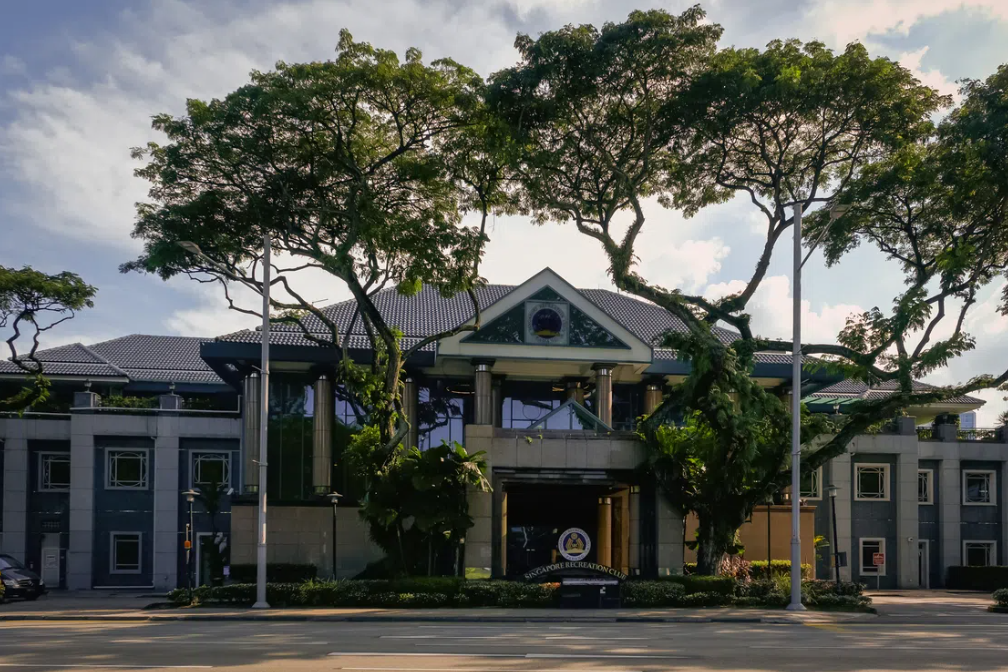
A Singapore High Court judge has paved the way for a substantive trial that will examine the legitimacy of a contested resolution passed by members of the Singapore Recreation Club to redevelop its billiards facilities into a modern co-working space. Senior Judge Chan Seng Onn's decision, released on August 26, overturns a lower court's dismissal of a lawsuit and establishes that several complex legal and procedural questions warrant full courtroom scrutiny rather than summary dismissal.
The dispute stems from an extraordinary general meeting held on October 18, 2025, where club members voted on how to respond to a sharp increase in land betterment charges that threatened the financial viability of an initially approved $16.6 million redevelopment plan. The charges, which had climbed from an anticipated $1.5 million to $4.9 million, forced the management committee to present three competing options to the membership rather than proceed with the original scheme. This escalating cost fundamentally altered the project's economics and necessitated a fresh vote, setting the stage for the procedural disputes now at the centre of litigation.
Two billiards section members, Sean Kerwin Mathews and Mu Yee Shyong, challenged the validity of the resolution that ultimately carried the second option—converting the billiards room to a co-working space—arguing that the voting process violated constitutional requirements. Their central contention hinges on the club's Constitution, which stipulates that major resolutions must pass with support from a majority of members physically present at the meeting. Since 559 members attended the October gathering, this rule would have required at least 280 affirmative votes. The resolution received only 151 votes in favour, falling far short of that threshold. This mathematical reality forms the crux of what the judge identified as a genuine triable issue.
The voting mechanics employed at the October meeting, however, introduced significant complications that lie at the heart of the dispute. Members received two distinct voting slips. The first addressed whether to proceed with the original relocation plan and approve payment of the ballooning $4.9 million in charges, with a clear instruction that voting "yes" meant the second voting slip would not apply. For those voting "no," a second slip offered a binary choice between two alternatives: either convert the existing billiards room to co-working space, or integrate the billiards room within a larger co-working facility. Out of 514 total votes cast, the results proved contentious: 151 favoured the second resolution, 125 opposed it, with 183 ballots rendered spoilt and 55 left blank.
Judge Chan identified a critical vulnerability in how the management committee structured this dual-resolution voting scheme. By requiring members to choose between two specific alternatives on the second slip, with no option to reject both proposals, the club effectively constrained voting choices in ways that raised constitutional concerns. Members could not simultaneously vote "no" to both alternative resolutions; such an attempt would result in a spoilt ballot. This structural constraint prompted the judge to observe that the management committee may have violated members' fundamental voting entitlements by eliminating their capacity to reject both alternatives and demand a genuinely open process.
The question of how to classify blank and spoilt ballots emerges as another pivotal issue requiring judicial determination. Mathews and Mu contended that the 55 blank votes should be counted alongside the 125 opposing votes, creating a combined total of 180 votes against the second resolution. This recharacterisation would fundamentally alter the mathematical outcome. Conventional practice treats blank and spoilt votes as neutral—neither supporting nor opposing a measure. However, Judge Chan noted that the peculiar circumstances surrounding this vote, particularly the conflicting instructions and constrained choice set facing members, may warrant departing from standard assumptions. When voters are effectively prevented from expressing clear opposition through normal means, blank votes potentially acquire different significance and may require reclassification.
The original application to strike out the entire claim was filed by the club and its management committee in May, followed by the lower court's allowance in the same month. When Mathews and Mu appealed to the High Court in June, Judge Chan reversed the earlier dismissal and provided comprehensive written reasoning for his decision. The judge rejected arguments that continuing the litigation served no useful purpose, noting that a fresh vote with clearer procedures and transparent constitutional compliance could resolve the underlying dispute. This reasoning reflects judicial recognition that procedural integrity in member governance—particularly at established institutions—warrants protection through full legal proceedings.
The Singapore Recreation Club, operating as one of the city-state's flagship social institutions with approximately 7,000 members, approved the original $16.6 million transformation plan in March 2024. That earlier vote carried member enthusiasm for modernising facilities and creating contemporary working spaces in a historic venue. The emergence of unexpected charges fundamentally altered the cost-benefit calculus and required fresh deliberation. Such recalibrations are common in major capital projects, yet the manner in which the revised vote was conducted has exposed important questions about member rights and democratic procedure within private clubs governed by constitutional frameworks.
Walter Alexander, representing the club and its management committee, had argued that invalidating the resolution would serve no legitimate purpose and potentially leave the institution in stalemate. Judge Chan's response rejects this consequentialist reasoning, emphasising that seeking a genuinely fair vote represents a legitimate purpose worthy of judicial protection. The judge's position reflects the principle that procedural regularity and constitutional compliance cannot be dispensed with merely because inconvenience might result from a fresh decision-making process. For Malaysian readers familiar with governance disputes in professional associations, chambers of commerce, and member-based institutions, this principle carries significant relevance.
The forthcoming trial will require the court to definitively interpret the SRC's Constitution, establish whether the voting procedures employed satisfied constitutional requirements, and determine the proper classification of disputed ballots. The judgment will likely influence governance practices across Singapore's network of membership-based organisations and potentially resonate throughout Southeast Asia, where similar institutions operate under comparable constitutional frameworks. This case underscores the tension between efficient management and constitutional faithfulness—a tension that becomes acute when major capital decisions hang in the balance and member satisfaction depends on transparent, procedurally legitimate processes.

