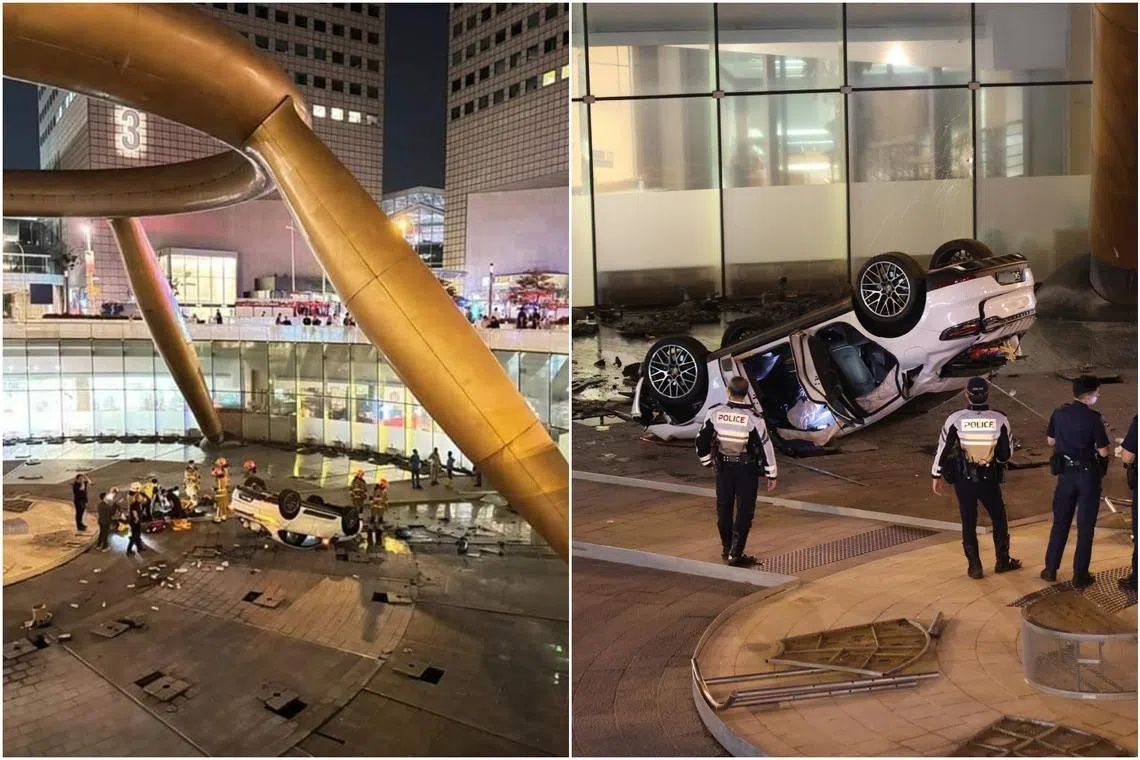
A Singapore man who piloted his vehicle into one of the island's most iconic public fountains whilst under the influence of alcohol has been handed a custodial sentence. Then Shing Chong, 58, drove his car through protective barriers and into the basement level of Suntec City's Fountain of Wealth on July 13, 2024, following an evening of heavy drinking at a nearby bar. The incident, which resulted in extensive property damage and narrowly avoided injuring construction workers on site, prompted District Judge Koo Zhi Xuan to impose a five-week jail term on Tuesday, along with a two-and-a-half-year driving ban.
The chain of events leading to the accident began on the afternoon of July 12, when Then departed his residence and travelled to Suntec City shopping mall to socialise with a friend. Court proceedings revealed that he arrived at the complex around 6pm, parked his vehicle in the basement carpark, and subsequently entered a bar within the mall. Over the next six hours, between 6.15pm and midnight, Then consumed approximately one litre of beer—a substantial quantity that would significantly impair judgment and motor control in most individuals. Despite this consumption, he made the decision to operate his vehicle and depart the premises.
The sequence of driving errors that followed suggested a severely compromised state of awareness. As Then exited the carpark, his vehicle came to a complete halt for roughly ten seconds whilst the automated gantry barrier processed his exit. Upon resuming movement along Temasek Boulevard, he gradually lost situational awareness and directional focus. Rather than following clearly marked signage indicating a required left turn into a nearby roundabout, he continued travelling in a straight trajectory across three lanes of traffic. This deviation from the correct path then took a dramatic and destructive turn when his car breached the protective barricade surrounding the Fountain of Wealth and plummeted into the basement area below.
The physical consequences of the collision were sobering, though human casualties were ultimately avoided. Deputy Public Prosecutor Gladys Lim highlighted during sentencing submissions that three construction workers were actively engaged in maintenance work within the fountain's basement at the precise moment of the impact. All three managed to escape without injury, though the prosecutor emphasised the potentially catastrophic nature of the incident. Had any of the workers been positioned directly beneath the vehicle's trajectory or resting in the immediate vicinity of the crash zone, the consequences would have extended far beyond property damage to include serious injury or loss of life. The vehicle eventually required recovery by a large crane before being removed from the fountain site.
Financial accountability formed part of Then's penalty structure. The collision inflicted approximately S$64,600 in damage to the fountain and surrounding infrastructure. Significantly, Then made full restitution for these costs, demonstrating some level of responsibility despite the reckless nature of his actions. This willingness to compensate for damages did not, however, persuade the judge to exercise leniency on the custodial sentence, reflecting the seriousness with which Singapore's judiciary treats impaired driving offences.
A critical complication emerged during legal proceedings when Then's defence team presented medical documentation from the Institute of Mental Health. His legal representatives, from Invictus Law Corporation, submitted that Then had disclosed to IMH assessors that he had consumed either an antihistamine or a sleeping medication prior to drinking alcohol—a combination that would substantially amplify intoxication effects and further diminish cognitive and motor function. Furthermore, the defence argued that Then was managing major depressive disorder at the time of the incident, and that his psychiatric condition may have contributed causally to the commission of the offence. On this basis, the defence requested that the court commission a formal assessment to determine whether Then's circumstances warranted a mandatory treatment order, a sentencing alternative whereby offenders receive psychiatric intervention rather than incarceration.
The prosecution mounted a robust counter-argument against this proposed approach. Deputy Public Prosecutor Lim opposed the filing of any mental health assessment, asserting that the specific nature and severity of drink-driving offences necessitated a punitive response grounded in general and individual deterrence. She emphasised that permitting offenders to avoid custodial sentences through psychiatric justifications would undermine the law's deterrent effect and fail to adequately communicate societal disapproval of such behaviour. The DPP's position reflected broader judicial philosophy in Singapore, where drink-driving is treated as a particularly serious transgression given its capacity to endanger public safety.
Judge Koo Zhi Xuan sided decisively with the prosecution's framing of the offence. In rejecting the defence application, the judge characterised Then's conduct as representative of highly irresponsible behaviour that warrants unambiguous legal consequences. The bench articulated the multifaceted harms at stake: the substantial property damage already sustained, the realistic potential for severe personal injury or fatality, and the broader message required to deter similar conduct by other drivers. The sentence of five weeks' incarceration, coupled with the two-and-a-half-year disqualification from holding any category of driving licence, reflected this principled insistence on accountability.
The Suntec City fountain incident serves as a cautionary example relevant to drivers throughout the region, particularly in Malaysia where similar incidents of impaired driving persist. The case underscores how rapidly and dramatically circumstances can deteriorate when individuals operate vehicles whilst under the influence of alcohol, especially when medication interactions amplify intoxication effects. For Malaysian readers, the Singapore judgment reinforces established principles in Malaysian law regarding dangerous driving and driving under the influence, offences that carry substantial penalties under the Road Transport Act 1987 and Penal Code. The incident also highlights the inadequacy of relying solely on mental health considerations to mitigate responsibility for actions taken whilst impaired—a principle consistently applied across Southeast Asian jurisdictions.
The fountain itself sustained notable reputational impact from the incident, though recovery efforts proceeded swiftly. Suntec City, a premium shopping and commercial complex located in Singapore's Marina Bay precinct, resumed normal operations shortly after the vehicle's extraction and damage assessment. The incident became a notable talking point in discussions about carpark design safety, barriers, and pedestrian protection, potentially influencing future infrastructure modifications at major public venues. The $64,600 restoration cost, while substantial, pales against the potential human cost of the accident.

