A Singapore court has handed down a 17-month jail sentence to a 22-year-old man who attacked a stabbing victim with a chair during a late-night brawl that proved fatal. Pradave Shashi Kumar pleaded guilty on Tuesday to voluntarily causing hurt using a dangerous weapon, marking the first conviction in what has become a complex case involving multiple accused parties and varying degrees of culpability.
The incident unfolded in the early hours of September 22, 2024, along Kitchener Road, claiming the life of 25-year-old Dhinessh Vasie, who died from a stab wound to the heart sustained during the chaotic confrontation. The case illustrates how a seemingly routine night out can escalate into tragedy within minutes, raising questions about public safety and alcohol-fuelled violence in Singapore's entertainment districts.
According to evidence presented during Pradave's sentencing hearing, the sequence of events began when he and three companions—along with two women—departed from a club at Golden Mile Tower in a private-hire vehicle bound for a pub on Sam Leong Road to continue their night of drinking. Their arrival around 4am coincided with a deteriorating situation unfolding in a nearby back alley, where a group of eight men were engaged in a heated dispute with three women. Dhinessh belonged to this larger group of men, a detail that would prove crucial to his fate.
The catalyst for the violence emerged when Satish Jason Prabhas, one of Pradave's companions, engaged in a verbal exchange with someone in Dhinessh's group before escalating matters by throwing punches. This initial confrontation rapidly snowballed into a full-scale altercation involving Pradave, Satish, and multiple members of Dhinessh's circle. The prosecutor's account reveals that as the situation deteriorated, Dhinessh's group retreated toward the direction of Verdun Road, attempting to create distance between themselves and their aggressors.
During this retreat, witnesses observed Muhammad Sajid Saleem, the third member of Pradave's party, wielding a small knife with a blade measuring 7.5 centimetres, held point-downward in his right hand. The sight of the weapon prompted Dhinessh and his companions to flee more urgently, yet their pursuers—Pradave, Sajid, Satish, and Kirrthik Roshan Prem Ananth—maintained their chase. Evidence suggests that Sajid inflicted knife wounds on Dhinessh and at least two others during this pursuit, even as the victims desperately attempted to escape.
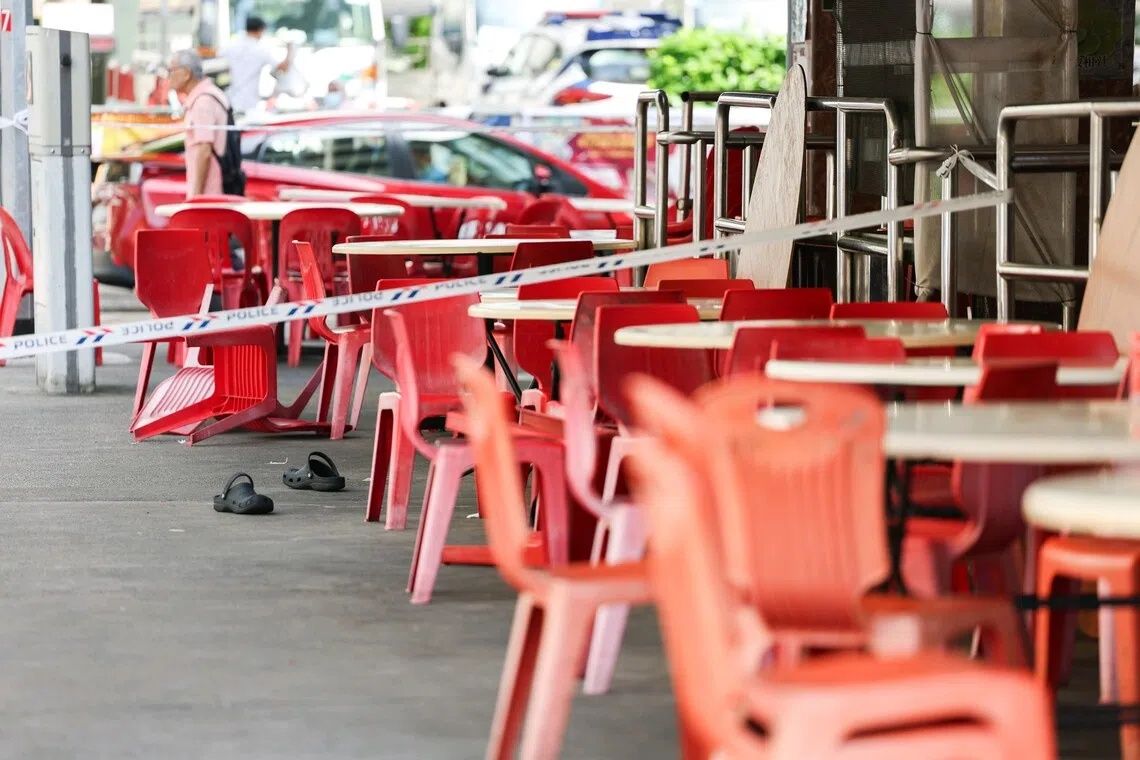
The fatal encounter crystallised when Dhinessh, slowing as he approached a coffee shop situated at the intersection of Verdun Road and Sam Leong Road, allowed his pursuer Sajid to close the distance. This moment witnessed what prosecutors characterise as a deliberate stabbing in the upper back, the blow that would ultimately claim Dhinessh's life. However, the violence did not cease with this initial stab wound. Kirrthik proceeded to retrieve a chair from the coffee shop and used it to repeatedly strike the already-wounded Dhinessh, who by this stage was incapacitated and offering no resistance.
Pradave's role in this final assault proved decisive in determining his criminal liability. He similarly seized a chair from the establishment and delivered two forceful blows to Dhinessh's head and chest while the victim remained slumped and unable to defend himself. The prosecutor emphasised this crucial detail—that Dhinessh was defenceless throughout the chair attack—in underscoring the severity and senselessness of Pradave's actions. Such violence against a vulnerable victim, even one already injured, carries particular moral culpability in the eyes of the law.
Following their assault, the group abandoned the scene and walked toward City Square Mall, leaving Dhinessh grievously wounded. Police and paramedic crews arrived shortly thereafter, but the injuries proved fatal. Pradave was apprehended at approximately 5.15am the same morning, enabling authorities to quickly secure one of the perpetrators.
The case remains ongoing with three other accused persons still facing judicial proceedings. Muhammad Sajid Saleem, aged 24, confronts the most serious charge of murder, reflecting his alleged role in wielding the knife that delivered the fatal wound. Satish Jason Prabhas and Kirrthik Roshan Prem Ananth, both 23 years old, are prosecuted on rioting charges, which carry their own substantial penalties under Singapore law. These distinctions in charges reflect differing levels of culpability, with the murder charge against Sajid acknowledging his role in inflicting the fatal injury.
Pradave's sentence of 17 months imprisonment falls within the statutory framework permitting imprisonment of up to seven years for those convicted of voluntarily causing hurt with dangerous weapons, alongside potential fines, caning, or combinations thereof. The court's determination of this specific sentence likely weighed his guilty plea, the nature of his weapon, the severity of the victim's condition during the attack, and comparative circumstances among the co-accused.
The case resonates beyond Singapore's borders as a cautionary tale relevant to Malaysian and Southeast Asian societies grappling with alcohol-fuelled violence in urban entertainment precincts. The tragic escalation from verbal dispute to lethal confrontation within minutes underscores how quickly social situations can deteriorate when alcohol combines with youthful impulsivity and group dynamics. For Malaysia, where late-night establishment violence occasionally surfaces in major urban areas like Kuala Lumpur and Penang, the Singapore case offers sobering perspective on consequences and enforcement priorities.

