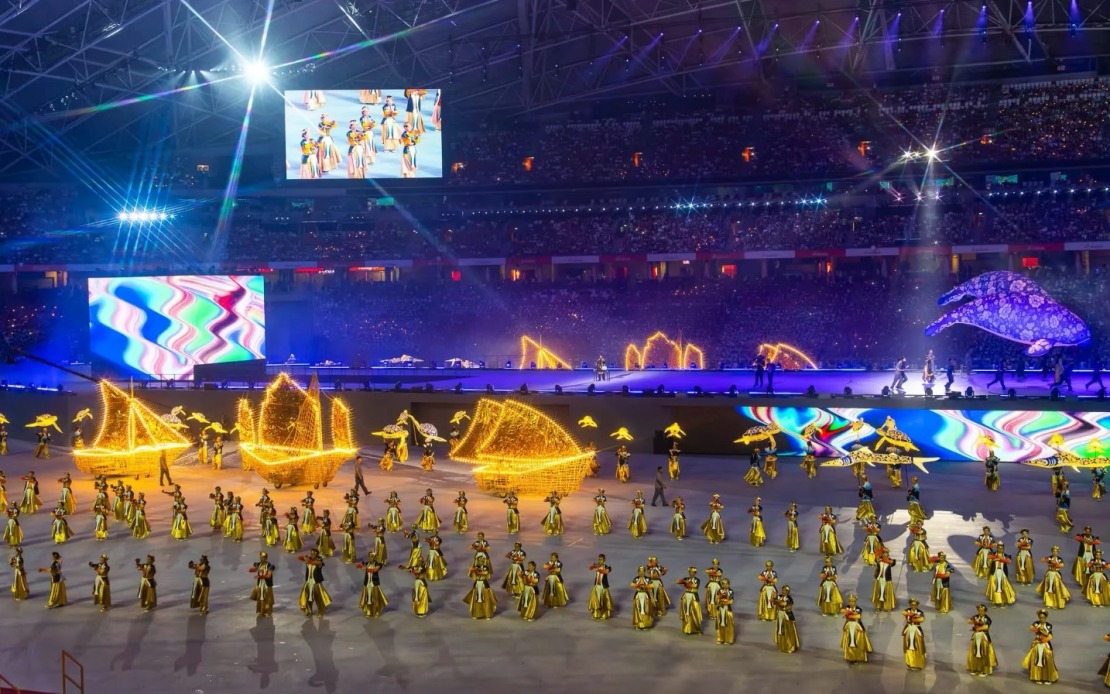
Singapore's National Day festivities on Sunday marked a significant milestone as the country's signature parade made its long-awaited return to the National Stadium after an absence spanning more than a decade. The event drew approximately 42,000 members of the public who converged on the venue dressed in the patriotic colours of red and white, creating a sea of national unity beneath the stadium's iconic structure. The celebrations operated under the rallying theme "Majulah Singapura, Go Beyond!", a phrase that encapsulates both the nation's traditional values and its forward-looking aspirations as it navigates an increasingly complex geopolitical and economic landscape in Southeast Asia.
President Tharman Shanmugaratnam and Prime Minister Lawrence Wong led the commemorations alongside the full Cabinet and parliamentary representatives, underscoring the ceremonial significance accorded to what remains Singapore's most important civic occasion. The return of the parade to its traditional home represents more than mere logistics; it signals a restoration of public gatherings and large-scale national events following years of pandemic-related disruptions that reshaped how nations across the region approached mass celebrations. For Malaysian observers, Singapore's capacity to mobilise such coordinated civic participation offers insights into how developed city-states maintain social cohesion and national identity in an era of rapid urbanisation and demographic diversity.
A particularly noteworthy innovation distinguished this year's proceedings: the Presidential Gun Salute and State Flag Flypast were conducted at Kallang Basin for the first time in Singapore's six-decade post-independence history, extending ceremonial elements beyond the stadium's confines. This decision reflected deliberate planning to broaden spectatorial access and create shared national experiences across a wider geographical footprint. Four 25-pounder Howitzer guns mounted on Mobility 3rd Generation rafts navigated the basin's waterways, a striking visual that transformed the broader Kallang precinct into an extended ceremonial zone and permitted thousands of additional citizens to participate in what was previously an enclosed stadium experience.
The traditional 21-Gun salute itself required substantial coordination, drawing 151 uniformed personnel from the 23rd Battalion of the Singapore Artillery and the 35th Battalion of Singapore Combat Engineers. Such ceremonial precision reflects the deep institutional traditions that characterise Singapore's approach to state occasions, where meticulous planning and flawless execution serve as expressions of national competence and orderliness. For regional neighbours observing Singapore's administrative capacity, such displays reinforce perceptions of institutional reliability that form part of the republic's broader diplomatic and economic positioning.
The parade and ceremony segment commenced around 6 pm and operated under the thematic banner "Go Beyond Self", assembling 32 distinct contingents that collectively mobilised more than 2,000 active participants. The composition of these contingents demonstrated Singapore's inclusive approach to national representation, encompassing six Guard of Honour units drawn from across the armed forces and emergency services—the Singapore Army, Republic of Singapore Navy, Republic of Singapore Air Force, Digital and Intelligence Service, Singapore Police Force, and Singapore Civil Defence Force. The integration of the newly established Digital and Intelligence Service within this ceremonial framework reflected contemporary security thinking and Singapore's emphasis on cyber capabilities alongside traditional military strength.
Youth organisations occupied a prominent role within the parade structure, with ten uniformed youth contingents marching alongside sixteen additional supporting units. This emphasis on youth participation carries particular significance in Singapore's national narrative, as these organisations serve as conduits through which the state cultivates patriotic consciousness and civic responsibility among younger generations. Sixteen additional supporting contingents complemented this youth focus, suggesting a deliberately broad social mobilisation designed to reinforce collective identity across generational and professional divides.
The evening's entertainment segment proved equally ambitious, featuring 36 performing artists supported by more than 2,600 additional performers who collectively presented Singapore's contemporary national story. This production arm of the celebration moved beyond conventional military pageantry to embrace artistic expression, technological innovation, and emotional resonance through thematic storytelling and carefully curated musical accompaniment. The scale of this entertainment apparatus—rivalling small professional theatre productions in terms of personnel and logistical complexity—underscores how modern nation-states deploy cultural performance as a mechanism for constructing and reinforcing national identity.
Particularly significant was the deliberate inclusion of seven dancers from diverse backgrounds within the performance lineup, encompassing representations of disability that extended to both autism and Down syndrome. This casting choice transcended superficial diversity metrics to advance a substantive message about inclusivity and equal national belonging. By positioning these performers centrally within the celebratory narrative, Singapore's organisers communicated that national contribution and collective futures accommodate all citizens irrespective of neurological difference or physical variation—a progressive stance that carries implications for how Southeast Asian societies increasingly conceptualise citizenship and social participation.
The thematic architecture emphasising "Go Beyond Self" resonated with Singapore's ongoing national development discourse, which increasingly emphasises collective problem-solving and transcendence of individual interest in service to shared objectives. This messaging proves particularly resonant given Singapore's status as a multicultural society where national cohesion requires constant cultivation through shared rituals and inclusive narratives. The parade thus functions simultaneously as celebration, civic reinforcement mechanism, and statement of national values directed both inward toward citizens and outward toward regional observers.
For Malaysia and other ASEAN members, Singapore's National Day proceedings merit attention as instructive case studies in state-sponsored civic mobilisation and the integration of ceremonial tradition with contemporary concerns around inclusivity and technological modernity. The deliberate geographic expansion of ceremonial elements beyond the stadium, the systematic inclusion of diverse participant backgrounds, and the sophistication of the entertainment apparatus all reflect considered choices about how to sustain national identity and social cohesion within increasingly plural urban contexts. As regional capitals confront similar challenges around maintaining social unity amid rapid change, Singapore's demonstrated capacity for large-scale ceremonial coordination while embedding progressive messaging about inclusion offers relevant models worth studying, even if the political contexts and resources available differ substantially across the region.

