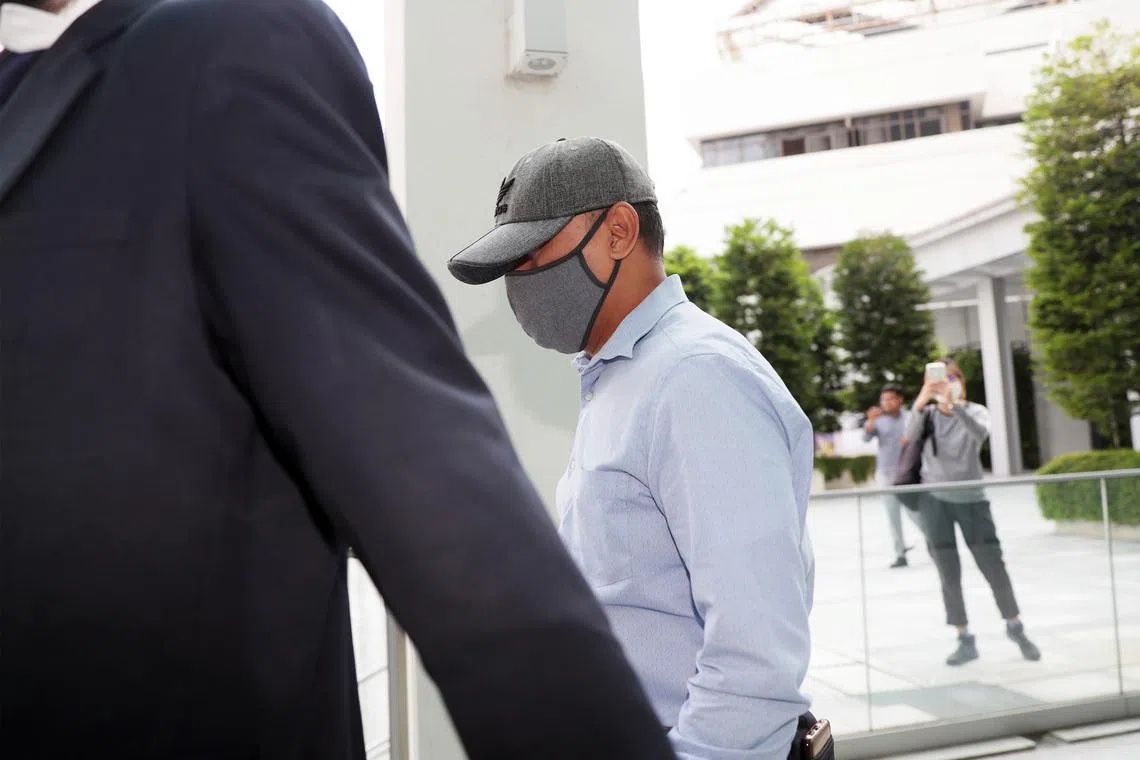
A former executive chairman of two Singapore mosques has received a 14-month jail sentence for corruption, marking a significant case involving abuse of authority within Singapore's religious institutions. Abdul Rahim Mawasi, 59, was convicted in April following trial on charges relating to his improper conduct as head of Darul Aman Mosque on Jalan Eunos and Sallim Mattar Mosque in MacPherson, where he simultaneously held positions as a senior officer with the Islamic Religious Council of Singapore (MUIS) on secondment.
The court found that Abdul Rahim had engaged in corrupt conduct by providing price guidance to his long-time associate Mohd Mustaqim Kam, also known as Kam Hock Beng, thereby enabling Kam's construction firm Zeal-Con Engineering to secure mosque contracts totalling S$223,000 without fair competition. This arrangement operated as part of a broader corrupt bargain: Kam agreed to use profits from mosque projects as capital investment in a travel company the two men would establish together, with Abdul Rahim contributing no initial funds but benefitting from equity stakes held in his son's name. Kam, then 66, received a six-month sentence in February 2025 for his role in the scheme.
The scheme unfolded over several months beginning in mid-2018, when Abdul Rahim first proposed the travel business partnership to Kam, a director at Zeal-Con Engineering. The arrangement explicitly stipulated that construction contracts from the two mosques would generate profits for capitalising the venture, creating a direct financial incentive for Abdul Rahim to favour Zeal-Con's bids. For Darul Aman Mosque's yard construction project, Zeal-Con submitted an initial quote of S$128,600 in August 2018, subsequently reducing it to S$118,000 by September—a revised figure that undercut the next-lowest competing bid at S$125,500. Evidence presented during prosecution established that Abdul Rahim had conducted extensive discussions with Kam regarding optimal pricing strategy and furnished him with critical price indications that directly influenced Zeal-Con's final quotation.
The mosque's management board, unaware of Abdul Rahim's involvement in pricing discussions, awarded Zeal-Con the contract for S$118,000 on September 26, 2018. Similarly, for works at Sallim Mattar Mosque—involving roof repairs and reception area modifications—Zeal-Con initially quoted S$115,700 in September 2018, then submitted a substantially reduced quote of S$105,000 in July 2019. Abdul Rahim explicitly advised Kam to lower the company's quotation to secure the contract. This pattern demonstrated consistent manipulation of the bidding process across both institutions, with the accused leveraging his administrative authority to channel lucrative work to his business associate.
To conceal the corrupt arrangement, Abdul Rahim orchestrated a scheme involving his son as a nominal shareholder. In November 2019, Kam converted an existing shell company into Amal Travel and Tour (ATT), capitalising it with S$100,000 and issuing 25,000 shares worth S$1 each to Abdul Rahim's son. This stratagem allowed Abdul Rahim to maintain financial interest in the travel venture while avoiding direct ownership that might trigger disclosure obligations to MUIS. The accused deliberately failed to disclose his beneficial interest to his employer, the Islamic Religious Council, thereby compounding his breach of public trust. During trial, Abdul Rahim denied involvement with ATT and maintained he held no shares in the company, though prosecutors argued the evidence overwhelmingly demonstrated his strategic interest through his son's shareholding.
Critically, Deputy Public Prosecutor Bryan Wong acknowledged that Zeal-Con completed the contracted construction works satisfactorily, and no substantial financial losses were demonstrated to the two mosques as a consequence of the inflated contract awards. Nevertheless, the prosecutor stressed that Abdul Rahim had committed a serious public sector corruption offence driven by personal financial gain. The distinction matters for understanding Singapore's approach to corruption enforcement: liability rests on the corrupt act itself—the abuse of authority for personal benefit—rather than exclusively on demonstrable quantifiable harm to the victim institution.
Abdul Rahim's legal representation, through lawyer Satwant Singh Sarban Singh, sought mitigation at sentencing, requesting no more than six months' jail and highlighting his previously unblemished record. The court rejected this appeal, imposing a 14-month sentence that reflected the seriousness of breaching public trust while holding authority over religious institutions. His bail was set at S$30,000, with imprisonment scheduled to commence on July 10, 2025.
The case carries particular significance for Malaysia and the broader Southeast Asian region, where mosque administration and religious institution governance operate under comparable frameworks involving appointed officials with fiduciary responsibilities. Corruption within religious bodies presents heightened reputational and community trust implications, as these institutions depend on public confidence in their governance and financial stewardship. Abdul Rahim's conviction demonstrates that religious office provides no exemption from anti-corruption enforcement, and that seconded government officials retain full accountability regardless of their operational independence from their home agency.
The involvement of MUIS—Singapore's statutory Islamic religious authority—underscores how corruption risks penetrate even highly structured institutional environments with formal oversight mechanisms. Abdul Rahim's position as a senior MUIS officer allowed him to leverage authority derived from the state-backed institution to execute his scheme, highlighting vulnerabilities in secondment arrangements where officials operate at operational distance from direct oversight. For Malaysian religious authorities, including the Islamic Development Department (JAKIM) and state-level Islamic councils, this case offers instructive lessons regarding procurement controls, disclosure requirements, and monitoring frameworks for senior officials engaged with external religious bodies.

