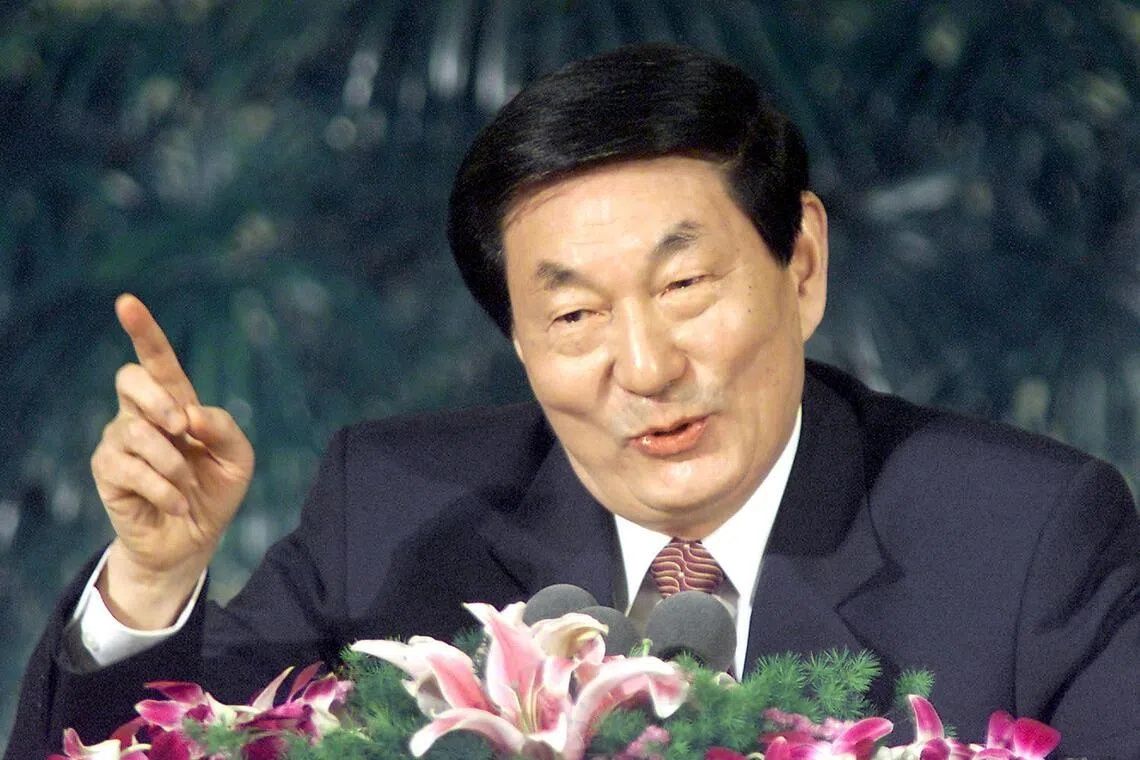
Singapore's Prime Minister Lawrence Wong has conveyed his sympathies to Chinese Premier Li Qiang following the recent death of Zhu Rongji, the influential former premier who passed away in Beijing on Wednesday, August 12, just two months before reaching his 98th birthday. In a formal letter dated August 13, Wong highlighted Zhu's pivotal contributions to shaping modern China and his significance to Singapore's relationship with the country.
Zhu's tenure as premier coincided with one of China's most transformative periods. Wong specifically acknowledged his role in steering the nation's economic reforms during a critical juncture when the country was repositioning itself within the global economic framework. The Singapore Prime Minister particularly underscored Zhu's instrumental involvement in orchestrating China's accession to the World Trade Organization in 2001, a milestone that fundamentally altered the nation's trade relationships and integration into international commerce. This achievement represented the culmination of years of negotiation and represented a watershed moment for China's emergence as an economic powerhouse.
Wong's tribute extended beyond formal diplomatic protocol to emphasise the personal dimension of Zhu's relationship with Singapore's leadership. He characterised the departed statesman as "an old friend of Singapore", noting that Zhu had maintained regular contact with Singapore's former prime ministers Lee Kuan Yew and Goh Chok Tong across multiple meetings and engagements. These connections reflected deeper institutional ties between the two governments that transcended the typical operational frameworks of bilateral relations.
A defining moment in this relationship came in 1999 when Zhu became the first Chinese leader to deliver the Singapore Lecture, a prestigious platform organised by the ISEAS – Yusof Ishak Institute that attracts prominent global figures to discourse on international and regional developments. This address was particularly significant as it offered Zhu an opportunity to articulate his vision for China's regional role at a moment when the country's economic trajectory was reshaping Asia's geopolitical and commercial landscape. In that lecture, Zhu expounded on his conviction that China's economic advancement would generate prosperity not only for the nation itself but for the broader Asian region and the global economy.
During the same address, Zhu proposed an innovative concept that would fundamentally reshape economic architecture across Southeast Asia and China: the establishment of a free trade area encompassing the Association of Southeast Asian Nations and China. This proposal, delivered from Singapore's platform, reflected strategic thinking about deepening commercial interdependence and creating mutual prosperity through reduced trade barriers. Wong observed that Zhu's vision has proven remarkably prescient, as China has indeed become an essential economic partner for Singapore and neighbouring countries, validating the former premier's strategic calculations made over two decades ago.
Beyond his role as premier, Zhu's contribution to bilateral relations extended back to his tenure as Shanghai's mayor, a position from which he facilitated institutional exchanges and collaborative learning programmes between Singapore and Shanghai officials. These grassroots diplomatic efforts helped establish a foundation of mutual understanding and operational compatibility between administrative structures, creating channels through which practical cooperation could flourish. Such person-to-person and official-to-official networks often prove more durable than formal agreements alone.
Wong particularly emphasised Singapore's partnership with China on the Suzhou Industrial Park, a joint government venture that represented an early and tangible expression of bilateral cooperation during Zhu's leadership. As an early advocate for this flagship project, Zhu demonstrated commitment to concrete economic collaboration that would benefit both nations. The industrial park subsequently developed into a model of successful China-Singapore partnership, attracting investment and generating employment while serving as a symbol of mutual confidence and long-term strategic alignment.
The PM noted that the groundwork laid during Zhu's era has enabled the robust relationship that Singapore and China now enjoy, characterised by extensive exchanges across multiple sectors and consistent strategic coordination. The foundations established through Zhu's initiatives and diplomatic efforts have facilitated deepening cooperation in trade, investment, technology, education, and cultural spheres. These contemporary ties represent the practical manifestation of the strategic vision that Zhu articulated and implemented during his stewardship of Chinese affairs.
Zhu's death marks the end of an era for a generation of Chinese leaders who navigated the country's transition from a command economy towards market-oriented reforms while carefully managing its integration into the global system. His legacy extends beyond China's borders to encompass his role in reshaping Asia's economic relationships and establishing frameworks for regional cooperation. For Singapore, Zhu represented a bridge between China's historical development and its modern position as a regional and global economic force, and his personal engagement with Singapore's leadership helped solidify bonds that continue to define the two nations' partnership today.

