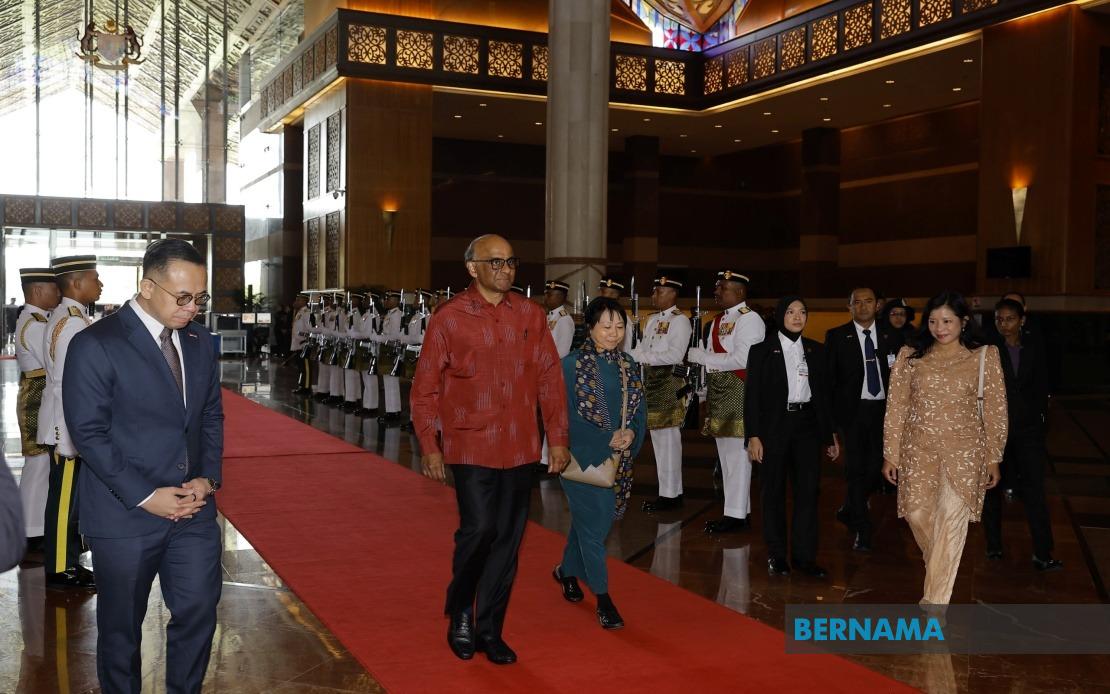
Singapore President Tharman Shanmugaratnam wrapped up his inaugural state visit to Malaysia on Tuesday, departing Kuala Lumpur International Airport in the early afternoon with his wife Jane Ittogi and their accompanying delegation. The departure from KLIA Terminal 1 at 2.20 pm marked the conclusion of a carefully choreographed diplomatic engagement that underscored the enduring partnership between the two Southeast Asian neighbours, who share extensive economic, cultural and security interests across the Strait of Johor.
The President's exit was marked with ceremonial honours befitting a visiting head of state. Upon arrival at the Bunga Raya Complex at the airport, Tharman was presented with a static Guard of Honour comprising two officers and 26 personnel drawn from the First Battalion of the Royal Ranger Regiment, commanded by Captain Muhammad Hanafi Ja'afar. The formal farewell reflected Malaysia's commitment to extending full diplomatic courtesies to its immediate neighbour, with Minister of Entrepreneur and Cooperatives Development Steven Sim attending to bid the Singaporean delegation goodbye.
Tharman's three-day visit, which commenced on Sunday, was undertaken at the specific invitation of His Majesty Sultan Ibrahim, King of Malaysia. The timing and nature of the visit carried particular significance, as it served as a reciprocal gesture to Sultan Ibrahim's own state visit to Singapore on May 6 and 7, 2024. Through these alternating high-level visits, both nations continue to reinforce the personal bonds between their respective heads of state, a practice that carries substantial weight in Southeast Asian diplomatic tradition where relationship-building remains central to bilateral affairs.
For Tharman, this represented a milestone moment in his still-young presidency. Having assumed office as Singapore's ninth President on September 14, 2023, this visit constituted his first state visit to Malaysia since taking the oath. The occasion therefore held dual significance—it allowed the new president to make his inaugural formal diplomatic journey to a crucial neighbour while simultaneously deepening Malaysia's connections with Singapore's new leadership. Both countries benefit from continuity in high-level engagement, particularly given the complexities of managing shared water agreements, maritime boundaries, and cross-border economic activities.
The substantive dimensions of the visit unfolded across multiple formal engagements. On the first full day of his stay, Tharman was accorded a state welcoming ceremony, followed by a private audience with Sultan Ibrahim at Istana Negara, the royal palace in Kuala Lumpur. These rituals serve not merely symbolic purposes but establish the tone for bilateral discussion and demonstrate mutual respect between heads of state. The formal reception signalled Malaysia's investment in maintaining strong relations with Singapore's leadership at the highest levels of governance.
Beyond ceremonial events, Tharman's visit encompassed substantive engagements with Malaysia's executive branch. Prime Minister Datuk Seri Anwar Ibrahim received the Singapore President through a courtesy call that also included the attendance of Foreign Minister Datuk Seri Mohamad Hasan, Investment, Trade and Industry Minister Datuk Seri Johari Abdul Ghani, and Minister Sim. The presence of these particular cabinet members reflects the breadth of bilateral concerns—encompassing foreign policy, economic cooperation, and developmental initiatives—that occupy the agenda between Kuala Lumpur and Singapore.
The visit extended beyond federal-level interactions to include protocols with Malaysia's state leadership. On the second day, the Sultan of Selangor, Sultan Sharafuddin Idris Shah, granted an audience to President Tharman at Istana Alam Shah in Shah Alam. This inclusion of state-level engagement demonstrates the comprehensive nature of the visit and acknowledges the role of Selangor, Malaysia's most economically dynamic state, in bilateral relations. Such multi-layered engagement architecture ensures that Singapore's president interacts with relevant decision-makers across Malaysia's federal and state systems of governance.
The broader context of this visit reflects the intensity with which Malaysia and Singapore manage their relationship. Despite their geographic proximity and economic interdependence, the two nations navigate complex historical legacies and present-day strategic considerations. Regular high-level visits serve as mechanisms for maintaining dialogue channels, addressing grievances before they escalate, and identifying areas for expanded cooperation. For Malaysia, hosting the Singaporean president within months of Sultan Ibrahim's own journey to Singapore demonstrates a commitment to sustained engagement despite occasional tensions over water supplies, maritime issues, or trade matters.
From a regional perspective, the strengthening of Malaysia-Singapore bilateral relations carries implications for broader Southeast Asian stability and economic integration. Both nations are anchor members of ASEAN and play consequential roles in regional security architecture and economic frameworks. When relations between immediate neighbours are robust and grounded in regular high-level contact, it creates a foundation for regional cooperation and helps prevent bilateral disputes from destabilising the wider environment. The frequency and quality of presidential and prime ministerial exchanges thus function as a barometer of bilateral health and a signal to the international community about Southeast Asian stability.
The visit also occurred within a specific economic and geopolitical context. Singapore remains one of Malaysia's most significant trading partners, while Malaysian workers represent an important labour force in Singapore's economy. Cross-border infrastructure projects, from the Kuala Lumpur-Singapore High Speed Rail initiative to various port and logistics ventures, require sustained political will at the highest levels to navigate implementation challenges. Presidential visits provide opportunities to reaffirm commitment to such ambitious undertakings and resolve obstacles that may have accumulated since the last formal engagement.
Looking ahead, Tharman's completion of his maiden state visit to Malaysia establishes a foundation for his presidency's approach to bilateral relations. His engagement with multiple levels of Malaysian governance—from the monarch to the prime minister to state sultans—sends a clear message about Singapore's investment in the relationship. Meanwhile, Malaysia's elaborate reception protocols and high-level ministerial turnout reflect Kuala Lumpur's recognition of Singapore's importance to its economic prosperity and regional standing.
The cyclical nature of these state visits, with each country reciprocating the other's courtesy, institutionalises regular opportunities for dialogue and relationship renewal. As both nations navigate forthcoming challenges—whether economic transitions, digital transformation, or evolving security threats—the personal rapport and institutional connections forged through such visits will prove invaluable. The successful conclusion of Tharman's visit thus represents not merely a ceremonial moment but a reaffirmation of a partnership that remains central to stability and prosperity across the Strait of Johor and throughout Southeast Asia.

