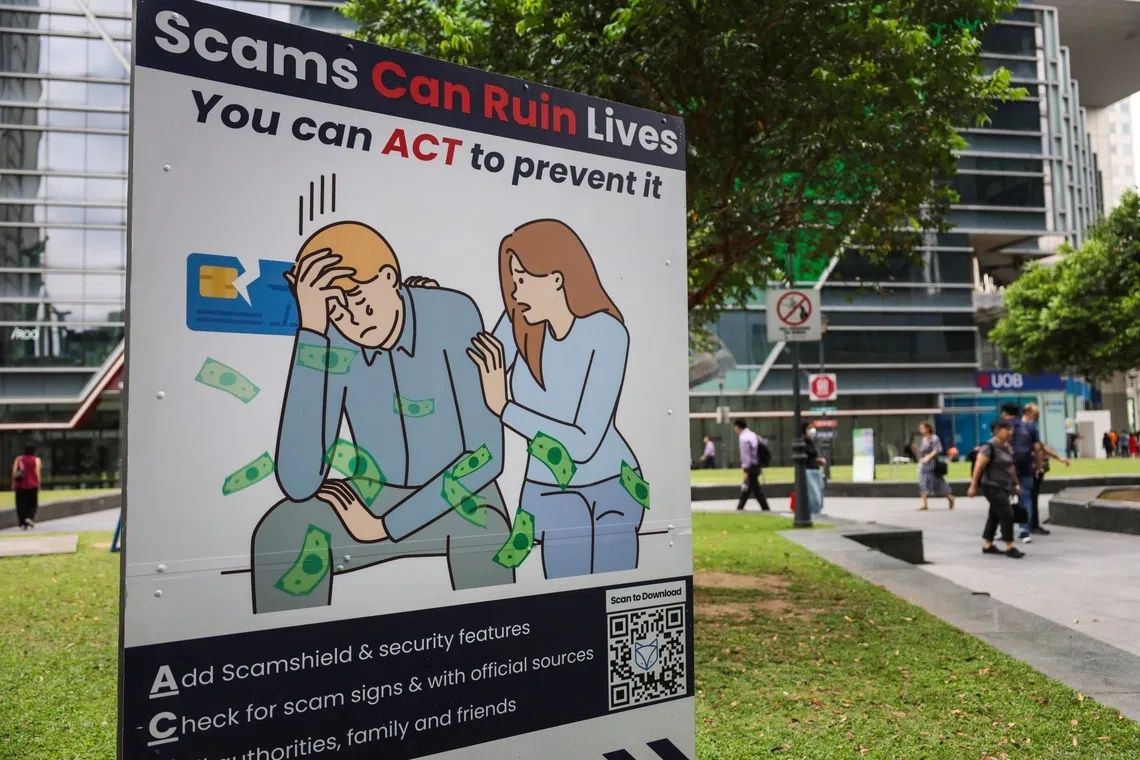
Singapore is moving decisively to close legal gaps that have allowed criminals to exploit social media and online marketplaces for fraud schemes, introducing sweeping new legislation that expands the definition of scam-related offences to encompass digital account fraud. The Scams (Countermeasures) and Other Matters Bill, tabled in Parliament this week, represents a significant escalation in the city-state's battle against a crime epidemic that now dominates three in five police reports and has extracted over S$913 million from victims in a single year.
The proposed measures directly target the infrastructure that enables modern scam operations: individuals who rent out their personal accounts or sell access to accounts they have created on platforms including Facebook, Instagram, WhatsApp, Telegram, TikTok and Carousell. Currently, law enforcement can prosecute money mules and those who peddle SIM cards for fraudulent purposes, but online account mules have operated in a legal grey zone. The legislation would criminalize the entire transaction chain, making it unlawful to provide personal information to create accounts for criminal activity, to supply such accounts, and to knowingly purchase access to them. Conviction would carry penalties of up to S$10,000 in fines, three years imprisonment, and up to 12 strokes of the cane.
The scale of Singapore's scam problem has reached crisis proportions, with losses now exceeding S$4 billion since 2019. Particularly alarming is the surge in government official impersonation scams, which more than doubled from 1,504 cases in 2024 to 3,363 in 2025, making it the fifth most prevalent scam category. This trajectory reveals how scammers have shifted tactics to exploit public trust in official channels, creating a secondary crisis of confidence in digital communications. The government's response reflects an understanding that traditional enforcement tools have become inadequate against criminals who operate at industrial scale, deploying armies of compromised accounts across multiple platforms simultaneously.
A critical innovation in the legislation addresses the velocity and scale of modern scam operations by authorizing the use of computer programmes, including artificial intelligence systems, to issue anti-scam directions to service providers. Police have identified that scammers now create vast numbers of fraudulent sites, accounts and advertisements faster than human moderators can review and disable them. By automating the detection and response process, authorities hope to achieve the speed necessary to outpace criminal innovation. The government has committed to implementing safeguards ensuring algorithmic accuracy and fairness, acknowledging public concerns about automated enforcement.
The Bill introduces three new enforcement tools that fundamentally reshape how authorities combat scams through service provider cooperation. A disclosure order would compel banks, telecommunications companies and online platforms to furnish detailed information about specified accounts and scam-related activities. An account disabling order would enable police to force temporary suspension of suspect accounts for up to 60 days total, creating space to investigate and disrupt active schemes. These mechanisms feed into Singapore's National Scams List, an automated information-sharing system designed to enable real-time data exchange between government agencies and private sector partners, allowing banks to freeze suspect accounts and telecommunications providers to block phone lines before stolen money moves through the financial system.
For Malaysia and other Southeast Asian nations watching Singapore's regulatory evolution, these measures offer both a template and a cautionary tale. Singapore's approach demonstrates how scam networks exploit regulatory arbitrage, operating across borders while taking advantage of inconsistent legal frameworks and enforcement capacity. The city-state's emphasis on service provider accountability reflects recognition that platforms and financial institutions are the chokepoints where scams can be disrupted most effectively. However, the reliance on AI-driven automated responses raises questions about false positives, legitimate users caught in overly broad restrictions, and the potential for surveillance mission creep that other regional governments must carefully consider.
The third enforcement tool introduced is a service limitation order, allowing police to restrict individuals' access to financial services, telecommunications accounts and Singpass digital services for up to three years. This represents a significant departure from traditional criminal justice approaches, effectively imposing civil penalties on suspected scam facilitators without requiring full conviction. The framework has already been deployed on a voluntary basis since October 2025, placing over 1,400 money mules, 1,400 SIM card mules and 53 corporate mules under restrictions. Formalizing this power through legislation signals that Singapore intends to make service limitation a standard enforcement mechanism, raising questions about due process protections and the rights of individuals whose legitimate service access may be restricted based on administrative rather than judicial determinations.
The government's aggressive penalty escalation reflects the perceived threat level. Maximum fines for service providers that fail to comply with anti-scam codes of practice and implementation directives have been raised tenfold from S$1 million to S$10 million, while daily fines for continuing non-compliance have tripled from S$100,000 to S$300,000. Meta has already received two implementation directives, in September 2025 and January 2026, mandating specific anti-scam measures. Police credit these directives with reducing impersonation scams on Facebook, providing evidence that statutory pressure on platforms can achieve results. However, the escalating penalties also reflect frustration with platform responsiveness; without evidence of persistent non-compliance, such severe financial consequences would be unnecessary.
The legislation arrives amid evidence that scam syndicates have become increasingly sophisticated in their use of technology. Major criminal groups now integrate artificial intelligence into their operations, using machine learning to optimize phishing messages, automate account creation and management, and identify vulnerable targets. This technological arms race between law enforcement and criminals mirrors the dynamic seen in cybercrime globally, where each advance in detection prompts criminals to develop countermeasures. Singapore's decision to authorize police use of AI in issuing anti-scam directions represents an acknowledgment that matching criminal innovation requires equivalent technological investment by authorities.
For Southeast Asian policymakers, Singapore's legislative response offers insights into the limits of platform self-regulation and the necessity of statutory intervention. Voluntary compliance codes, while politically simpler than legislation, have demonstrably failed to curb scams at the regional scale. The push toward automated information-sharing between government and private sector through systems like the National Scams List addresses a critical coordination problem: scammers exploit the silos between institutions, moving money through systems that do not communicate. Regional cooperation frameworks that replicate this information-sharing model across borders could amplify its effectiveness, though they would require harmonized legal standards that currently do not exist.
The Bill also enhances police operational capacity, though the original article provides limited detail on these enhancements. Presumably, these provisions grant investigators expanded powers to pursue scam networks across platforms and jurisdictions, reflecting law enforcement's experience that scam operations are inherently multi-jurisdictional. As mobile money services, digital banks and cross-border payment platforms proliferate across Southeast Asia, scam networks have become regional enterprises that move money across multiple countries within hours. Enhanced police powers must therefore be paired with regional cooperation agreements and mutual legal assistance treaties to have meaningful impact.
Singapore's approach represents a maximal enforcement strategy: extensive legislative criminalization, aggressive service provider penalties, automated enforcement systems, administrative restrictions on suspected facilitators, and enhanced police powers. Whether this maximalist model can be adapted to Malaysia and other regional nations with more limited enforcement capacity and different constitutional frameworks remains uncertain. What seems clear is that the era of treating scams as a manageable law enforcement problem has ended in Singapore, replaced by recognition of scams as an existential challenge to digital commerce and public confidence in online services. The question for other Southeast Asian governments is whether they will act with similar urgency before their own scam crises reach Singapore's current scale.

