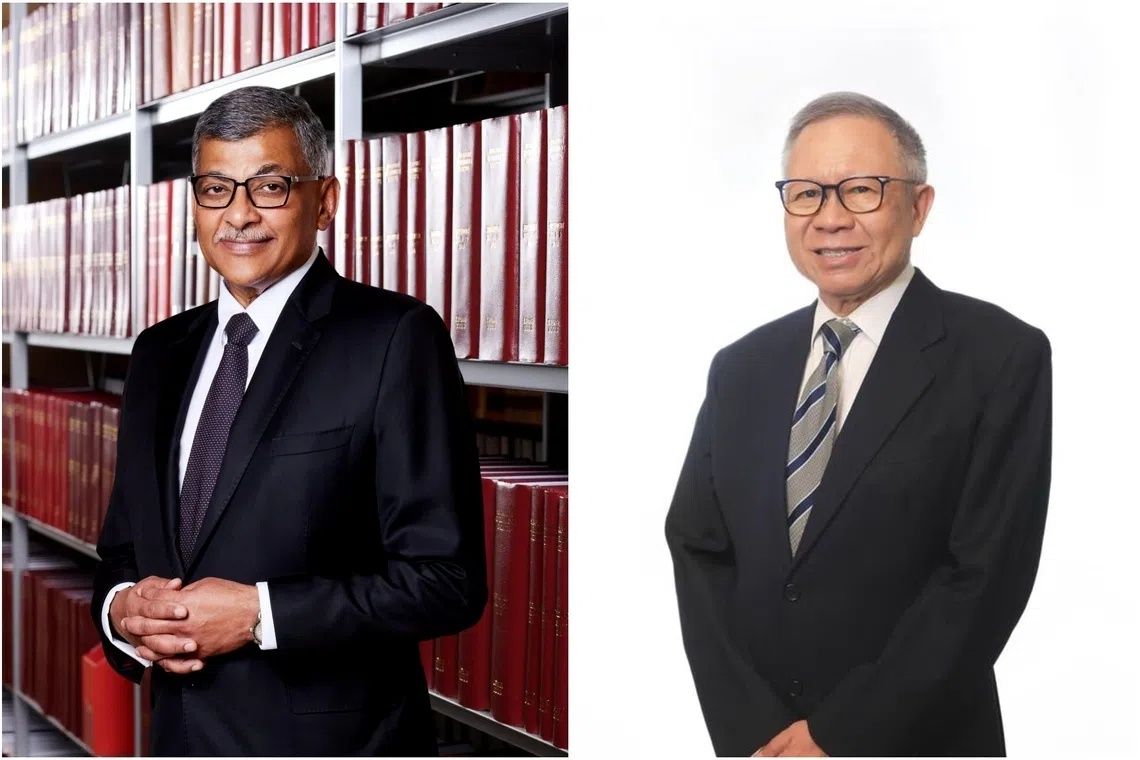
Singapore's outgoing Chief Justice Sundaresh Menon and Eddie Teo, the former chairman of the Council of Presidential Advisers, have been named recipients of the Order of Temasek (With Distinction) at the 2026 National Day Awards, honouring their exceptional service to the city-state. The two distinguished figures, aged 62 and 79 respectively, represent the pinnacle of Singapore's civilian recognition system, joining 7,491 other individuals receiving National Day honours this year.
Menon's 14-year tenure as Chief Justice, commencing in November 2012 and concluding on February 26, 2027, has fundamentally reshaped Singapore's judicial landscape. His leadership transformed the judiciary from an institution bound by tradition into a modern, efficient, and technologically advanced system. The modernisation programme he championed encompassed comprehensive digitalisation of court operations, a shift that improved accessibility and reduced case processing times while maintaining judicial integrity. Beyond operational improvements, Menon established critical institutional frameworks that strengthened the foundation of Singapore's legal system and enhanced public confidence in the administration of justice.
Under Menon's direction, the judiciary underwent structural transformations that expanded its capacity and specialisation. The establishment of the Appellate Division of the High Court created a dedicated appellate body, reducing bottlenecks in the appeals process and improving the quality of judicial decision-making. Equally significant was the creation of the Singapore International Commercial Court, positioning Singapore as a regional hub for complex commercial dispute resolution and attracting international legal work to the jurisdiction. These infrastructure developments reflected Menon's vision of a judiciary capable of serving not only domestic needs but also international commerce and regional legal standing.
A particularly innovative dimension of Menon's judicial philosophy involved the embrace of therapeutic justice principles across the Family Justice Courts and Youth Courts. This approach prioritises the rehabilitation and welfare of individuals over purely punitive outcomes, recognising that family disputes and juvenile offences often require healing rather than punishment alone. The establishment of the Singapore Judicial College complemented this philosophy by professionalising judicial education and ensuring that judges remained abreast of evolving legal principles, international best practices, and emerging areas of law. In his statement accepting the honour, Menon emphasised that Singapore's commitment to the rule of law has been a defining feature of the nation's governance architecture since independence, providing the stable legal foundation upon which economic opportunity and social cohesion rest.
Teo's recognition reflects a career spanning 56 years in the public service, a tenure that witnessed the nation's transformation from colonial outpost to developed economy. Beginning his career in 1970 with the Ministry of Defence's Security and Intelligence Division, Teo rose to become its director at the unusually young age of 31, a position he held for 15 years. His subsequent roles as permanent secretary for defence and later in the Prime Minister's Office placed him at the epicentre of Singapore's most sensitive policy decisions during the Cold War era and beyond. This early immersion in the nation's security architecture and strategic planning exposed him to the founding generation of Singapore's leadership, including Lee Kuan Yew, Goh Keng Swee, and former president S. R. Nathan—figures whose commitment to meritocracy and nation-building profoundly influenced his own career trajectory.
Teo's tenure as chairman of the Public Service Commission from 2008 to 2018 represented a deliberate effort to broaden the talent pool and professional diversity of Singapore's civil service leadership. By recruiting commission members from academia, law, and social work, Teo signalled that public service excellence transcended traditional bureaucratic pathways. This shift recognised that modern governance requires expertise spanning multiple domains and that the most effective public institutions draw talent from diverse professional backgrounds. His subsequent appointment as chairman of the Council of Presidential Advisers until June 2026 placed him in a constitutionally significant advisory role, one that carried particular importance during the Covid-19 pandemic.
The pandemic era highlighted the critical importance of Teo's work within the advisory framework. As the Government pursued an unprecedented fiscal stimulus, drawing approximately S$40 billion—the largest drawdown from past reserves in Singapore's history—the CPA played an essential constitutional role in ensuring that this extraordinary fiscal action remained consistent with the Constitution's provisions governing reserve management. The thorough discussions between the then-President Halimah Yacob and the CPA before approval underscored the constitutional safeguards embedded within Singapore's system, even as the nation navigated an unprecedented health and economic crisis. Teo's stewardship ensured that this massive fiscal intervention steadied the economy, protected businesses, and preserved employment without incurring heavy public debt—a balancing act that reflected decades of experience in public financial management.
In reflecting on his career, Teo emphasised the formative influence of learning directly from Singapore's pioneer leaders during his first two decades in service. These founding figures impressed upon him and his contemporaries the values of integrity, meritocracy, incorruptibility, and excellence that would become the defining characteristics of Singapore's public institutions. His articulation of these values in his statement accepting the honour carries particular significance for aspiring public servants, as Teo explicitly countered the perception that government service represents a financial sacrifice compared to private sector careers. By highlighting the intrinsic satisfaction and intellectual engagement of public service, Teo attempted to inspire the next generation to consider contributing their talents to the nation's governance and administration.
The broader context of this year's National Day Honours reflects Singapore's continuing emphasis on recognising contributions across multiple domains of national importance. Beyond Menon and Teo, five individuals received the Distinguished Service Order, the second-highest civilian honour, for contributions spanning public transport, aviation, the arts, community cohesion, and labour relations. Among these, Land Transport Authority chairman Alan Chan was recognised for his leadership in transforming Singapore's land transport system, achieving remarkable improvements in rail reliability—rising from 393,000 mean kilometres between failures in 2017 to two million by 2026. Similarly, Edmund Cheng's contributions to aviation, rehabilitation of ex-offenders, and the arts demonstrated the breadth of Singapore's recognition of service across society.
For Malaysian and Southeast Asian observers, these honours illustrate how Singapore systematises recognition of institutional leadership and long-term public service contributions. The emphasis on transformational leadership in the judiciary—Menon's modernisation agenda—and on sustained excellence in public administration—Teo's 56-year career—offers instructive examples of how institutions can evolve while maintaining core principles of integrity and rule of law. The particular significance accorded to the judiciary's development and to the careful constitutional stewardship of fiscal policy during crisis periods reflects Singapore's foundational conviction that durable economic success and political stability rest upon robust institutions rather than personality-driven leadership. As regional economies confront challenges ranging from digital transformation to fiscal sustainability, these institutionalised approaches to recognising and sustaining excellence in governance carry lessons extending beyond Singapore's borders.

