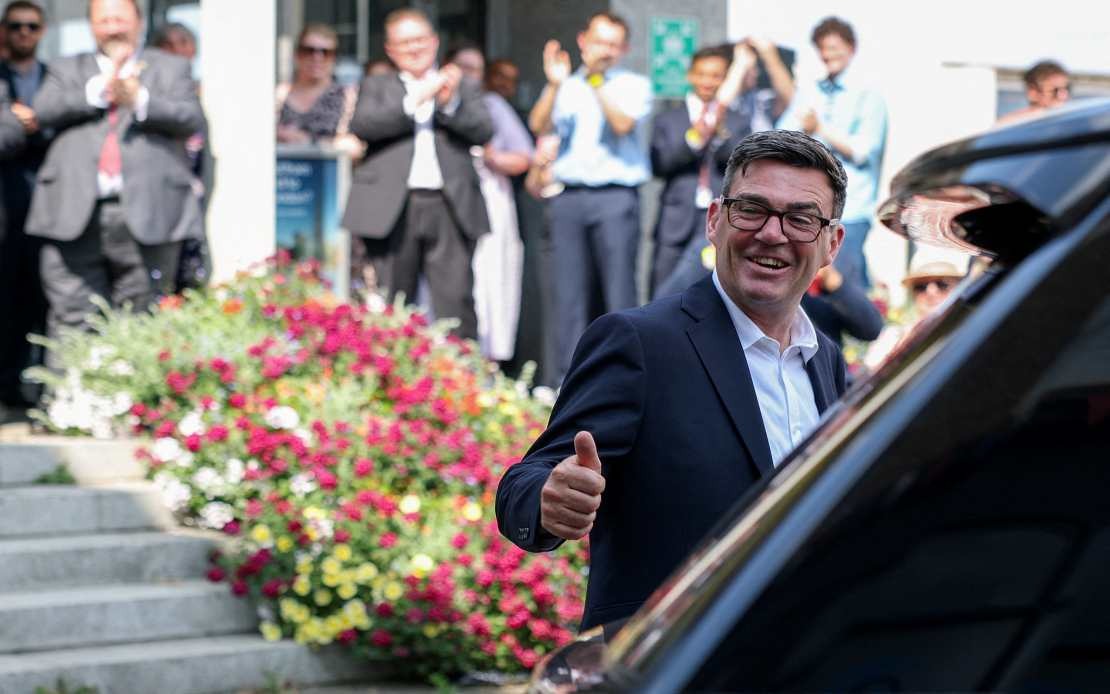
Singapore's Prime Minister Lawrence Wong moved swiftly to extend diplomatic greetings to Andy Burnham following the Labour Party leader's formal appointment as Britain's new prime minister on Monday, with the island nation's top official pledging renewed commitment to strengthening ties between the two countries during a period of significant global flux. Burnham met with King Charles III and received the invitation to form a government, officially assuming office as the UK's latest premier and marking a significant leadership transition in Westminster.
Wong's congratulatory missive underscores Singapore's determination to build momentum in its relationship with Britain at a time when geopolitical uncertainty and economic volatility dominate the international landscape. The prime minister framed Burnham's assumption of power not merely as a change of administration but as an opportunity for reinvigorated partnership, wishing the new British leader success in navigating what Wong described as a period of profound transformation affecting both nations and the broader world order.
The foundation of Singapore-UK relations, according to Wong's remarks, rests on a Strategic Partnership that has evolved through decades of accumulated trust and multifaceted cooperation. This framework extends well beyond ceremonial diplomatic gestures, encompassing substantive collaboration across numerous sectors that reflect the maturity and sophistication of the bilateral relationship. Wong's letter specifically highlighted innovation, science and technology, and defence as priority areas for continued engagement, domains where both nations possess considerable expertise and complementary interests.
Particularly significant is Wong's emphasis on the principle of partnership resilience in uncertain times. By noting that Singapore and the UK have repeatedly demonstrated their capacity to achieve ambitious objectives through coordinated effort despite volatile global conditions, the prime minister positioned their relationship as a stabilising force capable of transcending temporary disruptions or shifts in international sentiment. This framing suggests that both governments view their connection as structurally sound and enduring rather than subject to the vicissitudes of domestic political change.
Beyond bilateral ties, Wong accorded considerable weight to Britain's broader regional footprint. Singapore greatly values the UK's role as an ASEAN Dialogue Partner, a designation that formalises Britain's stake in Southeast Asian development and security matters. Furthermore, Wong noted the significance of the Five Power Defence Arrangements, a multilateral security framework involving Singapore, Malaysia, the United Kingdom, and Australia that has functioned as a cornerstone of regional stability for decades. The continued British commitment to these arrangements holds particular importance given emerging geopolitical tensions in the Indo-Pacific region.
Wong identified a forthcoming convergence of responsibilities that presents distinctive opportunities for collaborative leadership. Singapore is set to assume the ASEAN Chairmanship, positioning the city-state at the helm of one of the world's most dynamically important regional organisations at a critical juncture. Simultaneously, the UK is slated to hold the G20 Presidency in 2027, providing Britain with a platform to shape global economic and political discourse. Wong suggested that these concurrent leadership roles create an ideal moment for both nations to coordinate strategy on shared challenges spanning the developed and developing world.
The mention of strengthening multilateral cooperation carries particular resonance for Southeast Asian observers. As a small, externally-oriented economy, Singapore has long championed rules-based international systems and multilateral institutions as mechanisms through which smaller states can punch above their weight in global affairs. Britain's stewardship of the G20, combined with Singapore's ASEAN leadership, could theoretically enable productive dialogue between developed economies and the dynamic emerging markets of Southeast Asia, addressing trade, investment, climate, and security matters of mutual concern.
Wong's remarks reflect Singapore's sophisticated diplomatic approach of maintaining robust great-power relationships while simultaneously positioning itself as an indispensable node in regional and global networks. The prime minister avoided partisan language regarding Burnham's Labour victory, instead focusing on institutional continuities and forward-looking partnership frameworks that transcend the particular complexion of any government. This diplomatic pragmatism signals that Singapore's commitment to the UK partnership rests on structural factors and shared interests rather than ideological alignment.
For Malaysian and broader Southeast Asian observers, Wong's message carries significance beyond the immediate Singapore-UK dynamic. It underscores the region's value to major powers and the continued willingness of developed nations to invest in Southeast Asian relationships despite competition and shifting priorities. Britain's continued engagement with ASEAN and participation in regional security arrangements like the Five Power Defence Arrangements reflects London's determination to maintain influence in an increasingly contested Indo-Pacific region where China's assertiveness has prompted traditional powers to reaffirm commitments to Southeast Asia.
The timing of Wong's congratulatory gesture also merits consideration. As Burnham takes office amid economic challenges, international security concerns, and demands for domestic reform, his administration will likely seek to maintain and consolidate Britain's international partnerships. Singapore's prompt and substantive acknowledgment of the new government helps establish positive momentum and signals openness to deepening engagement across multiple sectors. Such early diplomatic courtesies often set the tone for subsequent high-level interactions and policy coordination.
Looking forward, the identification of specific collaboration areas suggests concrete pathways for deepening ties. Innovation and science and technology partnerships align with both nations' competitive advantages and strategic priorities in addressing challenges from cybersecurity to sustainable development. Defence collaboration, historically robust, appears positioned for expansion given evolving security dynamics in the Indo-Pacific and shared concerns about maritime security, freedom of navigation, and regional stability.
The convergence of Singapore's ASEAN Chairmanship and Britain's G20 Presidency presents a genuine opportunity to bridge developed and developing world perspectives on economic governance, climate action, and technological advancement. Such platforms could facilitate dialogue on issues where Singapore and other ASEAN members possess crucial stakes, from trade patterns and digital regulation to energy transition and global financial stability. Wong's framing suggests that both governments see potential in translating their individual leadership roles into genuine collaborative advantage benefiting their respective constituencies and the international community more broadly.

