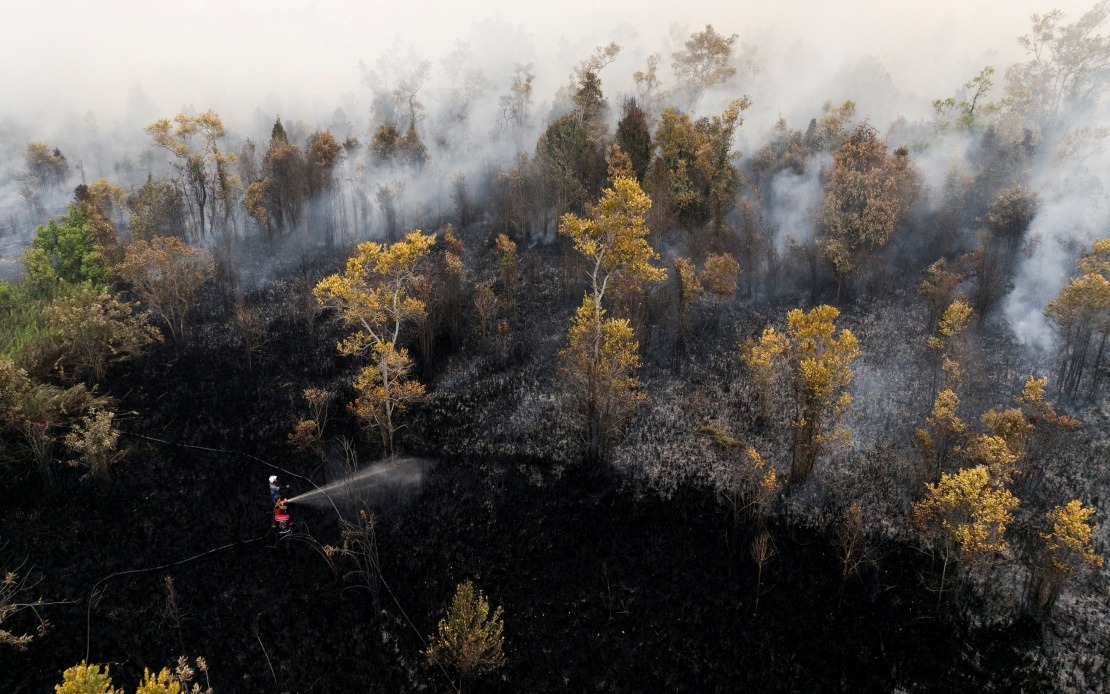
The complete suspension of flight operations at Singkawang Airport on Saturday underscores the escalating severity of Indonesia's seasonal fire crisis and its mounting impact on regional air transport. Located approximately 145 kilometres north of Pontianak, the provincial capital of West Kalimantan, Singkawang Airport primarily handles domestic traffic connecting communities across Indonesian Borneo. The airport authorities justified the unprecedented shutdown through a safety-first directive posted on their official Instagram account, emphasising that visibility conditions had deteriorated beyond permissible operational thresholds, obliging the airline industry to ground all scheduled services and accommodate stranded passengers through rebooking arrangements.
The decision reflects stringent protocols established by Indonesia's aviation regulatory framework, where visibility remains the decisive factor governing whether airports can safely accommodate commercial aircraft movements. Director-General of Civil Aviation Lukman F. Laisa articulated the regulatory rationale in statements released Friday, explaining that flight delays, diversions, and outright cancellations become mandatory when atmospheric conditions fall beneath established operational minimums. This uncompromising stance prioritises passenger safety while acknowledging the physical realities that pilots face when navigating through smoke-laden air that obscures runway visual range and navigation aids. The Transport Ministry has positioned itself as actively monitoring the situation across multiple Kalimantan airports, coordinating responses with airlines, airport operators, and emergency services to manage cascading disruptions to regional connectivity.
The underlying cause of Singkawang's airport closure traces directly to the accelerating pace of forest and land fires consuming vast tracts of Kalimantan's landscape. Satellite data compiled by NASA's Terra and Aqua monitoring systems, as reported by the Transport Ministry on Friday evening, detected a combined total of 126 high-confidence thermal hotspots distributed across the three Kalimantan provinces. Central Kalimantan registered the highest concentration with 56 detected hotspots, followed by West Kalimantan with 51, and South Kalimantan with 19 fires burning as of 9:30 pm local time. These figures represent only the most confidently identified active burn sites visible from orbital altitude, suggesting the actual ground-level fire activity substantially exceeds satellite-detected counts, particularly in remote areas where smaller fires may escape detection algorithms or remain obscured by existing smoke layers.
Atmospheric quality metrics compiled by Indonesia's Meteorology, Climatology and Geophysics Agency (BMKG) have classified extensive portions of West and Central Kalimantan as experiencing "very unhealthy" air quality conditions, a category that triggers health warnings and activity restrictions for vulnerable populations. The transboundary nature of smoke transport means that air quality degradation extends beyond Kalimantan's provincial boundaries, affecting neighbouring regions in Malaysia and Singapore. For Malaysian readers particularly, this Kalimantan fire episode carries direct relevance, as prevailing wind patterns during certain seasons can carry smoke and haze across the Malacca Strait into Malaysian airspace, potentially triggering similar airport disruptions and public health concerns reminiscent of previous transboundary haze episodes that have periodically afflicted the region.
Indonesian authorities have mobilised a comprehensive firefighting response combining ground-based and aerial operations, including water-bombing missions deployed from strategic locations. Additionally, weather modification operations have been positioned as a contingency measure, awaiting suitable atmospheric conditions where cloud seeding techniques might be deployed to induce precipitation that could suppress active fire zones. These interventions, however, remain temporally constrained and geographically limited compared to the vast areal extent of fires burning simultaneously across Kalimantan. The sheer scale of the fire outbreak—spanning multiple provinces and persisting across weeks—strains response capacity and underscores systemic challenges in fire prevention and early suppression before fires achieve destructive scale.
Investigative efforts by Central Kalimantan police have identified approximately 12 suspects in connection with forest and land fire cases as of mid-August, according to statements from provincial police chief Inspector-General Iwan Kurniawan. This criminal investigation dimension reflects Indonesian authorities' determination to attribute causation and assign culpability for deliberate fire-setting, whether through agricultural land clearing practices, peatland drainage followed by accidental ignition, or intentional arson aimed at clearing tracts for agricultural expansion. Establishing legal responsibility remains crucial for deterrence, though enforcement challenges persist in remote forest regions where investigation capacity remains constrained and evidentiary collection proves difficult under field conditions complicated by ongoing smoke and fire activity.
The Singkawang Airport closure illustrates how Indonesia's recurring fire crises generate compound disruptions extending far beyond immediate environmental degradation and public health impacts. Transportation networks serving regional commerce and tourism suffer directly, with passengers facing cancelled bookings, rearranged itineraries, and accumulated delays that ripple through supply chains and economic activity. For Malaysia's business community and tourism operators, Indonesian haze episodes and associated transport disruptions create unpredictable conditions affecting cross-border travel, trade logistics, and ASEAN connectivity that regional economic integration frameworks nominally aim to facilitate.
The timing and intensity of this fire outbreak reflect the seasonal dynamics that Kalimantan experiences annually during the dry season, when moisture content in vegetation and peat soils diminishes, creating conditions conducive to rapid fire spread. Climate patterns including El Niño episodes amplify drought severity, intensifying fire risk across Southeast Asia more broadly. Malaysia, with its own fire-prone regions in Sarawak and Peninsular areas subject to transboundary smoke transport, shares comparable vulnerabilities and thus maintains substantive interest in Indonesian fire management outcomes and regional haze prevention cooperation frameworks.
The concatenation of circumstances—satellite-detected fires, degraded air quality metrics, aviation safety protocols triggering cancellations, and criminal investigations proceeding in parallel—demonstrates how natural hazards intersect with regulatory responses, public health implications, and legal accountability mechanisms across Indonesia's governance structures. Singkawang Airport's Saturday suspension represents merely one visible manifestation of systemic challenges associated with large-scale seasonal burning that periodically destabilises regional environmental quality and transport infrastructure. Sustained solutions require addressing underlying drivers of deforestation and land-use conversion that create conditions enabling fire outbreaks, a complex problem involving agricultural economics, rural development priorities, and enforcement of environmental regulations across Indonesia's vast and geographically dispersed forest regions.

