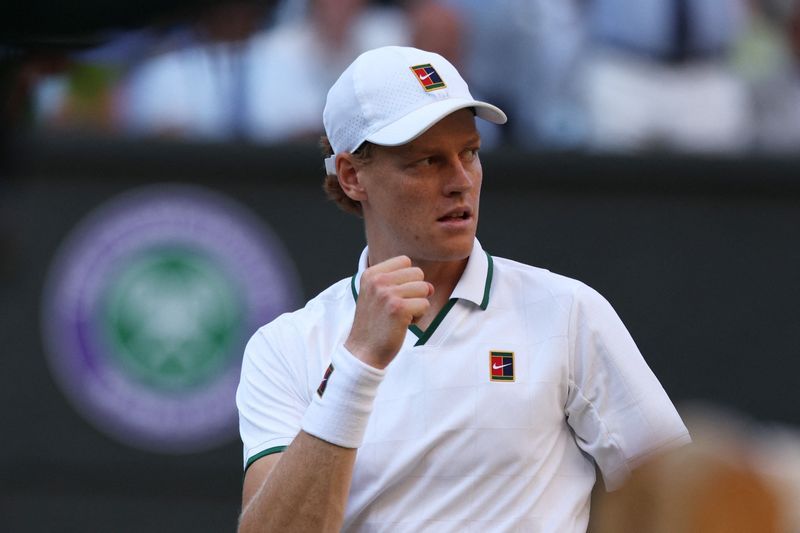
Italian world number one Jannik Sinner successfully retained the Wimbledon title on Sunday, weathering an inspired assault from Alexander Zverev to claim his fifth Grand Slam championship. The collision between the top seed and second seed unfolded as a masterclass in modern tennis power and precision, with Sinner ultimately triumphing 6-7(7) 7-6(2) 6-3 6-4 after three hours and 46 minutes of absorbing play on Centre Court. The victory cements Sinner's status as the dominant force in men's tennis and places him among an elite fraternity of only ten men to successfully defend the Wimbledon singles title in the professional era.
Zverev arrived at the final riding the momentum of his maiden Grand Slam triumph at Roland Garros just weeks earlier, positioning himself as a genuine threat to Sinner's quest to become only the second Italian ever to win back-to-back Wimbledon titles. The German's credentials were formidable: he carried the belief that at 29 years old, he finally possessed the game and temperament to capture the grass-court crown, something no German man had achieved since Michael Stich's victory in 1991. Yet despite a composed and powerful display, particularly in the opening set where his forehand struck with rare consistency and authority, Zverev's resistance ultimately collapsed as Sinner's superior movement and court intelligence proved decisive when the pressure intensified.
The opening set became a contest defined by razor-thin margins, with both players demonstrating the kind of heavy-hitting baseline exchanges that have become the hallmark of contemporary professional tennis. Contested across 65 minutes in sweltering conditions on a hot and breezy Centre Court, the set yielded remarkably few opportunities for either player to gain an advantage. Only a single break point materialized in the opening 12 games, which fell to Sinner at 4-3, but the Italian squandered it uncharacteristically by framing a forehand wide. Zverev's serve proved nearly impenetrable throughout, conceding just eight points on his first serve in the opening set, while his forehand—historically a source of fragility during crucial moments in major tournaments—operated with outstanding fluidity and penetration.
The tiebreak that decided the first set crystallized the competitive intensity of the encounter. Zverev secured the initial set point opportunity, only to be passed brilliantly at the net by Sinner after the Italian executed a rare drop shot that drew his opponent forward. The German responded with an ace to save the point, and when another set point came his way, Zverev unleashed a forehand winner that ended Sinner's remarkable streak of winning 14 consecutive sets against him. This breakthrough provided momentary encouragement for Zverev, suggesting that if the German could maintain this intensity and execution, a genuine upset remained possible.
Frustration visibly mounted for Sinner in the early stages of the second set as Zverev's serving continued to present an seemingly insurmountable obstacle. The German's delivery appeared virtually untouchable, and the Italian made limited inroads with his return game during the initial stages. However, Sinner's championship mettle and superior court positioning reasserted itself in the subsequent tiebreak, where the Italian elevated his aggression significantly. He seized the initiative at 3-3 and ultimately leveled the match, demonstrating the mental resilience and tactical flexibility that distinguishes him from his contemporaries. This proved the decisive momentum shift, as Sinner would not relinquish it for the remainder of the match.
The critical turning point arrived approximately two hours and 42 minutes into the proceedings, early in the third set at 3-3. After extended baseline exchanges showcasing both players' willingness to engage in thunderous hitting from deep in the court, Zverev earned his first and only break point of the entire match. As Sinner executed a delicate drop shot intended to disrupt Zverev's rhythm, the German slipped while attempting to adjust direction near the baseline and tumbled awkwardly onto the turf. The stumble appeared relatively minor initially, but Zverev was visibly shaken by the fall, and more significantly, the impact manifested in his movement quality for the remainder of the match. Sinner approached his opponent with concern, but Zverev indicated he could continue, and the Italian capitalized immediately by holding serve before breaking Zverev's service as the German moved noticeably more gingerly, his frustration evident as he flung his racket across the grass.
From this juncture, Sinner's control became increasingly pronounced. The Italian broke serve again at 4-3 in the fourth set, establishing a decisive advantage that Zverev, despite a brief recovery of composure, could never overcome. The match's conclusion featured two spectacular rallies as Sinner served for the championship, showcasing the spectacular ball-striking and tactical acumen that have propelled him to the top of world tennis. The final point arrived after three hours and 46 minutes, with Sinner clinching victory and claiming his first Wimbledon title in 2023 by defeating fellow teenage sensation Carlos Alcaraz, earning the distinction of becoming the first Italian male to win a Wimbledon singles crown. The 24-year-old has since demonstrated remarkable consistency, successfully managing the expectations and pressures associated with defending a major championship.
Sinner's pathway to this final contained notable adversity that underscored the mental fortitude required to succeed at the highest levels of professional tennis. He suffered a shocking second-round elimination at Roland Garros earlier in the summer and narrowly escaped a first-round exit at Wimbledon against Miomir Kecmanovic. Rather than allowing these setbacks to compromise his confidence, Sinner responded by elevating his performance throughout the later stages of the tournament, most impressively in the semi-final and final rounds where he did not surrender a single service game. This combination of resilience and excellence illustrates why, despite his tender age, Sinner has emerged as the clear successor to Novak Djokovic as the sport's dominant player.
Zverev's defeat, his fourth in a Grand Slam final, represented a difficult pill to swallow given the magnitude of his achievement in claiming the French Open at his 41st major championship attempt. Yet the German's performance at Wimbledon has clearly elevated his confidence regarding grass-court tennis, where he demonstrated capabilities that rival the world's elite. At 29 years old, Zverev's philosophical observation that for the first time in his career he genuinely believed he could capture the Wimbledon title suggests future opportunities may materialize. His recent major victory has matured him considerably, and his showing against Sinner, despite the loss, illustrated a player whose game has become considerably more formidable against the highest opposition.
The implications of Sinner's victory extend beyond individual accolades, signaling the consolidation of a new era in men's tennis. His fifth Grand Slam title at merely 24 years of age, achieved across three different surfaces, confirms that he possesses the complete arsenal required for sustained dominance. For Malaysian and Southeast Asian tennis enthusiasts, Sinner's rise represents a shift in the sport's power structure, with a new generation of players demonstrating both technical excellence and the mental maturity once characteristic of Djokovic's generation. As the tennis calendar proceeds toward the remaining major championships and year-end competitions, Sinner appears positioned to compile a record-breaking resume that could rival the greatest players in the sport's history.

