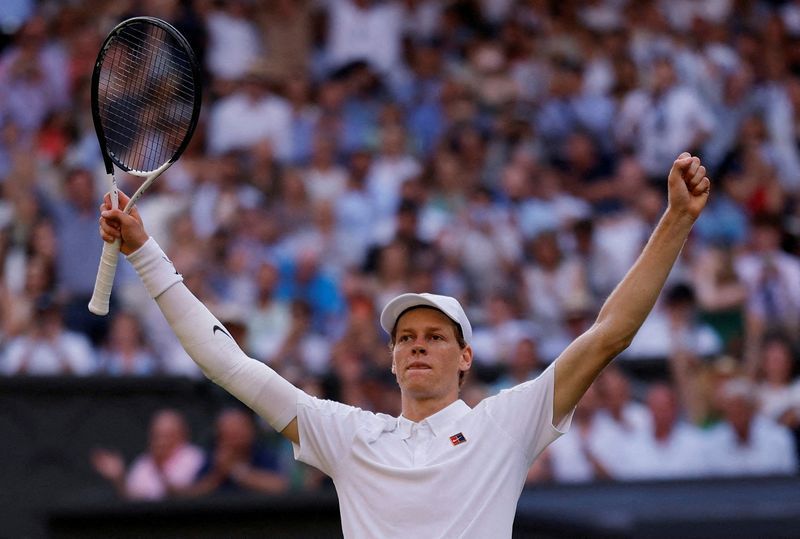
Jannik Sinner returns to the All England Club as defending Wimbledon champion, yet the Italian arrives stripped of the aura that surrounded him through his devastating clay-court dominance earlier this year. The world number one must now navigate the fastest surface in tennis whilst simultaneously proving he can withstand the physical and mental rigours that Grand Slam competition demands, all whilst top contenders circle with renewed belief that the crown is vulnerable.
Sinner's trajectory shifted sharply at Roland Garros last month, where his remarkable 30-match winning streak dating back to February evaporated in shocking fashion during the second round. The collapse raised fundamental questions about his durability and mental resilience when facing the intense demands of major tournaments, particularly given that he is still only 24 years old and navigating the pressures of being the tour's top-ranked player. Despite his pedigree and recent dominance on clay, the sudden unravelling suggested that something deeper than momentary form was at play.
Mats Wilander, the seven-times Grand Slam champion, offered a measured assessment of the situation whilst maintaining confidence in Sinner's credentials. According to Wilander's analysis, the immediate cause of Sinner's Paris collapse was straightforward: exhaustion compounded by inadequate recovery time. The Italian had contested numerous tournaments leading into the French Open with minimal opportunity to conduct meaningful training sessions, a schedule that gradually depleted his physical reserves until his body simply could not sustain the required performance level. Wilander suggested that Sinner has now had adequate rest and should arrive at Wimbledon refreshed, though he cautioned that grass surfaces present their own unpredictable variables that cannot be entirely anticipated or controlled.
The grass courts of Wimbledon present Sinner with a genuine opportunity to reset his narrative and reassert his dominance, but only if he can manage the transition seamlessly. Unlike clay, where he demonstrated near-invincibility during his winning streak, grass demands different technical skills, tactical approaches, and physical adaptations. Notably, Sinner chose to skip all warm-up tournaments before Wimbledon, a decision that reflects either prudent preparation or concerning caution, depending on interpretation. This absence from competitive action means his first substantial test on grass will arrive at the sport's most prestigious venue, against opponents who have been sharpening their games on the surface for weeks.
Novak Djokovic emerges as perhaps the most formidable challenger to Sinner's title defence, notwithstanding the Serb's own unexpected departure from Roland Garros. At 39 years old, Djokovic carries the distinctive profile of a player running short on opportunities to achieve his remaining objectives. An eighth Wimbledon title would draw him level with Roger Federer's record, whilst a 25th Grand Slam triumph would represent the elusive standalone record that has defined his late-career ambitions. The combination of these twin motivations transforms Wimbledon into something beyond a regular tournament in Djokovic's calendar—it becomes a potentially final meaningful opportunity to etch his name into tennis history.
Andy Roddick, the former world number one and three-times Wimbledon finalist, articulated precisely why Djokovic should not be dismissed despite his Paris performance. The Serb's movement and return of serve on grass remain exceptionally sharp, and his last Wimbledon victory came only four years ago, indicating that the surface remains well within his technical mastery. Roddick suggested that Djokovic will have scrutinised the landscape of elite tennis carefully and recognised that Wimbledon represents a genuine pathway to a title, regardless of whether he is competing at his absolute peak. The fact that Sinner arrives with obvious questions hanging over his fitness and form only brightens Djokovic's prospects.
Alexander Zverev, meanwhile, approaches Wimbledon with the confidence of a player who has just achieved the breakthrough that had eluded him throughout his career. The German's triumph at Roland Garros represents his maiden Grand Slam victory, and Boris Becker, his compatriot and six-times major winner, has suggested that Zverev must now be considered a genuine Wimbledon contender. Becker's logic is straightforward: with Alcaraz sidelined by injury and Sinner's form deeply uncertain, the pathway to the title has cleared considerably. Zverev's exceptional serve, which stands as one of the fastest and most reliable weapons in professional tennis, becomes particularly potent on grass, where it can routinely generate unreturnable deliveries and dictate points from the outset.
The absence of Carlos Alcaraz from Wimbledon due to injury represents a seismic shift in the tournament's dynamics. The Spanish champion demonstrated extraordinary dominance on grass during his recent title runs in 2023 and 2024, establishing himself as perhaps the most naturally gifted grass-court player of the modern era. His removal from contention eliminates one of the few players capable of imposing their game on the surface with genuine inevitability, fundamentally altering the competitive balance and distributing opportunities across a wider constellation of challengers.
Beneath the upper echelon of contenders, a secondary wave of talented competitors will harbour genuine ambitions of disrupting the favourites' plans. American players Ben Shelton, Taylor Fritz, and Frances Tiafoe all possess the technical weapons—powerful serves, aggressive baseline play, and court movement—necessary to trouble established top players in the unpredictable environment of Wimbledon. Additionally, Flavio Cobolli, who reached the French Open final and demonstrated mental toughness under extreme pressure, represents another emerging threat capable of making an unexpected tournament run. These players will approach the draw with the knowledge that Sinner's vulnerability and the absence of Alcaraz have created an unusually open championship.
The broader context for Malaysian and Southeast Asian tennis enthusiasts centres on the unpredictability that now characterises the men's game. For years, the sport existed within the gravitational pull of either Djokovic or the emerging triumvirate of Alcaraz, Sinner, and others. That apparent certainty has fractured dramatically. Sinner must overcome not only the physical and mental challenges of competing at Wimbledon but also the psychological burden of defending a title whilst harbouring doubts about his own condition. Djokovic must convince himself and the tennis world that one final great achievement remains within his grasp. Zverev must prove that his Grand Slam breakthrough represents a genuine elevation or merely an anomalous tournament result. This convergence of narrative threads suggests that Wimbledon 2024 will be contested in an atmosphere of genuine competitive uncertainty, where multiple legitimate pathways to the trophy exist.

