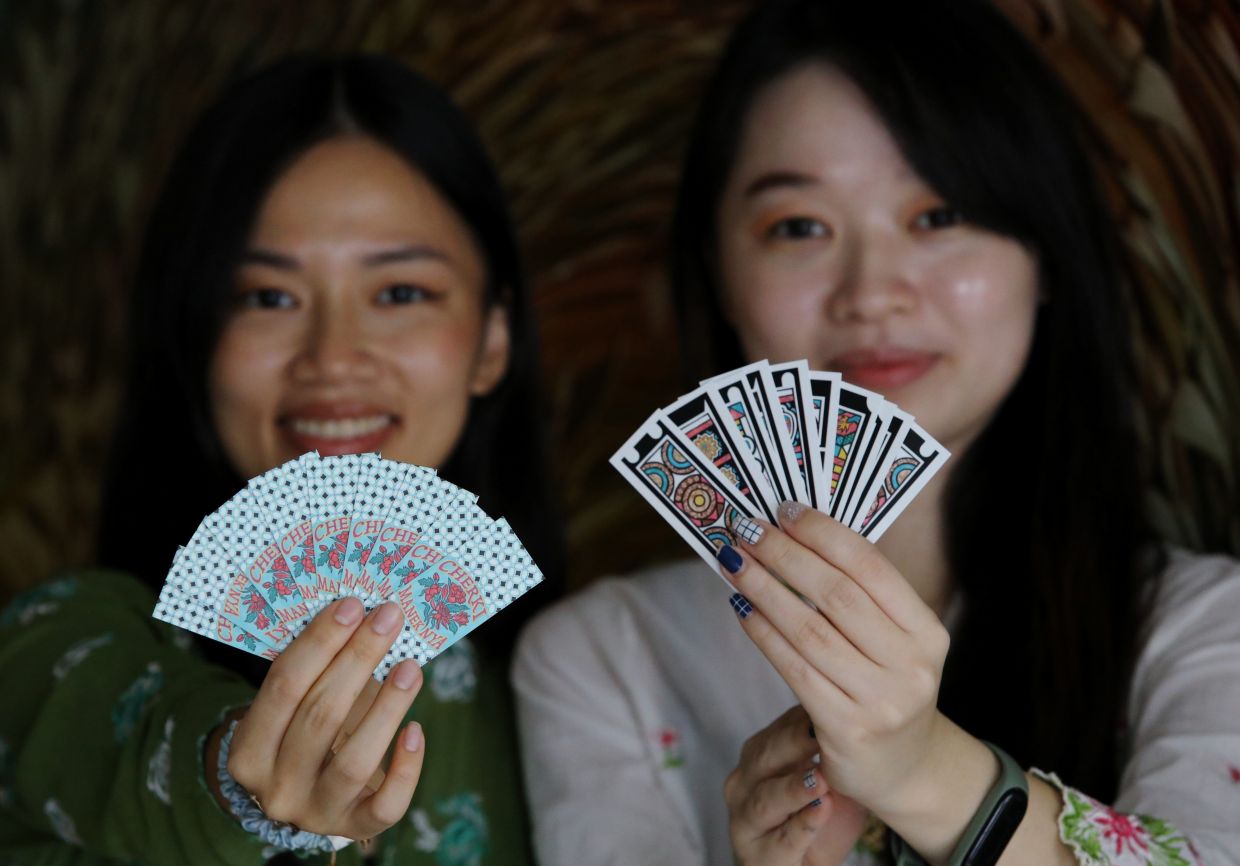
Two Malaysian sisters have undertaken a mission to rescue a centuries-old Peranakan card game from obscurity by reimagining it for the digital age. Lee Swee Lin, 32, and Lee Swee May, 31, have transformed the traditional Cherki with vibrant colours and contemporary illustrations, hoping to spark renewed interest among younger members of their community who are increasingly disconnected from Peranakan traditions. The sisters, who operate a Kuala Lumpur-based business specialising in Peranakan beaded footwear and decorative pieces, developed their redesigned card deck throughout 2024 in what represents a natural extension of their work preserving their heritage.
Cherki, also known as Ceki, Chi Kee or Koa, stands as one of the most distinctive games within Peranakan culture, yet its prominence has faded significantly over recent decades. Traditionally played with simple black-and-white designs, the game features 60 cards arranged into three suits – coins, strings and myriads – with values ranging from one to nine, supplemented by three special cards. The Lees recognised that contemporary Peranakans have largely forgotten how to play the game, with many younger members and even their own mother's generation lacking familiarity with its rules and significance. This knowledge gap motivated the sisters to develop a version that could appeal to modern sensibilities whilst maintaining authentic cultural elements.
The inspiration behind the project runs deeply personal for both women. Their paternal grandmother, Deo Yeok Kim, wielded tremendous influence over their understanding of Peranakan culture throughout their childhood in Melaka. Growing up in their grandmother's household, the sisters absorbed countless lessons about food, language, storytelling and the daily practices that sustained Peranakan identity. The recent passing of their grandmother crystallised their realisation that much of their cultural knowledge had been transmitted directly through family interaction – a form of transmission increasingly rare as lifestyles modernise and family structures shift. Every aspect of their beading business, which they learnt from their mother and grandmother, carries meanings and influences traceable back to these formative years, making the Cherki project feel like a continuation of inherited responsibility.
Swee Lin articulates a concern that resonates throughout the Peranakan community: younger generations face diminishing opportunities to learn from their elders as traditional family-based knowledge transmission weakens. She views the Cherki revival as more than recreational; it represents a deliberate effort to preserve cultural narrative and identity. Without intentional preservation efforts, she argues, this distinctive game risks becoming completely forgotten, severing another thread connecting contemporary Peranakans to their ancestral past. The challenge extends beyond the game itself – it reflects broader patterns of cultural erosion affecting younger Peranakans who increasingly gravitate towards digital entertainment, social media engagement and international pop culture rather than traditional practices.
Academic research confirms this cultural drift. A 2022 study examining Baba Nyonya material culture in Malacca documented how younger descendants face heightened exposure to global influences whilst experiencing reduced connection to traditional cultural expressions. The research underscored the necessity of proactive education and awareness efforts to counter this erosion. Lee Yuen Thien, deputy president of Persatuan Peranakan Baba Nyonya Malaysia, attributes the disconnection to lifestyle changes and competing priorities. With the association maintaining approximately 3,000 members whilst an estimated 10,000 to 15,000 Peranakans exist nationwide, many younger members find themselves preoccupied with career demands and modern commitments that leave little space for cultural engagement. Cultural activities, viewed increasingly as non-essential rather than integral, struggle for attention within these pressurised lives.
The challenges intensifying this drift prove multifaceted and structural. Geographic dispersion from ancestral centres like Melaka and Penang, where traditions maintained strongest transmission, has fragmented the community and disrupted knowledge transfer. Changing family structures and intermarriage patterns have reshaped how cultural practices flow across generations. Yet cultural experts argue against treating this evolution as purely negative. Tan, manager of the Baba & Nyonya Heritage Museum Melaka, advocates for allowing culture to evolve whilst simultaneously building awareness amongst younger Peranakans about their ancestry. He contends that sparking interest in heritage amongst younger generations requires understanding their modern contexts and meeting them where they are, rather than insisting on static preservation of outdated forms.
The Cherki redesign directly addresses this philosophy by maintaining traditional structures whilst embracing contemporary aesthetics. Working with a small design team utilising digital tools including Procreate and Adobe Illustrator, the sisters expanded the deck from 60 cards with patterns repeated twice to 120 cards with patterns repeated four times, enhancing gameplay variety. Critically, they retained the three traditional suits and nine value cards whilst replacing the original special cards – white flower, red flower and old thousand – with butterfly, dragon and phoenix, symbols carrying Peranakan significance. Each value card incorporates different Peranakan motifs: kantan, the fragrant flower integral to Nyonya cooking; chupu, the porcelain vessels traditionally used for serving food; kerongsang, the ornamental brooches fastening kebaya; and gelang, the bracelets worn by Nyonya women. These symbols provide educational layers, teaching younger players about material culture and daily life practices of their ancestors whilst they engage with gameplay.
Swee May explains the creative philosophy animating these choices: they wanted Cherki to feel like a contemporary game worthy of pulling out with friends, not a historical artefact confined to textbooks or museums. The vibrant colours and modern illustrations enhance visual appeal and accessibility, whilst the preservation of traditional Peranakan patterns and symbols maintains authentic cultural connection. The sisters explicitly designed the game to feel approachable to new players, with clearer instructions and improved clarity compared to traditional versions. This dual approach – making the game fun and visually engaging whilst honouring heritage – attempts to bridge the generational divide by enabling younger Peranakans to access their culture through a medium aligned with their contemporary preferences and lifestyle.
Historically, Cherki represents one element within a broader pattern of cultural transmission from China through Southeast Asia. Card games are believed to have originated during China's Tang Dynasty in the ninth century, where historical records describe a "leaf game." These games travelled along trading routes that eventually carried them to Europe by the fourteenth century, whilst versions established themselves across Singapore, Malaysia, Indonesia and Thailand. In Malaysia, the cards became known as daun ceki, with "daun" meaning leaf in Malay – terminology subsequently adopted by the Peranakan community. Understanding this deep historical lineage contextualises the Cherki revival as connecting contemporary players to centuries of cultural practice extending across multiple civilisations and trading networks.
The sisters' initiative arrives at a moment when Peranakan heritage increasingly attracts scholarly and popular attention, yet risks remaining confined to elite cultural discourse rather than embedded within community practice. Museum exhibitions, academic studies and heritage tourism promote awareness of iconic elements – beaded slippers, baju kebaya, intricately patterned tiles and distinctive culinary traditions like ayam buah keluak and Nyonya laksa – yet fewer Peranakans actually maintain living engagement with these cultural forms. The Cherki project attempts to shift this dynamic by reactivating a traditional game within contemporary social contexts, transforming it from museum piece into living practice. This reintroduction may catalyse broader interest in Peranakan heritage amongst younger community members, whilst demonstrating that cultural preservation need not require rejecting modernity but rather thoughtfully integrating tradition with contemporary forms.
Looking forward, the success of this endeavour will depend partly on how effectively younger Peranakans respond to the redesigned game and whether it genuinely facilitates intergenerational engagement. The project suggests that technology and design innovation need not diminish cultural authenticity but can instead serve as tools for making heritage accessible and relevant. As Malaysia's Peranakan community continues navigating pressures of modernisation and globalisation, initiatives like the Cherki revival demonstrate commitment to ensuring that distinctive cultural knowledge, values and practices persist not as historical curiosities but as living, evolving elements of community identity. The sisters' work illustrates how personal heritage projects, rooted in family relationships and informed by contemporary creative possibilities, can contribute meaningfully to broader efforts at cultural continuity across rapidly changing societies.

