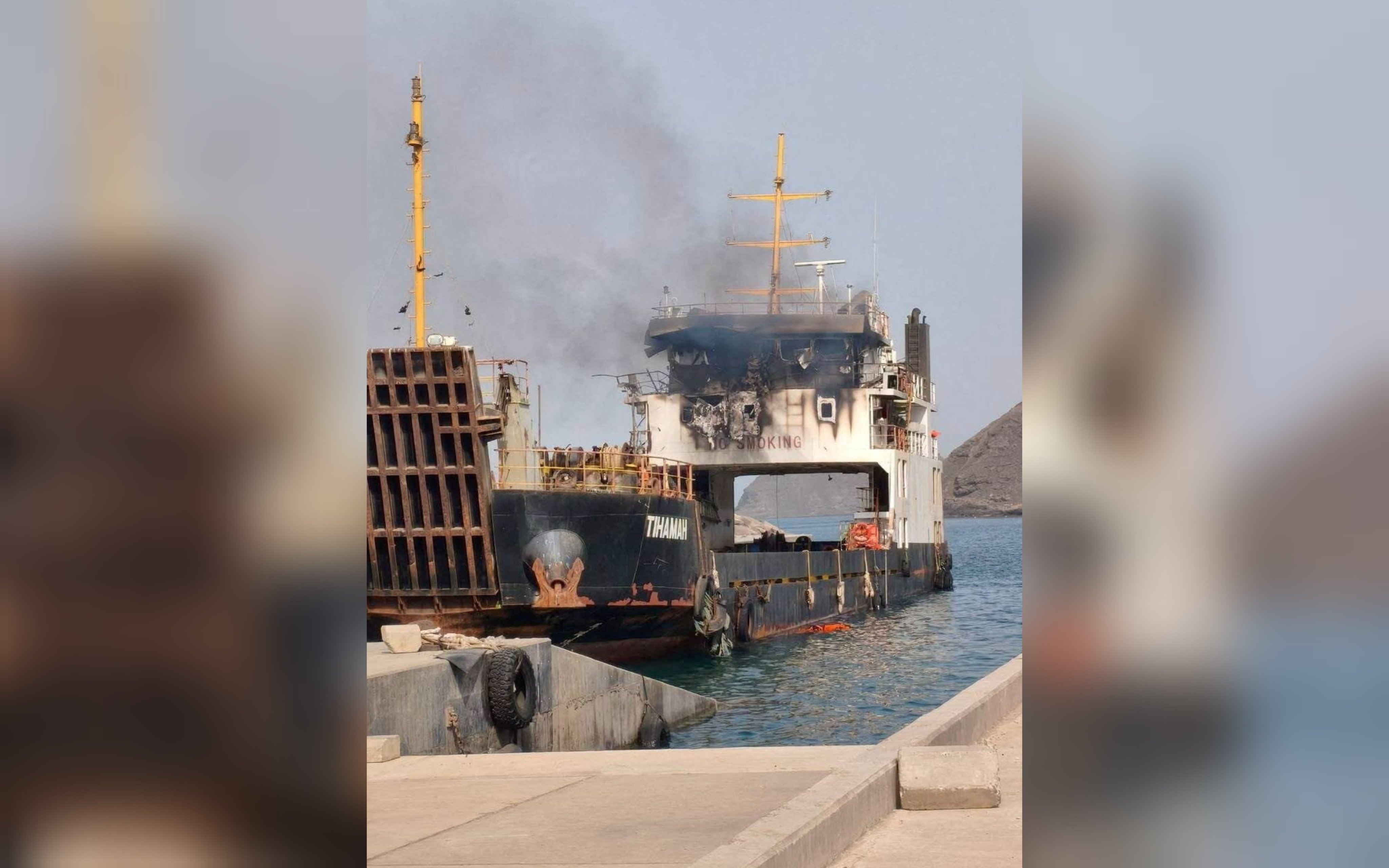
Yemen's Houthi militia launched a devastating assault on a commercial cargo ship traversing the Bab al-Mandeb Strait on Tuesday, resulting in six deaths and ten injuries according to Yemen's Coast Guard. The incident underscores the persistent threat posed by the Iran-aligned group to maritime commerce in one of the world's most strategically important shipping lanes, a waterway through which billions of dollars in global trade passes annually.
The Yemeni-flagged vessel Tihamah came under repeated bombardment from the Houthis, taking three direct hits from ballistic missiles while navigating the narrow strait separating Yemen from Djibouti and Eritrea. The strikes triggered an onboard fire and inflicted severe structural damage to the ship. Among those killed were four crew members—three nationals of Pakistan and one from Indonesia—alongside two members of Yemen's 2nd Naval Brigade who were aboard the vessel. The attack also wounded seven additional crew members, two coast guard personnel, and another soldier from the naval unit.
Rescue efforts were further complicated when Houthi forces allegedly fired a fourth missile at the Tihamah as emergency teams scrambled to reach survivors, a tactic the Yemeni authorities interpreted as a deliberate attempt to obstruct humanitarian operations and maximize casualties. Eleven Pakistani and Indonesian mariners were ultimately rescued from the stricken vessel, though their exact condition remains unclear. The targeting of a food supply ship represents a troubling escalation, as such strikes directly threaten the precarious supply chains sustaining Yemen's civilian population across both government-held and Houthi-controlled territories.
Yemen's Transportation Ministry condemned the operation as a "terrorist crime," arguing that it exemplifies a broader Houthi strategy to destabilize the nation's economy and disrupt civilian access to essential resources. Officials characterize recent Houthi actions as part of an intensifying campaign that extends beyond military targets to encompass ports, civilian infrastructure in government-controlled zones, and merchant vessels servicing those areas. The ministry's statement explicitly linked the attack to threats against food security for millions of Yemenis already facing acute humanitarian challenges.
The strategic implications of such attacks reverberate far beyond Yemen's borders. The Bab al-Mandeb Strait functions as the critical chokepoint connecting the Indian Ocean to the Red Sea and onward to the Suez Canal—a route through which approximately 12 percent of global maritime trade flows. Disruptions to shipping through this passage elevate insurance premiums, delay deliveries, and force vessels to undertake costly alternative routes around the African continent. For Malaysia and other Southeast Asian nations, such instability in global shipping corridors directly impacts supply chain costs and the pricing of consumer goods.
The Houthi group has escalated maritime operations substantially over recent years, employing drone strikes, cruise missiles, and naval mines against vessels they perceive as hostile or connected to regional adversaries. Their asymmetric tactics have proven increasingly effective at imposing economic costs on regional and international actors without requiring expensive naval assets. The group's apparent indifference to the humanitarian consequences of targeting food shipments suggests a calculated strategy to leverage control over Yemeni territory and threaten both local populations and international commerce simultaneously.
Geopolitical dimensions further complicate the situation. The Houthis, supported materially and strategically by Iran, employ maritime attacks as leverage in the broader regional competition with Saudi Arabia and United Arab Emirates—countries that have invested heavily in Yemen's government and military forces. The group's designation as a terrorist organization by several nations, including the United States and Saudi Arabia, remains contested by some international observers who view them primarily as a political-military faction engaged in Yemen's civil conflict. This labeling distinction carries implications for international responses and legal frameworks governing maritime intervention.
The incident occurred amid ongoing international efforts to stabilize the Red Sea region. Various naval coalitions, including those led by the United States and European nations, have deployed assets to deter such attacks and protect commercial shipping. However, the Houthis' demonstrated ability to penetrate defensive measures and strike high-value targets suggests that purely military solutions prove insufficient without addressing underlying political grievances and the group's operational capabilities.
For Malaysian stakeholders, including shipping companies, traders, and consumers dependent on imported goods, the security situation in the Bab al-Mandeb Strait represents a tangible economic consideration. Malaysian vessels and cargoes transiting these waters face elevated risk premiums and insurance costs. Companies must weigh the expenses of alternative routing against the time and fuel costs associated with circumnavigating the African continent. Supply chain vulnerabilities in critical chokepoints like this one demonstrate why regional and global maritime security cooperation remains essential to maintaining predictable trade flows.
The Houthis have issued no public statement regarding Tuesday's attack at the time of reporting, maintaining a pattern of ambiguity around specific operations while claiming broader justifications rooted in anti-colonial and anti-imperialist rhetoric. This silence reflects tactical discipline designed to preserve operational security while avoiding immediate provocation that might trigger escalated international military responses. Their continued attacks despite international pressure indicate limited leverage available to external actors seeking to moderate their behavior through diplomatic channels.
Yemen's humanitarian crisis, exacerbated by years of civil conflict, makes civilian access to food and essential supplies critically dependent on maritime commerce. Attacks targeting vessels carrying such cargo impose secondary humanitarian costs by reducing available supplies and elevating prices for vulnerable populations. The ministry's warning that maritime disruptions threaten food security across both government and Houthi-controlled areas reflects the grim reality that such attacks harm not only external parties but also populations in territories the Houthis nominally govern and claim to protect.
Moving forward, international maritime security efforts will likely intensify, potentially including enhanced naval presence, improved vessel protection measures, and coordinated intelligence sharing among regional and international naval forces. However, sustainable resolution of the Bab al-Mandeb security challenge ultimately requires progress on Yemen's underlying political conflict and the grievances fueling Houthi operations. Without such resolution, maritime commerce in the region will remain vulnerable to periodic disruptions that elevate costs and undermine stability throughout the Indian Ocean and beyond.

