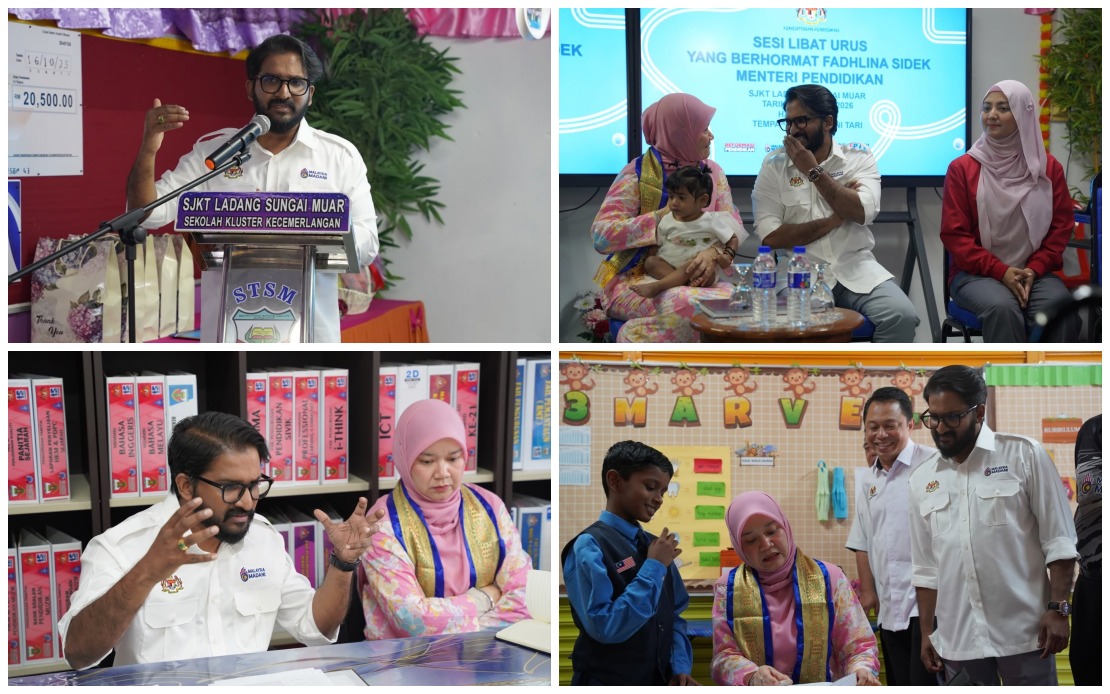
The relocation of SJKT Ladang Sungai Muar, a Tamil vernacular primary school in Segamat, has progressed to the land ownership stage following sustained advocacy by the constituency's Member of Parliament. The school's repositioning is being managed through formal procedures involving the Segamat Land and Mines Office, confirming that administrative frameworks are now actively guiding the project forward. Segamat MP R. Yuneswaran disclosed this development during an engagement session held at the school premises, an event that carried symbolic significance through the attendance of Education Minister Fadhlina Sidek.
The ministerial presence underscores the elevation of this relocation initiative within the federal education bureaucracy. By participating in direct consultation with school stakeholders, Fadhlina Sidek demonstrated tangible government responsiveness to longstanding concerns affecting the Tamil-speaking student community in this rural Johor constituency. Such high-level ministerial engagement, though perhaps routine in administrative terms, sends a powerful signal that education infrastructure matters are receiving priority consideration at the cabinet level—a reassurance particularly meaningful for vernacular school communities that have historically navigated resource constraints.
Yuneswaran's commitment to this project predates his election in 2022, with the MP framing the relocation as integral to his constituency representation. Since assuming office, he has systematically elevated the school's predicament, citing three interconnected justifications: safety hazards inherent in the current location, the facility's isolation from residential areas served by the institution, and broader infrastructure deficiencies that compromise educational quality. These rationales reflect practical concerns that resonate beyond a single school, touching upon questions of educational equity and community development in less urbanised regions of Peninsular Malaysia.
The safety argument carries particular weight in Malaysian educational discourse. Schools situated in remote or poorly connected areas face elevated risks ranging from limited emergency services accessibility to inadequate transportation corridors. The distance factor compounds these concerns, creating operational challenges for daily school administration and potentially discouraging parental engagement. Infrastructure deficiencies—encompassing utilities, facilities maintenance, and learning resources—create cumulative disadvantages that affect student outcomes and institutional stability.
The movement into the land ownership stage represents substantive bureaucratic progress rather than mere symbolic commitment. Land acquisition for government institutions in Malaysia typically involves intricate negotiations spanning multiple agencies, valuation procedures, and sometimes protracted compensation discussions with existing titleholders. The engagement of the Segamat Land and Mines Office indicates that technical machinery has been activated to navigate these processes, suggesting timelines and resource allocations are under active consideration.
For Tamil-vernacular education in Malaysia, school relocation initiatives carry broader significance. These institutions serve as cultural anchors within Tamil-speaking communities while simultaneously facing resource competition within the national education system. When government demonstrates willingness to invest in relocating vernacular schools, it implicitly affirms commitment to mother-tongue education pluralism—a principle embedded in Malaysia's constitutional educational framework but subject to periodic pressure and resource constraints.
Segamat, as a constituency in Johor's interior, represents the type of semi-rural locality where educational infrastructure development often lags behind metropolitan regions. The MADANI Government's stated prioritisation of education, as invoked by Yuneswaran, must translate into concrete resource allocation and timeline certainty. Schools awaiting relocation for years experience cumulative disadvantage that no single intervention fully remedies; momentum and follow-through become essential variables in project success.
The collaboration framework involving the school, local administration, and federal education authorities suggests multi-stakeholder consensus around the relocation's necessity. When schools themselves endorse repositioning proposals, bureaucratic resistance diminishes and implementation becomes more feasible. Community endorsement, as evidenced through the engagement session, transforms relocation from top-down administrative decision into locally-sanctioned institutional development.
Yuneswaran's commitment to ongoing monitoring reflects awareness that land acquisition represents a necessary but insufficient condition for project completion. Subsequent phases—design, construction, equipment procurement, and the actual transition—require sustained political attention and resource protection. Malaysian experience demonstrates that infrastructure projects can experience extended delays or budget compression if political priority wanes between initial announcement and final delivery.
The MADANI Government's broader education policy framework provides contextual importance to this particular school's relocation. Increasing allocations to vernacular education and addressing rural-urban educational disparities constitute stated policy objectives. SJKT Ladang Sungai Muar's repositioning aligns with these frameworks, embodying the translation of policy rhetoric into tangible constituency-level improvements.
For other Tamil vernacular schools facing similar infrastructure challenges across Malaysia, this case study carries instructional value. Securing ministerial engagement, establishing multi-agency coordination structures, and maintaining parliamentary-level advocacy appear conducive to moving beyond problem-identification toward solution-implementation. The progression to land ownership stage suggests that bureaucratic pathways exist for resolving such matters when political will aligns with administrative capacity.
The timeline for completing this relocation remains unspecified, creating uncertainty for current students and staff whose educational environment remains static despite being identified as inadequate. Establishing transparent project schedules and resource commitments would enhance stakeholder confidence and facilitate planning for affected families. Educational infrastructure development benefits from clarity regarding resource flows and completion horizons.

