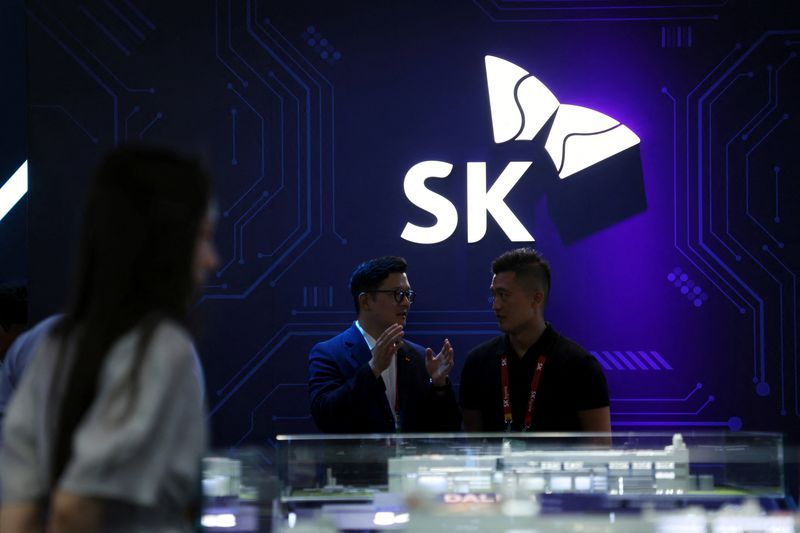
South Korea's SK Hynix announced plans on Wednesday to raise up to 45.45 trillion won ($29.43 billion) through the listing of American Depositary Receipts, marking an aggressive push to expand its global investor base while capitalising on soaring demand for memory chips used in artificial intelligence systems. The company will issue 17.79 million new shares to back the ADR offering scheduled for listing on the Nasdaq market on July 10, with the final amount subject to adjustment following the bookbuilding process.
The capital injection represents a strategic move by one of the world's largest chipmakers to secure funding for major expansion projects that underscore the industry's pivot toward AI-driven semiconductor demand. SK Hynix has identified several key deployment areas for the proceeds, including construction of a new fabrication plant in Yongin and an advanced packaging facility in Cheongju. Additionally, the company plans to acquire critical manufacturing equipment, notably Extreme Ultraviolet Scanners, which represent the cutting edge of semiconductor production technology and are essential for producing next-generation chips.
The offering structure involves a conversion ratio whereby ten ADRs will equal one common share, a mechanism designed to make the securities more accessible to international retail and institutional investors. The deal is being orchestrated by a heavyweight consortium of financial institutions including BofA Securities, Citigroup Global Markets, Goldman Sachs, and JP Morgan Securities, reflecting the transaction's scale and importance to global capital markets.
If completed at the upper end of the proposed price range, this would eclipse Alibaba's 2014 New York debut as the largest-ever ADR offering in history, surpassing the Chinese e-commerce giant's $21.8 billion raise. This milestone would underscore both the capital intensity of modern semiconductor manufacturing and the extraordinary investor appetite for companies positioned at the intersection of artificial intelligence and hardware innovation.
The timing of SK Hynix's listing capitalises on the company's emergence as one of the world's most successful beneficiaries of the artificial intelligence boom. The firm has consolidated its position as a critical supplier of high-bandwidth memory chips that power AI systems developed by technology giants including Nvidia and Alphabet's Google. These specialised memory components have become indispensable for training and operating large language models and other advanced AI applications, creating a structural supply-demand imbalance that has driven semiconductor prices upward.
SK Hynix's ascendancy is reflected in its recent achievement of becoming South Korea's most valuable company by market capitalisation on Monday, a symbolic milestone that displaced Samsung Electronics from the top position after decades of Samsung dominance. This shift represents a generational change in South Korea's corporate hierarchy, with semiconductor specialists focused on emerging technologies outpacing the more diversified electronics conglomerate. The valuation shift signals investor confidence in the durability and profitability of AI-related chip demand.
For Malaysian and broader Southeast Asian investors and policymakers, SK Hynix's capital expansion programme holds considerable significance. The region has developed into a major hub for semiconductor assembly, testing, and packaging operations, with Malaysia, Thailand, and Vietnam hosting substantial manufacturing capacity owned by various chipmakers. SK Hynix's decision to invest heavily in domestic South Korean production rather than expanding Southeast Asian facilities reflects the company's confidence in Korean industrial capabilities and labour productivity, though it may influence regional competitive dynamics as the company rationalises global operations.
The ADR listing structure itself provides important context for understanding how South Korean companies access international capital markets. Rather than pursuing a full secondary listing in New York—which would require navigating complex cross-border regulatory compliance—SK Hynix utilises the American Depositary Receipt mechanism, which allows foreign companies to offer securities in the United States while maintaining their primary listing on the Korea Exchange. This approach has long been favoured by Korean corporations seeking to deepen their investor base without incurring the substantial costs and complexities of a dual listing.
The semiconductor industry's capital requirements remain extraordinary, with modern fabrication plants requiring multi-billion dollar investments and continuous upgrades to remain competitive. SK Hynix's fundraising underscores the sector's structural need for substantial, recurring capital injections to maintain technological leadership. The Extreme Ultraviolet Scanner equipment mentioned in the company's filing represents the frontier of current semiconductor manufacturing technology, available only from a handful of suppliers and essential for producing chips at the smallest process nodes where AI memory components operate.
From a geopolitical perspective, SK Hynix's expansion reinforces South Korea's position as a critical node in global semiconductor supply chains during an era of heightened technological competition between the United States and China. American restrictions on exports of advanced chip-making equipment and designs to China have elevated the strategic importance of allies like South Korea. SK Hynix's investment in domestic capacity expansion, funded partly through American capital markets, represents a convergence of commercial and strategic interests between Seoul and Washington.
The company's success in securing substantial ADR funding also reflects confidence among international investors in South Korea's ability to maintain technological leadership in semiconductor manufacturing despite increasing competition from Samsung Electronics and emerging Chinese competitors. SK Hynix's specialisation in memory chips—rather than the logic chips that dominate Samsung's portfolio—has allowed the company to occupy a distinct market niche with limited direct competition, contributing to its valuation premium and investor appeal.