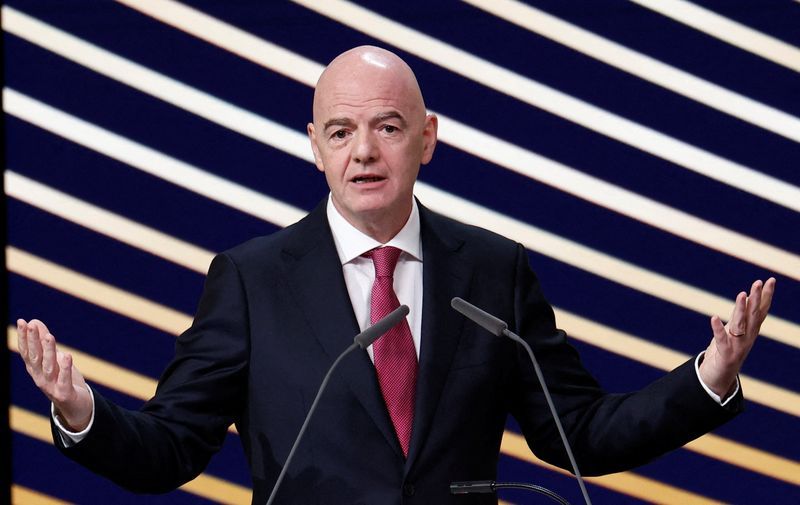
Gianni Infantino's grip on the FIFA presidency appears increasingly precarious following a dramatic loss of confidence from European soccer's governing bodies, yet his path to a fourth term may ultimately be paved not through appeasement of established football powers but through cultivating support among the world's smaller, developing nations that have grown accustomed to his financial generosity.
The crisis engulfing the Swiss administrator's decade-long tenure crystallized after his ill-fated proposal to involve private equity in World Cup financing triggered an unprecedented backlash from UEFA and CONCACAF. Wales formally withdrew its backing for Infantino this week, becoming the first national federation to publicly signal its abandonment of the FIFA chief. Simultaneously, UEFA indicated it is preparing legal action against him concerning the private investment scheme, signalling that Europe's soccer establishment is unified in its opposition.
Despite confirming his candidacy for a fourth term at next year's Congress scheduled for April, Infantino faces mounting pressure that may not allow him the luxury of waiting for a scheduled election. The rules governing FIFA permit any 20 percent of the organization's 211 member associations to formally petition for an Extraordinary Congress, which would then be convened within three months. Such a vote would provide an immediate vehicle for removing the incumbent before April's deadline. UEFA alone possesses sufficient numbers among its 55 members to trigger this mechanism if it votes unanimously, though orchestrating such a move remains complicated by internal dynamics and the broader question of whether a simple majority truly exists to unseat him.
The mathematical reality of FIFA's one-nation, one-vote system creates an unusual political landscape that defies conventional assumptions about power dynamics in international sports governance. While wealthier soccer nations with established professional leagues certainly wield considerable symbolic influence, their numerical advantage dissolves within a structure where Bhutan and Vanuatu hold identical voting power to France, Spain, or England. This democratic arithmetic may ultimately prove Infantino's salvation, as smaller nations have become the principal beneficiaries of his tenure's financial redistribution policies.
The scale of FIFA's largesse directed toward developing football nations has expanded significantly under Infantino's administration. During the current World Cup cycle spanning 2023 to 2026, FIFA increased development grants to individual member associations to a maximum of three million dollars annually, representing a substantial increase from the two million dollars available in the previous cycle. While such sums represent negligible amounts for wealthy federations operating alongside professional club systems generating billions in revenue, they constitute transformative resources for smaller nations where football development projects depend almost entirely on external funding.
Vanuatu exemplifies this dynamic perfectly. The Pacific island nation with a population of approximately 340,000 inhabitants secured a FIFA development grant of 4.15 million dollars that enabled construction of a 6,500-capacity stadium in Port Vila, completed in 2022. Beyond infrastructure, Infantino elevated Lambert Maltock, the Vanuatu Football Association president, to one of eight vice-presidential positions within FIFA's Executive Council, granting the tiny nation a seat at the organization's most exclusive decision-making table. For Brian Kaltak, Vanuatu's first professional footballer now playing for Perth Glory, Infantino's interventions have expanded the horizons of developing football nations in tangible ways.
This pattern of strategic financial investment and political inclusion extends across Africa, Asia, the Caribbean, and the Pacific regions where FIFA has financed training facilities, gymnasium infrastructure, and structured development programmes that national associations would otherwise find financially impossible to establish. The grants have effectively transformed football governance in numerous countries by providing sustainable funding for activities that rich nations take for granted but developing nations cannot afford independently. Consequently, a substantial voting bloc within FIFA's membership has accrued material benefits from Infantino's tenure that create powerful incentives to preserve his leadership.
Critics contend that this funding model has institutionalized a symbiotic relationship between FIFA leadership and smaller nations that fundamentally undermines efforts to hold administrations accountable. By concentrating financial resources in the hands of the sitting president and distributing them strategically among nations that lack alternative funding sources, the system creates what detractors characterize as a quid pro quo arrangement where political loyalty flows toward whoever controls FIFA's purse strings. This structural dynamic makes coalition-building to remove an incumbent president substantially more difficult than it appears on the surface.
The contrast between European opposition and developing-world support reveals deeper fractures within global football governance. European federations, which derive substantial revenue from their domestic club competitions and broadcasting rights, view FIFA's proposed private equity reforms as potentially threatening their financial interests and governance autonomy. Developing nations, by contrast, depend heavily on FIFA funding to sustain their football programmes at all. Any FIFA president perceived as willing to invest significantly in these regions and include their leaders in international governance structures commands loyalty that transcends ideological opposition to specific policies.
Though the Extraordinary Congress mechanism theoretically provides a pathway to remove Infantino before his scheduled re-election campaign, constructing a majority coalition faces formidable obstacles. The necessary coalition would require European nations to convince developing-world federations to vote against a president who has materially improved their financial circumstances. Success would demand either an alternate candidate offering substantially greater financial commitments or a unified message about governance violations so serious that even financially dependent nations feel compelled to vote their consciences rather than their economic interests.
Infantino's survival strategy thus depends far less on reconciliation with European soccer's establishment than on maintaining the allegiance of smaller nations through continued financial commitment and political inclusion. While UEFA and CONCACAF have declared their lack of confidence publicly, translating that position into a voting majority at FIFA remains uncertain. The coming months will reveal whether opposition to the private equity proposal and concerns about governance standards can overcome the gravitational pull of FIFA's financial patronage system.

