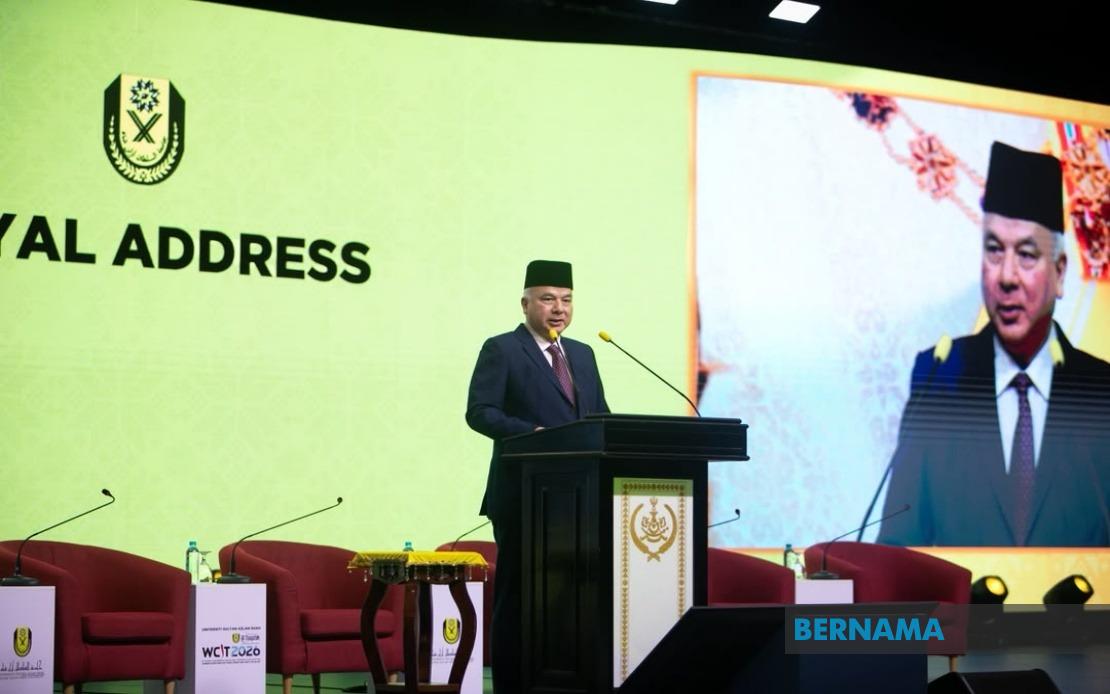
At the 8th World Conference on Islamic Thought and Civilisation in Ipoh, Perak Sultan Sultan Nazrin Shah made a compelling case that conventional security measures—while necessary—remain fundamentally insufficient without deeper social foundations. Speaking before Deputy Prime Minister Datuk Seri Fadillah Yusof, Menteri Besar Datuk Seri Saarani Mohamad, and Higher Education Minister Datuk Seri Dr Zambry Abd Kadir, His Royal Highness positioned social cohesion as the enduring architecture upon which genuine national security must rest.
The distinction Sultan Nazrin drew between external military readiness and internal social integrity carries particular weight in Malaysia's context. A nation capable of repelling external threats whilst harbouring corruption, injustice, and community alienation has not truly achieved security—it has merely deferred an inevitable reckoning. This observation reflects growing recognition across the Islamic world that sustainable stability cannot be built on fortress mentality alone. Rather, when citizens lack genuine investment in their nation's future, no apparatus of law enforcement or surveillance can compensate for that fundamental absence of belonging.
Central to His Royal Highness's message was a sharp warning about the weaponisation of religious identity for partisan purposes. Malaysia's experience with communal sensitivities makes this caution particularly apposite. The manipulation of faith to drive division rather than foster unity, to create exclusion rather than the inclusion this conference championed, represents a profound erosion of national integrity. This form of exploitation is especially insidious because it wraps itself in the language of principle whilst serving narrow factional interests.
Sultan Nazrin articulated a vision of national belonging that transcends ethnic and religious boundaries. True integrity demands that every citizen, irrespective of their heritage or creed, perceives themselves as having an equal and meaningful stake in their country's trajectory. Where that sense of belonging is fractured, where communities feel structurally marginalised or excluded from meaningful participation in governance, no security establishment can repair the damage. The resilience of a nation ultimately depends on whether its diverse populations can see themselves fairly represented in its institutions, laws, economic opportunities, and leadership structures.
The Sultan distinguished between two fundamentally different types of unity. Cohesion imposed through coercion is inherently fragile, prone to fracture when enforcement mechanisms weaken or shift. By contrast, unity built on authentic shared belonging—a sense that everyone has voice and stake—generates the kind of resilience that absorbs pressure and adapts to challenges. This latter form constitutes what His Royal Highness identified as the truest security a nation can achieve, precisely because it is self-sustaining rather than externally enforced.
Transitioning to human capital development, Sultan Nazrin argued that Malaysia's preparedness for emerging challenges—automation, climate disruption, and knowledge-driven economies—hinges on educational investment that extends far beyond expanding infrastructure. The country requires simultaneous strengthening of scientific and mathematical literacy whilst protecting space for humanities, arts, and moral reasoning. This integration matters because technological competence divorced from ethical grounding produces technically capable but spiritually adrift populations.
Particularly significant was His Royal Highness's elevation of vocational and technical education to parity with academic pathways. In many Southeast Asian contexts, including Malaysia, social hierarchies continue to privilege university degrees over skilled trades despite emerging labour market realities. Revaluing technical expertise as equally worthy of investment and societal respect would address both skills shortages and perceptions of educational inequality. A young person aspiring to mastery of a skilled trade deserves the same institutional encouragement and dignified recognition as one pursuing medical or engineering degrees.
The Sultan's observations on artificial intelligence and pedagogy reflect profound shifts in what constitutes useful knowledge. Traditional models emphasising rote memorisation and standardised testing were designed for an industrial economy where information scarcity and standardised problem-solving dominated. That economy is obsolescent. When information retrieval becomes instantaneous and nearly costless, educational value migrates toward capacities machines cannot readily replicate: critical analytical thinking, ethical reasoning grounded in principled frameworks, creative problem-solving, and adaptive capacity across domains.
Notably, Sultan Nazrin positioned Islamic education as naturally aligned with these emerging imperatives. Properly conceived Islamic learning has historically emphasised integration of revealed knowledge with rational inquiry, creating space for both faith-based wisdom and intellectual questioning. This synthesis, he suggested, equips learners precisely with the human capacities most essential in an AI-inflected world. This framing carries implications for how Southeast Asian Muslim-majority nations conceptualise educational modernisation—not as Western secular models supplanting Islamic content, but as recovering and revitalising Islam's own intellectual heritage that has always privileged reasoning alongside revelation.
For Malaysia specifically, Sultan Nazrin's address carries multi-layered relevance. The nation's founding compact envisioned pluralism managed through elite accommodation, yet contemporary pressures—demographic changes, religious revivalism, economic anxiety—stress that original framework. His emphasis on ensuring every community sees itself reflected in governance structures, economic systems, and cultural institutions directly addresses anxieties driving intercommunal tensions. Furthermore, his investment in education as a tool for cultivating human capacities suited to the coming technological era provides an alternate vision to purely economistic approaches that have dominated recent policy discourse.
The Sultan's vision ultimately reframes security discourse in Southeast Asia away from zero-sum competitions and threat-centric thinking toward positive-sum frameworks emphasising inclusion and belonging. This philosophical reorientation, combined with practical commitments to educational equity and transparent governance, offers a template for how Muslim-majority democracies might navigate the complex terrain between security imperatives and pluralistic values. Whether Malaysia's policymakers fully internalise these arguments—particularly regarding the equal dignity of all citizens and the dangers of religious politicisation—will substantially determine whether the nation achieves the resilient stability His Royal Highness described.

