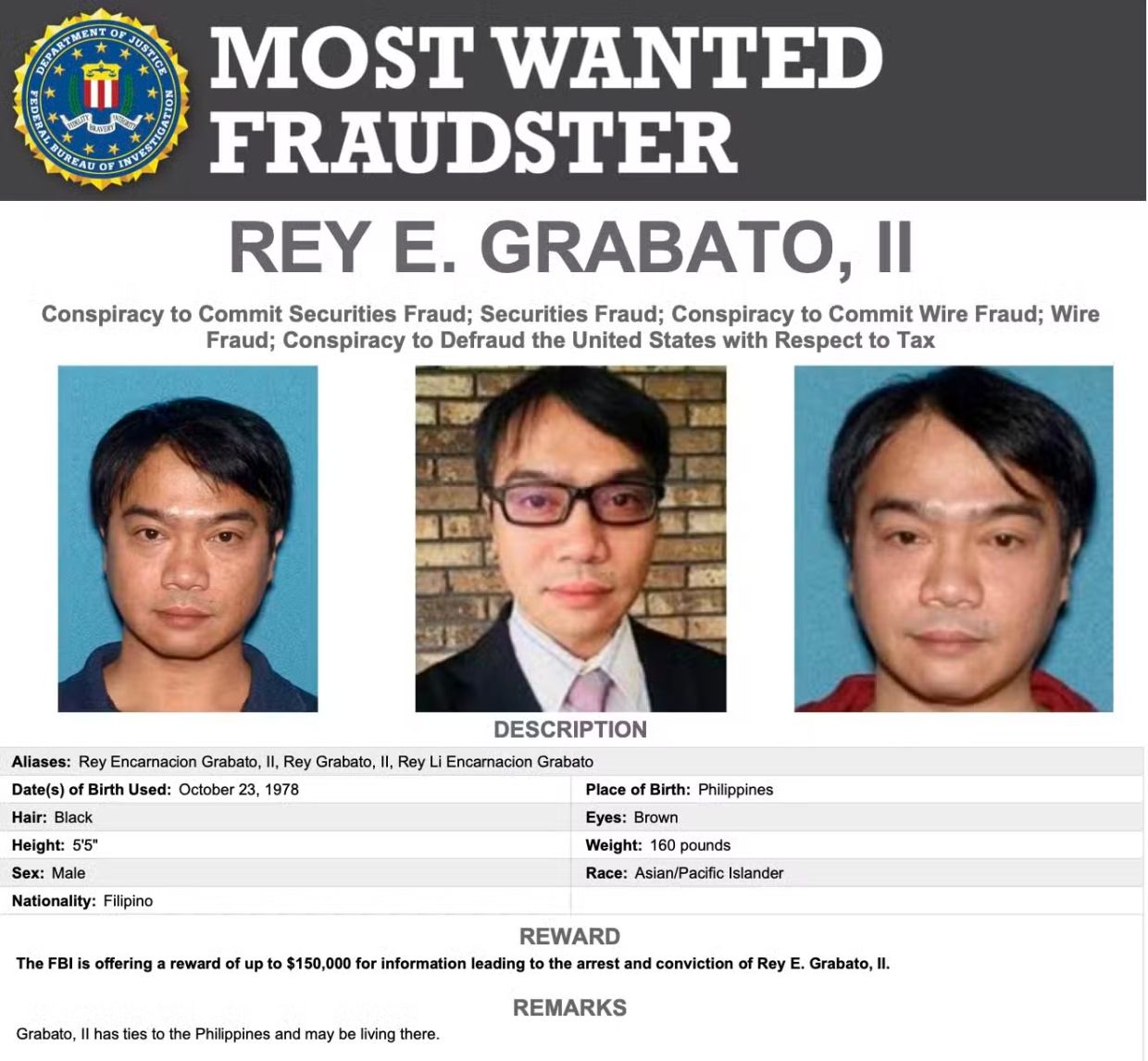
Rey E. Grabato II, the son of Mina Mayor Rey P. Grabato in Iloilo province, has been designated on the FBI's Most Wanted Fraudsters list following allegations that he orchestrated a massive investment fraud that victimised roughly 2,000 investors across the United States. The federal agency is offering a reward of up to US$150,000 for actionable information that results in his apprehension and conviction. Grabato's placement on this enforcement roster underscores the expanding reach of transnational financial crime and the difficulties authorities face in locating fugitives with international connections.
Grabato held the position of former president and majority owner of National Realty Investment Advisors LLC, a firm that purportedly specialised in real estate investment services. He is implicated in orchestrating a sprawling scheme that operated between February 2018 and January 2022, with substantial concentrations of victims located in New Jersey. His mother, Lydia Encarnacion Grabato, has previously held the mayoral office in the same municipality, placing the case within the context of a prominent political family now facing serious criminal allegations abroad.
Federal prosecutors characterise the operation as a US$650 million Ponzi scheme, a fraudulent investment model where returns to earlier participants depend entirely on contributions from subsequent investors rather than genuine business revenue. Grabato and his identified co-conspirator, Thomas Nicholas Salzano, constructed an elaborate deception by presenting false and misleading information to prospective investors regarding the NRIA Partners Portfolio Fund I LLC, a real estate investment vehicle. The marketing apparatus deployed by the enterprise was exceptionally comprehensive, utilising thousands of email communications alongside traditional media channels including television spots, radio advertisements, and billboard placements, complemented by in-person investor presentations designed to create the appearance of legitimacy and market authority.
The fraud operated by systematically misrepresenting the financial health and operational performance of the investment vehicle. Prospective investors received communications suggesting that NRIA maintained robust financial stability and consistently generated substantial returns. The reality, according to federal authorities, starkly contradicted these representations: the company produced negligible profits or operated at a loss, and instead recycled incoming capital from newer investors to finance promised distributions to earlier participants. This structural impossibility eventually necessitated the scheme's collapse, as the mathematical inevitability of a Ponzi structure means that redemptions must eventually exceed new capital inflows.
Beyond the core investment fraud, Grabato and his associates engaged in substantial misappropriation of funds entrusted by investors. Prosecutors allege that millions of dollars intended for the stated investment purposes were redirected for unauthorised uses, compounding the financial devastation experienced by the defrauded parties. The breadth of victimisation extended across state lines, with hundreds of affected investors concentrated in New Jersey, though others spread across the continental United States. For many victims, losses represented retirement savings, educational funds for children, or life-changing financial resources.
The conspiracy extended into a parallel scheme targeting the American tax system. Between November 2007 and August 2022, Grabato allegedly participated in activities designed to obstruct Internal Revenue Service collection efforts on approximately US$26 million in unpaid tax obligations owed to the federal government. This component of the case demonstrates a multifaceted approach to deception and financial malfeasance extending beyond victim fraud into direct evasion of state revenue obligations, suggesting a pattern of deliberate disregard for legal obligations across multiple jurisdictions.
A federal arrest warrant for Grabato was issued on October 12, 2022, following his formal charges in the United States District Court for the District of New Jersey located in Newark. At the time of charging, Grabato maintained residency connections to both Hoboken, New Jersey, and the Philippines, presenting complex jurisdictional considerations for apprehension and extradition. Despite the warrant's issuance, he evaded capture and remained at large, contrasting with his co-conspirator Salzano, who was arrested in October 2022. The fugitive status underscores challenges in locating individuals with international mobility and cross-border connections.
Grabato has operated under multiple aliases designed to complicate identification and tracking efforts. Law enforcement records document his use of the names Rey Encarnacion Grabato II, Rey Grabato II, and Rey Li Encarnacion Grabato, reflecting a deliberate strategy to obscure his identity and evade legal accountability. The utilisation of alternative names speaks to premeditation and sophistication in concealment methodology. His current whereabouts remain unknown to US authorities, though the FBI's expansive investigative apparatus continues pursuing leads through international channels.
The FBI established its Most Wanted Fraudsters list in June 2026 as part of a strategic institutional decision to elevate public awareness and enforcement priorities regarding significant fraud fugitives. This development represents an escalation in federal focus on organised financial crimes, particularly those affecting large populations of victims. Grabato's inclusion reflects his case's severity and the scale of financial harm perpetrated, distinguishing him among fraud investigations for prioritised enforcement attention.
Several individuals with Filipino heritage and connections populate the FBI's Most Wanted Fraudsters roster, illustrating the transnational dimensions of modern fraud schemes and their connections to Southeast Asia. Michael Lizaso Marasigan, a Filipino-American dual citizen with established ties to both Guam and the Philippines, appears on the list following his May 2025 conviction on charges encompassing illegal gambling operations, money laundering, and wire fraud. Additionally, the couple John Michael Dimitrion and Julieanne Baldueza Dimitrion remain fugitives after pleading guilty in 2009 to orchestrating a mortgage fraud scheme in Hawaii; they failed to appear for sentencing proceedings scheduled in July 2010.
For Malaysian and Southeast Asian observers, this case illuminates the risks associated with international investment solicitations and the vulnerability of diaspora populations in developed economies to sophisticated fraud schemes. The geographic dispersion of victims combined with the involvement of individuals with Philippine roots demonstrates how transnational family networks and international migration patterns create vulnerabilities to exploitation. The sophistication of the marketing apparatus utilised—combining digital and traditional media channels—represents tactics that could potentially be replicated against vulnerable populations across Asia-Pacific economies.
Federal authorities have appealed to the public for assistance in locating Grabato, requesting that individuals with credible information contact their nearest FBI field office or the United States embassy or consulate serving their respective region. For those within the Philippines or Southeast Asia, the American diplomatic mission provides the primary avenue for reporting information to federal investigators. The case underscores the extended commitment of American law enforcement to pursuing fugitives regardless of geographic distance or temporal distance from the commission of offences.

