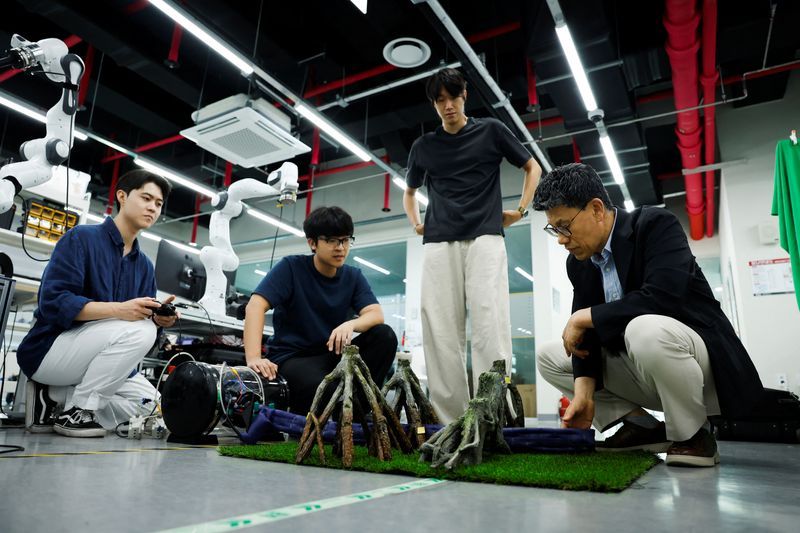
Scientists collaborating across South Korea and the United States have demonstrated a breakthrough in wearable robotics: garments equipped with pneumatic mechanisms that can independently dress a person without the need for manual intervention or external help. The innovation, jointly developed by KAIST in Daejeon and Stanford University, represents a significant departure from traditional clothing design and opens possibilities for deployment across sectors ranging from emergency response to semiconductor manufacturing.
The core innovation involves embedding flexible, vine-like structures throughout the fabric itself. These artificial vines respond to pressurised air by extending and contracting in coordinated movements, effectively rolling the garment up the body and conforming it closely to the wearer's shape. The mechanism operates similarly to climbing ivy spreading across a trellis, but in reverse—instead of the plant seeking surfaces to climb, the fabric seeks the body's contours and adheres to them. Remarkably, the entire process takes approximately ten seconds from initiation to complete coverage.
One of the technology's most practical advantages lies in its operational independence from the wearer's positioning or movement patterns. Unlike many robotic systems requiring stationary subjects or complex computational oversight, this invention functions effectively whether the user remains still or continues moving. This flexibility emerged from initial inspiration drawn from everyday situations. Kim Nam Gyun, the postdoctoral researcher at KAIST who led the research, recounted his motivation: caught in unexpected rain while cycling, he envisioned clothing that could equip itself automatically without requiring the rider to stop or use their hands.
The underlying mechanical principle that enables this adaptability comes from the robot's growth mechanism rather than full-body locomotion. Professor Ryu Jee-Hwan of KAIST's civil and environmental engineering department explains that the vine-like structures advance by extending at their tips, similar to how actual plants grow, rather than by repositioning their entire length. This approach allows the artificial vines to navigate the complex topography of a human body seamlessly, maintaining stable contact even as they traverse curved surfaces, shoulders, and limbs.
The robustness of the system extends to environmental variability as well. The researchers emphasise that their creation can function across diverse surface conditions—whether dealing with slippery, adhesive, or inclined areas. This versatility contrasts sharply with many robotics applications that perform optimally only within carefully controlled parameters. The vine robot's ability to adapt continuously to its surrounding environment as it moves makes it substantially more practical for real-world deployment scenarios.
Applications in the semiconductor industry represent a particularly compelling use case. Cleanroom environments in chip manufacturing require workers to don protective suits rapidly and precisely, often multiple times during shifts. The hands-free capability of this technology could streamline these processes while reducing contamination risks associated with manual dressing. Similarly, emergency services personnel could benefit significantly—firefighters, hazmat responders, and medical teams frequently need to equip themselves with protective gear quickly during critical situations where manual assistance may be unavailable or inefficient.
The technology also carries substantial implications for improving quality of life among elderly and disabled populations. Traditional clothing often presents significant challenges for individuals with reduced mobility or dexterity. An autonomous dressing system could restore independence and dignity to those who struggle with conventional garments, addressing both the practical mechanics of dressing and the psychological dimensions of self-sufficiency.
Professor Ryu highlighted an important broader context for this development. Amid widespread attention to artificial intelligence and software advancement, mechanical engineering innovations often receive less public recognition. Yet the self-dressing robot exemplifies how sophisticated mechanical design can operate independently of complex algorithms, serving as a vital complement to software-driven systems. This integration of mechanical ingenuity with modern technology demonstrates that engineering progress extends across multiple disciplines simultaneously.
The research underwent rigorous peer review before publication in IEEE Robotics and Automation Letters, a respected journal in the field. This validation through established scientific channels reinforces the credibility of the findings and methodology, positioning the work within the broader landscape of robotics research rather than as an isolated demonstration.
For Southeast Asian contexts, where rapidly ageing populations increasingly strain healthcare and social support systems, such innovations carry particular relevance. The region's demographic trajectory mirrors global trends toward older societies, creating urgent demand for technologies addressing care and independence. Additionally, as regional semiconductor manufacturing expands—with significant operations across Singapore, Malaysia, and Vietnam—innovations improving cleanroom efficiency directly impact industrial competitiveness.
The collaborative nature of this research also underscores the value of international scientific partnership. By combining KAIST's expertise with Stanford's resources and knowledge, the researchers accelerated development and broadened the innovation's potential applications. For nations throughout Asia-Pacific pursuing technological advancement, such cross-border collaboration models offer strategic pathways for capability building.
Looking forward, the researchers anticipate refinement and specialisation of their technology. While the current prototype addresses general clothing requirements, future iterations might target specific professional contexts—perhaps customised suits for particular industries or medical applications designed for patients with specific mobility limitations. As the technology matures and moves from laboratory demonstration to practical deployment, it could reshape multiple industries and substantially improve accessibility across populations currently underserved by conventional solutions.

