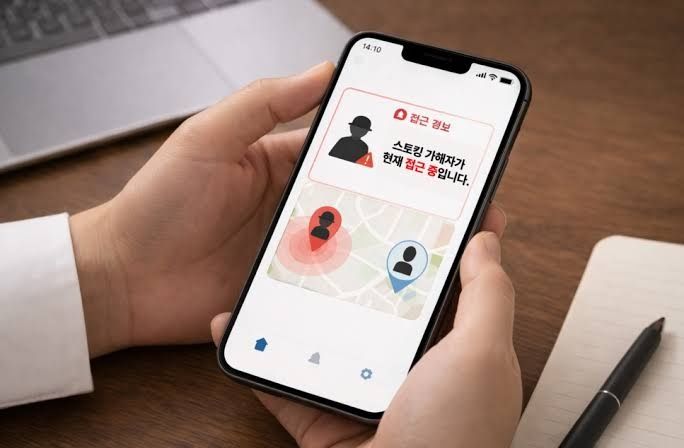
South Korea's Ministry of Justice unveiled a new mobile application on June 24 aimed at strengthening protections for stalking victims by granting them direct access to real-time location data of suspected perpetrators wearing electronic ankle monitors. The system represents a significant shift in how authorities approach the escalating domestic threat of organised stalking, moving beyond passive emergency alert devices to empower victims with active surveillance capabilities.
The application fundamentally changes the information asymmetry that has long disadvantaged victims in stalking cases. Rather than remaining uncertain about a suspect's whereabouts, victims can now monitor not only the current position of the monitored individual but also track their direction of movement through their mobile devices. This capability provides both practical safety benefits and, critically, a psychological reassurance that victims have been largely denied under previous systems. The platform is accessible through a straightforward mobile interface operated entirely by the Justice Ministry, ensuring centralised control and standardised data protocols across all cases.
The urgency driving this initiative stems from documented failures in existing protective mechanisms. According to Representative Lee Gwang-hee of the ruling Democratic Party of Korea, between 2021 and August 2025 alone, 23 stalking victims were killed or became targets of attempted murder despite having been issued emergency alert devices. This stark reality underscores how traditional approaches—reactive alert systems that depend on victims activating them during moments of crisis—have proven insufficient against determined perpetrators. The casualty figures have galvanised policymakers to fundamentally reconsider the architecture of victim protection.
Electronic monitoring of high-risk stalking suspects is itself a relatively recent addition to South Korea's criminal justice toolkit. Only since 2024 has the courts begun issuing orders for ankle monitor placement in certain stalking cases, supplementing the smartwatch-style emergency alert systems that had been provided to victims for years prior. The introduction of monitoring technology acknowledged a gap: without some form of continuous accountability mechanism, even court-ordered restraining orders remain difficult to enforce when perpetrators are determined to evade detection. The new app essentially bridges the gap between monitoring technology and victim agency.
The expansion of victim access to suspect location data inevitably raises privacy considerations, even when the individual in question is under court-ordered monitoring. Recognising this tension, South Korea's Justice Ministry took the precautionary step of revising the regulatory framework governing electronic monitoring protocols in December 2025. These revisions establish guardrails around data access, ensuring that location information is shared only with authorised victims in relevant cases and that the information architecture itself remains secure against misuse. The balance between victim safety and suspect privacy rights remains delicate, but regulators have determined that in cases involving proven stalking behaviour, victim access takes precedence.
The app deployment occurs within a broader regional context of escalating stalking prevalence across East Asia. South Korea, Japan, and Taiwan have all witnessed rising rates of intimate partner violence and obsessive stalking, often enabled by ubiquitous smartphone technology and social media platforms. What distinguishes South Korea's response is its willingness to deploy location monitoring as a standard protective tool rather than an exceptional measure. This approach implicitly acknowledges that stalking has become sufficiently prevalent and dangerous that conventional restraining orders and emergency alert systems no longer provide adequate deterrence or protection.
Looking forward, the South Korean government is planning additional structural reforms to further empower victims within the legal system. In April 2027, the Ministry of Justice intends to implement a mechanism allowing stalking victims to directly petition courts for restraining orders, rather than depending on law enforcement agencies to initiate such requests. This change removes a critical bottleneck in the protective process. Currently, victims must persuade police to file petitions on their behalf—a process that can introduce delays, bureaucratic friction, and potential misalignment between victim priorities and prosecutorial resources. Direct victim access to court petitions would accelerate protective orders and ensure that legal remedies are granted based on victim assessments of threat rather than law enforcement capacity constraints.
For Malaysian readers, South Korea's evolution in this domain offers both cautionary lessons and potential policy insights. Stalking and harassment through technology are increasingly common in Malaysia, yet the country's legal framework and protective infrastructure remain fragmented. While the Personal Data Protection Act governs data handling, and the Penal Code contains provisions against criminal intimidation, there is no unified victim-centred system comparable to what South Korea is constructing. The combination of electronic monitoring, real-time location access for victims, and direct court petition mechanisms represents an integrated approach that several Southeast Asian jurisdictions could adapt to their own contexts.
The technological architecture underlying South Korea's new app also merits attention. The platform operates through a centralised Justice Ministry system rather than a decentralised or private-sector model, which ensures consistency, prevents data fragmentation, and maintains government accountability for information security. Such an approach differs from some Western models that rely on private apps or third-party platforms, introducing variables around data retention, vendor stability, and cross-jurisdictional compatibility. For regional policymakers considering similar systems, the centralised model offers advantages in governance and control, though it requires robust cybersecurity investment and clear legislative oversight.
The psychological dimension of victim empowerment through location tracking should not be underestimated. Stalking victims typically experience profound loss of autonomy and persistent fear; knowing a perpetrator's location in real time can substantially reduce hypervigilance and allow victims to make safer decisions about their movements. Research on intimate partner violence suggests that victim agency and access to information significantly improve both safety outcomes and psychological recovery trajectories. By shifting from a model where victims passively wait for alerts to one where they actively monitor threats, South Korea is fundamentally changing the power dynamics within the stalking relationship.
Implementation challenges will likely emerge as the system scales. Questions about user interface accessibility for elderly or technology-averse victims, the reliability of ankle monitor GPS data in urban environments with dense building structures, and the legal definitions of appropriate usage all require careful management. Additionally, perpetrators may seek to circumvent monitoring through technical means, necessitating continuous security updates and regulatory adaptation. The planned 2027 expansion of direct court petition access introduces its own operational considerations, including ensuring that courts can process victim petitions efficiently without creating new bottlenecks.
Ultimately, South Korea's initiatives reflect a hardening consensus that stalking represents a serious criminal threat warranting technological and institutional responses traditionally reserved for the most severe offences. The combination of real-time victim location access and forthcoming direct court petition mechanisms suggests a jurisdiction moving toward a victim-centric model of criminal justice in this domain. Whether these measures achieve their stated protective goals will depend on consistent implementation, adequate funding, and ongoing refinement as perpetrators adapt their tactics. For the region, the South Korean experiment provides a valuable case study in how democracies can leverage technology and institutional reform to address a persistent form of violence.

