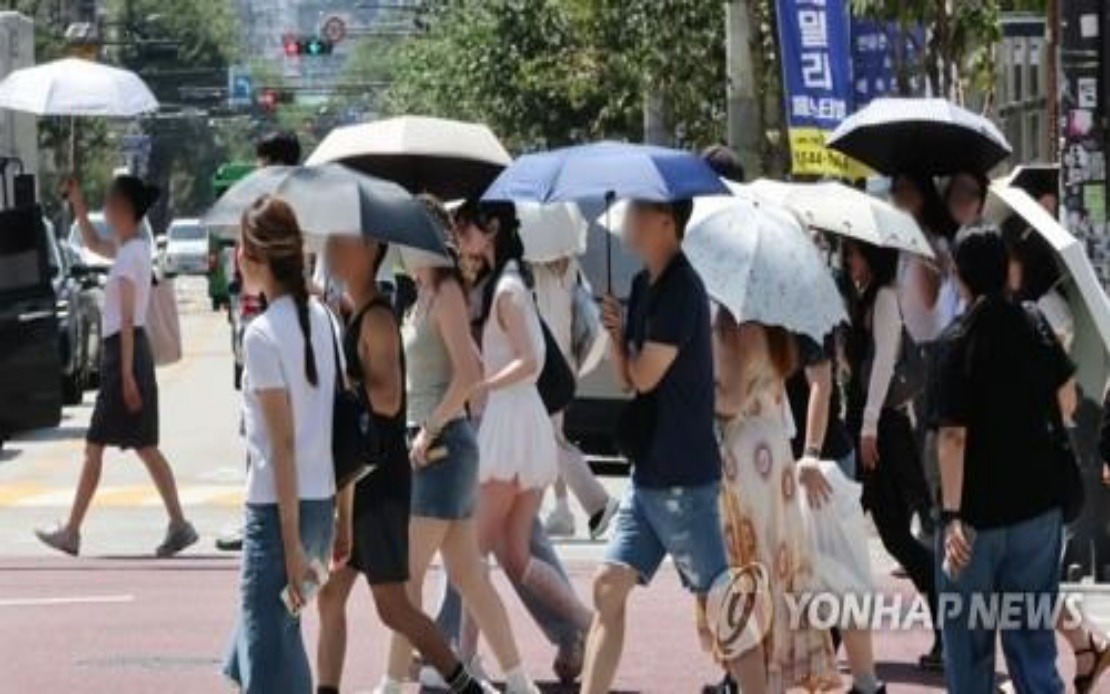
South Korea faces an intensifying heat crisis as three major population centres simultaneously recorded temperatures exceeding the alarming 40-degree Celsius mark, according to data released Friday by the Korea Meteorological Administration. The unprecedented readings underscore the severity of a heat wave that has gripped the country for weeks, with implications that extend beyond South Korea's borders to neighbouring Southeast Asian nations increasingly vulnerable to extreme temperature patterns.
Seoul's Nowon ward registered 40.2 degrees Celsius at 3:28 pm, representing the capital's highest temperature since August 1, 2018, when the thermometer had climbed to 41.8 degrees. The six-year interval between such extreme readings highlights both the rarity and the mounting frequency of dangerous heat events in East Asia. This resurgence of record-breaking temperatures comes at a time when climate scientists have warned of accelerating warming patterns across the Asian continent, driven by changing atmospheric conditions and oceanic temperature variations.
Beyond Seoul, the heat wave manifested with equal ferocity in surrounding regions. Hanam's Deokpung district, positioned southeast of the capital, reached 40.7 degrees Celsius at 2:32 pm, while Gwangyang, situated approximately 300 kilometres south of Seoul, recorded 40.2 degrees at 2:37 pm. These simultaneous breaches of the 40-degree threshold across geographically dispersed locations suggest a broad-based atmospheric phenomenon rather than localized weather variance. Notably, other areas including Yeongweol in Gangwon Province and Yeoju in Gyeonggi Province hovered near the critical threshold at 39.8 degrees, indicating that the extreme conditions enveloped vast swathes of populated territory.
The Korea Meteorological Administration's measurements reveal the cumulative toll of prolonged exposure to dangerous heat. Between June 1 and Thursday of the reporting week, the country averaged 14.8 days of what meteorologists classify as heat wave conditions, defined as daytime temperatures reaching 33 degrees Celsius or above. This figure ranks as the fourth-highest for the corresponding period since nationwide weather observation networks expanded in 1973, indicating that while not unprecedented in isolation, the current episode occupies the upper echelon of recorded extremes. What particularly distinguishes this event, however, is the phenomenon of tropical nights—periods when minimum temperatures fail to drop below 25 degrees Celsius—which reached a record 13 days during the measurement period. This metric carries serious public health implications, as it prevents human bodies from experiencing adequate thermal recovery during darkness hours.
The extended duration and intensity of tropical nights fundamentally differs from historical patterns and poses acute risks to vulnerable populations including the elderly, infirm, and those lacking adequate air conditioning. The inability of ambient temperatures to decline meaningfully overnight compounds physiological stress, elevating risks of heat-related illness and mortality. For Malaysia and other Southeast Asian nations where tropical conditions already feature elevated nighttime temperatures, South Korea's experience serves as a cautionary indicator of how climate change may exacerbate existing challenges in managing public health during warm seasons.
Authentic relief appeared marginal as the Korea Meteorological Administration projected only modest improvement through the weekend. Saturday's forecast predicted morning lows ranging from 21 to 26 degrees Celsius nationally, with daytime highs between 26 and 35 degrees. While these figures represent a departure from the extreme peaks witnessed Friday, they nonetheless remain substantially elevated relative to seasonal norms and would continue to present hazardous conditions for outdoor activities and prolonged exposure. The persistent nature of the warmth suggested that underlying atmospheric patterns would persist despite tactical improvements.
In response to the anticipated moderation, authorities modified their official warning framework. The Korea Meteorological Administration downgraded serious heat wave warnings affecting Seoul and eastern and southwestern regions to ordinary warnings beginning at 6 pm Friday. These warnings had been elevated to their highest tier since Tuesday, reflecting the extraordinary nature of the preceding conditions. The administrative decision hinged on KMA guidelines stipulating that serious heat wave warnings trigger when apparent temperatures reach 38 degrees Celsius or higher, or when daily maximums exceed 39 degrees, in areas where the highest perceived temperature already exceeds 35 degrees for two or more consecutive days.
The methodology underpinning these warnings emphasizes apparent temperature—a measure combining actual temperature with humidity and wind conditions to reflect how heat genuinely affects human physiology. This distinction matters substantially, as high humidity characteristic of Korean summers can make actual temperatures feel considerably more intense than raw readings suggest. When Seoul's Nowon ward measured 40.2 degrees, the apparent temperature experienced by residents likely exceeded that figure, intensifying the physiological strain.
The Korean heat crisis carries regional ramifications extending into Southeast Asia. The meteorological systems generating extreme heat across East Asia originate from broader climatic shifts affecting the entire Asian continent. Malaysia and other nations in the region have documented their own temperature escalations, and studying South Korea's response mechanisms offers valuable lessons. The administrative frameworks, warning systems, and public health protocols that Seoul has implemented provide models for adaptation, particularly regarding management of vulnerable populations and coordination of emergency response during extreme weather events.
Looking forward, the pattern raises questions about seasonal expectations and infrastructure adequacy. South Korea's grid systems, urban planning, and occupational safety regulations were established under historical temperature norms that are increasingly becoming obsolete. As extreme heat events escalate in frequency and intensity, investment in heat-resilient infrastructure becomes economically and socially imperative. For Southeast Asian policymakers, the Korean experience underscores that incremental adaptation proves insufficient when climatic baselines shift fundamentally. Comprehensive restructuring of energy systems, building codes, and workplace regulations appears essential to managing a future of routinely extreme temperatures.
The heat wave's resolution remained uncertain beyond the weekend projection window. While meteorological agencies provided confident forecasts for the immediate period ahead, the underlying drivers of the heat—ocean temperatures, atmospheric pressure patterns, and jet stream positioning—showed no definitive signs of complete dissipation. Scientists warn that heat waves increasingly persist for extended periods, with brief respites followed by resumption of intense conditions. South Korea's situation therefore exemplifies not merely a weather event but an emerging climatic reality to which Asian societies must adapt structurally and systematically.

