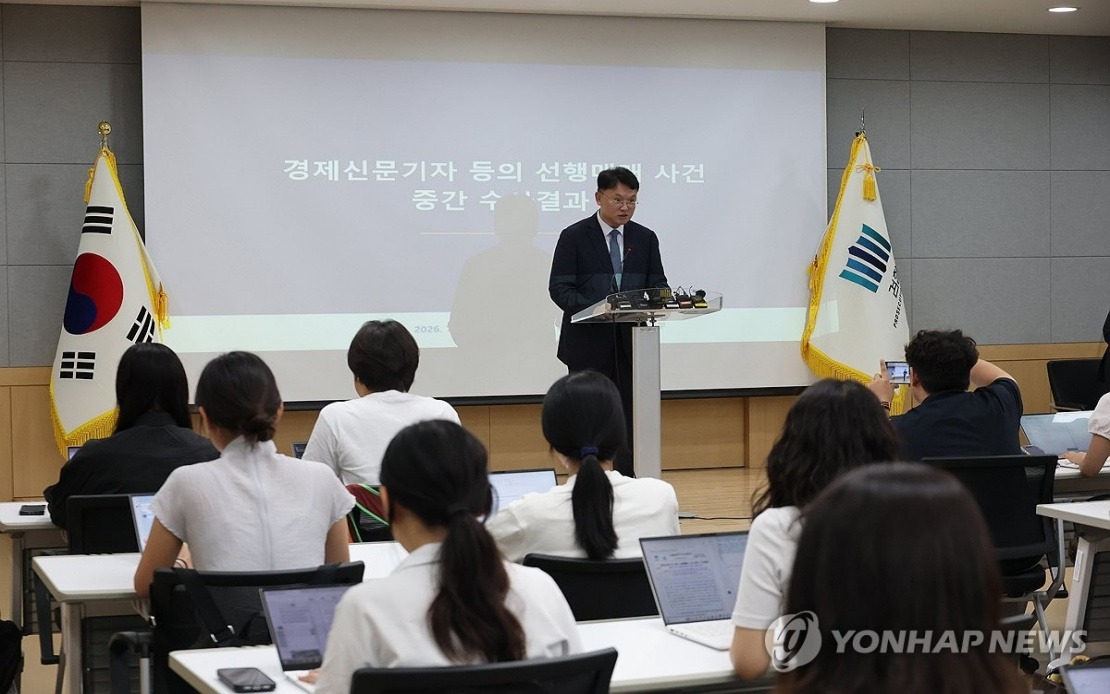
South Korea's prosecution authorities have moved forward with charges against eight individuals implicated in an elaborate scheme to manipulate equity prices and extract illicit gains exceeding 9 billion won, according to an announcement made Wednesday. The operation represents a significant breach of market integrity and journalistic ethics, combining financial crime with abuse of media influence to artificially inflate share valuations and generate substantial personal profits at the expense of ordinary investors.
The mechanics of the alleged conspiracy reveal a calculated approach to market manipulation. The accused parties would identify stocks trading at low volumes or exhibiting high volatility, then orchestrate the publication of positive news coverage specifically designed to drive up prices. Once valuations rose in response to this manufactured positive sentiment, the conspirators would sell their holdings at inflated prices, realizing substantial profits. This pattern exploits a fundamental weakness in market infrastructure—the capacity of strategically timed media narratives to move investor behaviour independent of underlying corporate fundamentals.
Investigations by prosecutors centred on a core group comprising five journalists, an accountant, and an investor who collectively generated approximately 8.55 billion won in unlawful proceeds. Between October 2020 and June of the following year, this network produced roughly 1,800 articles engineered to influence market sentiment. The journalists operated on a compensation structure offering 300,000 won per article published, creating a direct financial incentive to participate in the scheme and ensuring continued cooperation through tangible rewards proportionate to their output.
The distribution of proceeds among the journalist participants reveals varying degrees of involvement and benefit. Three of the reporters accumulated individual profits of approximately 150 million won, 160 million won, and 28 million won respectively, suggesting differences in participation duration, article frequency, or seniority within the arrangement. These sums substantially exceeded legitimate journalism compensation, underscoring the powerful financial motivation driving participation in what constitutes systematic fraud against the investing public.
Separately, authorities identified a sixth journalist operating under different parameters, who allegedly abused positional authority to generate nearly 740 million won through a more extended campaign spanning from October 2022 to July 2024. This individual authored approximately 340 articles advancing the manipulation scheme, indicating sustained engagement over an extended period and suggesting either greater appetite for illicit gain or a more integrated position within editorial decision-making processes that facilitated the arrangement.
The prosecution's characterization of these activities as disruptions to stock market integrity reflects growing concern across Asia about the intersection of media influence and financial crime. In markets increasingly dependent on sentiment and information flow, the capacity of coordinated actors to weaponize journalistic platforms represents a systemic vulnerability. Southeast Asian equity markets, including Malaysia's Bursa Malaysia, face analogous risks as retail investor participation expands and social media amplifies the market impact of news narratives.
For Malaysian investors and regulators, this case illuminates vulnerabilities in market oversight that transcend national boundaries. While South Korean authorities pursued prosecution, the incident highlights how media outlets and financial journalists serve as critical infrastructure in market systems. Compromised editorial judgment or deliberate manipulation by newsrooms introduces noise into price discovery mechanisms and undermines investor confidence in fundamental information equality. Malaysian regulators and media organizations should examine whether similar vulnerabilities exist domestically.
The prosecution has committed to aggressive recovery efforts, promising to identify and confiscate all criminal proceeds derived from the scheme. This commitment signals intent to ensure that participants cannot retain the fruits of their misconduct, though tracing and recovery of such gains typically presents substantial practical challenges given the time elapsed since transactions and the potential movement of assets across jurisdictions or into difficult-to-trace instruments.
The incident also carries implications for South Korea's broader regulatory environment governing financial journalism. Business journalists occupy a privileged position, enjoying early access to information and the capacity to reach broad audiences with market-moving narratives. This case demonstrates how that privilege, absent adequate ethical frameworks and oversight mechanisms, can be converted into personal enrichment schemes that victimize other market participants. Enhanced disclosure requirements for financial journalists regarding personal securities holdings and stricter conflict-of-interest protocols have become increasingly common internationally in response to similar incidents.
For regional equity markets and regulators in Southeast Asia, including Malaysia's Securities Commission and Bursa Malaysia, this serves as a cautionary example warranting proactive review of existing safeguards. The case also raises questions about media outlet governance structures and editorial oversight mechanisms designed to prevent the instrumentalization of news platforms for financial gain. Strengthening relationships between financial regulators and media organizations through formal cooperation frameworks could enhance capacity to detect and prevent similar schemes.
The prosecution's willingness to pursue criminal charges against media professionals, despite the sensitivity surrounding press freedom, indicates that South Korean authorities view market integrity as coequal with media independence in the hierarchy of public values. This balancing act remains complex and contested across democracies, yet the explicit coordination between journalists and financial actors to manipulate prices arguably crosses a threshold from protected editorial discretion into criminal conspiracy.
Looking forward, the case underscores why continuous vigilance regarding conflicts of interest, transparency mechanisms, and cooperative oversight between media and financial regulators remains essential across all developed and developing markets.

