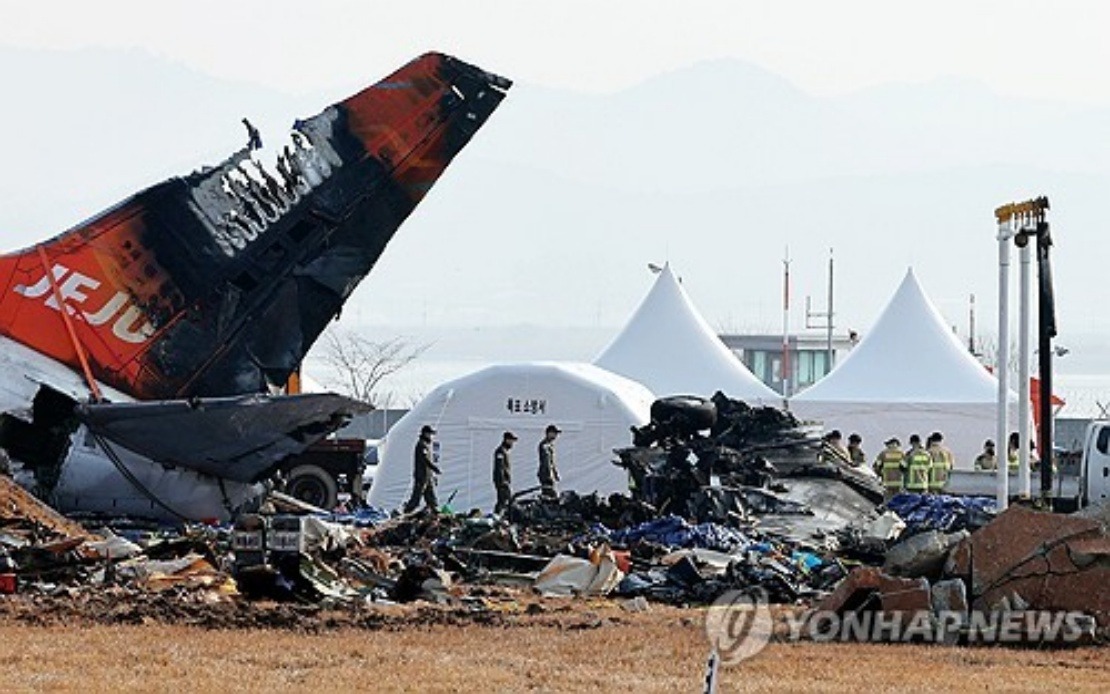
A major accountability inquiry into South Korea's deadliest aviation disaster has taken a significant turn with prosecutors receiving referrals against seven transport ministry officials accused of obscuring critical safety information. The South Korean police special investigation team submitted the charges on Tuesday, alleging that the officials drafted misleading public statements about a navigation device's regulatory compliance despite possessing knowledge of its deficiencies. This development underscores the mounting pressure on government agencies to explain their role in what critics describe as an institutional failure preceding the catastrophic incident.
The Jeju Air tragedy unfolded on December 29, 2024, when a Boeing 737-800 aircraft executing an emergency belly landing at Muan International Airport, located approximately 290 kilometres south of Seoul, collided with a concrete structure housing a localiser—a precision navigation system essential for guiding aircraft during approach and landing procedures. The impact proved catastrophic, claiming the lives of 179 passengers and crew members in what became South Korea's worst aviation accident in decades. The sheer scale of fatalities immediately prompted questions about whether preventable design or maintenance factors had amplified the tragedy's severity.
The localiser's placement within a reinforced concrete mound has emerged as a focal point in the ongoing investigation, with aviation safety experts and officials scrutinising whether this configuration represented a hazard that compounded injuries during the impact. Rather than treating the device's location as an unfortunate circumstance, investigators have directed their attention toward examining whether responsible authorities recognised potential risks but failed to disclose them transparently to the public or to aviation operators. The referral of the seven officials suggests that investigators believe the narrative disseminated to the public diverged substantially from internal assessments of the system's actual operational status.
According to police findings, the officials in question drafted and released statements asserting that the localiser had been installed in compliance with all applicable regulatory standards and safety protocols. However, the investigation uncovered evidence indicating that these same officials possessed information contradicting such assurances—specifically that the installation did not fully meet the requirements mandated by aviation safety regulations. This alleged discrepancy between public messaging and private knowledge constitutes the core of the cover-up allegations, representing a breach of the transparency expected from government agencies responsible for transportation safety infrastructure.
The investigation's focus on information management and public communication reflects a broader pattern evident in major industrial accidents across East Asia, where questions about institutional accountability often centre on how government bodies frame incidents to the public. In South Korea's highly competitive aviation market and tightly regulated transport sector, the perception of governmental integrity in safety matters carries significant weight for both domestic operators and international carriers. A finding that officials deliberately misrepresented safety compliance would undermine public confidence not merely in the specific agency but in the regulatory framework itself.
The seven officials' referral to prosecution introduces a distinct dimension to the investigation beyond the immediate technical causes of the crash. While aviation accident inquiries typically focus on mechanical failures, human error, and procedural breakdowns directly preceding an incident, this prosecution track addresses actions taken after the disaster occurred. The alleged fabrication of compliance statements represents a separate violation that compounds the original tragedy by suggesting institutional obstruction of truth-seeking efforts. Such conduct, if substantiated, would carry profound implications for how government agencies are held accountable in Korea's regulatory and political landscape.
For Malaysia and Southeast Asia more broadly, the Jeju Air case offers instructive lessons regarding aviation safety governance and inter-agency coordination. Regional carriers and airport operators managing aircraft movement across the ASEAN region operate under frameworks influenced by international standards and, increasingly, by peer accountability mechanisms. The revelation that a major transport ministry might have issued misleading public statements about navigation system compliance raises important questions about inspection regimes, certification processes, and the institutional culture surrounding safety disclosure throughout Asia's aviation sector. Many Southeast Asian nations maintain similar infrastructure installed decades ago, prompting inevitable comparisons with Korean systems.
The investigation also illuminates tensions between operational efficiency and safety absolutism that pervade aviation management across the region. Airport authorities managing high-volume traffic at constrained facilities often balance competing demands for throughput, cost containment, and risk mitigation. The localiser's location within the concrete mound presumably offered some operational advantage or reflected historical construction constraints. Whether officials appreciated that this placement represented an unacceptable hazard, or whether they consciously downplayed known risks, remains central to determining culpability and institutional responsibility. The prosecution process will test South Korea's commitment to holding senior officials accountable for safety governance failures.
The timeline between the crash on December 29, 2024, and the referral of charges approximately eight months later demonstrates the intensive investigative effort required to reconstruct governmental decision-making and communications. Prosecutors will need to examine emails, meeting records, policy memoranda, and regulatory assessments to establish what officials knew and when they possessed such knowledge. This forensic approach to institutional accountability represents a commitment to transparency that, if sustained through prosecution and potential conviction, would set notable precedent for how Asian governments address official misconduct intersecting with public safety catastrophes.
The referral of seven officials does not necessarily imply that all seven will face identical charges or bear equal responsibility. Prosecutorial discretion will determine which individuals face trial and on what specific allegations, whether ranging from deliberate deception to negligent disregard for accurate representation. The outcome of these proceedings will significantly influence how South Korean transport authorities calibrate their public communication strategies regarding infrastructure safety going forward. For the families of the 179 victims and for the broader aviation community throughout Asia, the prosecution phase represents an opportunity to extract systemic insights that prevent recurrence of similar institutional failures.
Looking ahead, the investigation's expansion to encompass official conduct beyond technical causation establishes an important precedent regarding comprehensive accountability in aviation disasters. Rather than confining inquiries to engineering and operational factors, South Korea is examining the human institutions responsible for certifying safety and communicating risks to stakeholders. This holistic approach suggests a maturing commitment to transparency in how governments discharge safety responsibilities. For Malaysia, which has experienced aviation tragedies of its own and maintains ambitious expansion of aviation infrastructure, the Korean example warrants careful attention regarding how regulatory bodies should institutionalise honesty in safety disclosures.

