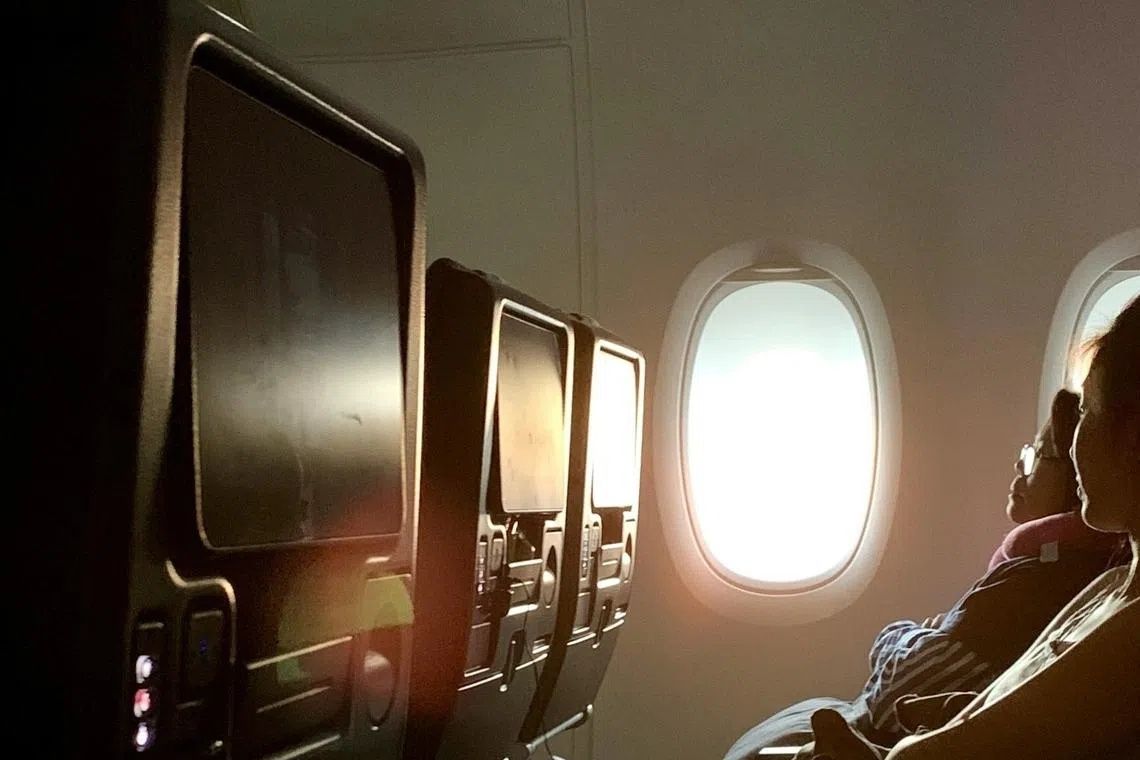
A young South Korean petitioner has formally complained to the government about involuntary exposure to violent and inappropriate material during a flight, bringing renewed scrutiny to how airlines manage in-flight entertainment for passengers under 18. The middle schooler filed the complaint through Petition 24, a government feedback platform operated by the Ministry of the Interior and Safety, describing their distress at being unable to avoid watching scenes in a movie deemed unsuitable for their age group. The case highlights an ongoing tension between commercial airline practices and child protection laws in one of Asia's busiest aviation markets.
According to the petition submission, the adolescent experienced repeated exposure to both violent and sexually explicit sequences while flying, compounded by the presence of their younger sister—then a fourth-grade primary school student—in an adjacent seat. The petitioner emphasised that despite their effort to refrain from viewing the objectionable material, the screening equipment's prominent placement and unavoidable proximity made it practically impossible to shield themselves from what was displayed. This situation underscores the physical constraints of modern aircraft cabins, where individual seatback monitors offer limited privacy and content visibility to neighbouring passengers, particularly those of significantly different ages.
The petitioner has specifically advocated for mandatory implementation of privacy screens on all seat-mounted displays, positioning this as a straightforward technical solution to a persistent problem. They argue that such protective measures would enable passengers to control their own viewing experience while simultaneously preventing involuntary exposure for others, particularly children and teenagers seated nearby. This proposal reflects growing awareness among consumers that passive exposure to age-inappropriate content represents a distinct form of harm, separate from active content selection.
The complaint invokes two pieces of South Korean legislation that directly address this issue. Both the Child Welfare Act and the Youth Protection Act contain explicit provisions designed to shield minors from harmful content across various media platforms and public spaces. The petitioner contends that current in-flight entertainment practices may conflict with the spirit and intent of these laws, which place responsibility on authorities and institutions to create environments where children are not routinely exposed to material classified as unsuitable for their developmental stage. This legal framing adds weight to what might otherwise be dismissed as a parental concern, positioning it instead as a potential regulatory compliance issue.
South Korea's two dominant carriers—Korean Air and Asiana Airlines—have already adopted some protective measures that distinguish them from many international competitors. Neither airline permits programming rated for audiences aged 19 and above to be broadcast to general cabin populations, demonstrating a recognition that adult content has no place in shared passenger spaces. Additionally, both carriers typically utilise edited versions of theatrical releases, with studios providing specially prepared cuts that eliminate or obscure the most graphic scenes of violence, sexual content, and profanity. These practices represent a middle ground between complete content restriction and unrestricted access.
Nonetheless, this approach has proven insufficient in certain cases. Most notably, in 2020, both airlines controversially removed the internationally acclaimed film Parasite from their in-flight playlists despite its 15+ rating in South Korea. The decision came in response to public concern about violent and sexual content within the narrative, even after standard editorial modifications had been applied. The removal of such a critically celebrated and culturally significant work illustrates the tension between artistic merit and protective standards, as well as the difficulty of establishing consistent guidelines that address parental concerns without becoming overly restrictive.
The Parasite precedent raises complex questions about how much editing constitutes adequate protection, and at what point content restrictions become paternalistic or culturally limiting. A film rated for fifteen-year-olds in South Korea presumably contains material deemed acceptable for that demographic by the classification board, yet the airlines' decision to suppress it entirely suggests that the proximity of younger siblings and the passive viewing environment of aircraft cabins may warrant different standards than those applied in home settings or cinemas where parental oversight is more direct.
This petition arrives at a moment of broader global reassessment regarding child protection in commercial settings. Airlines internationally face inconsistent pressures from different regulatory environments and passenger expectations. What constitutes appropriate content standards varies significantly across jurisdictions, and carriers operating across multiple regions must navigate competing demands. Southeast Asian airlines operating under similar pressures in Malaysia, Singapore, and Thailand may find this South Korean case instructive as they evaluate their own in-flight entertainment policies.
For Malaysian and regional aviation stakeholders, the petition highlights an emerging consumer expectation that airlines take active responsibility for protecting children from unintended exposure to inappropriate content. The proposed privacy screen solution is technologically feasible and potentially cost-effective, making it a practical option worthy of consideration across the industry. Such measures could differentiate carriers in an increasingly competitive market while demonstrating genuine commitment to family-friendly travel experiences, a selling point that resonates with regional family-oriented travel patterns.
The case also illuminates how modern regulatory frameworks, designed before mass in-flight entertainment systems became standard, may require updating to address contemporary realities. South Korean authorities now face pressure to clarify whether existing child protection legislation imposes specific obligations on airlines regarding shared-screen environments, potentially setting precedent for other countries grappling with identical issues. The outcome of this petition could influence how airline regulators across Asia approach content governance in the years ahead.

