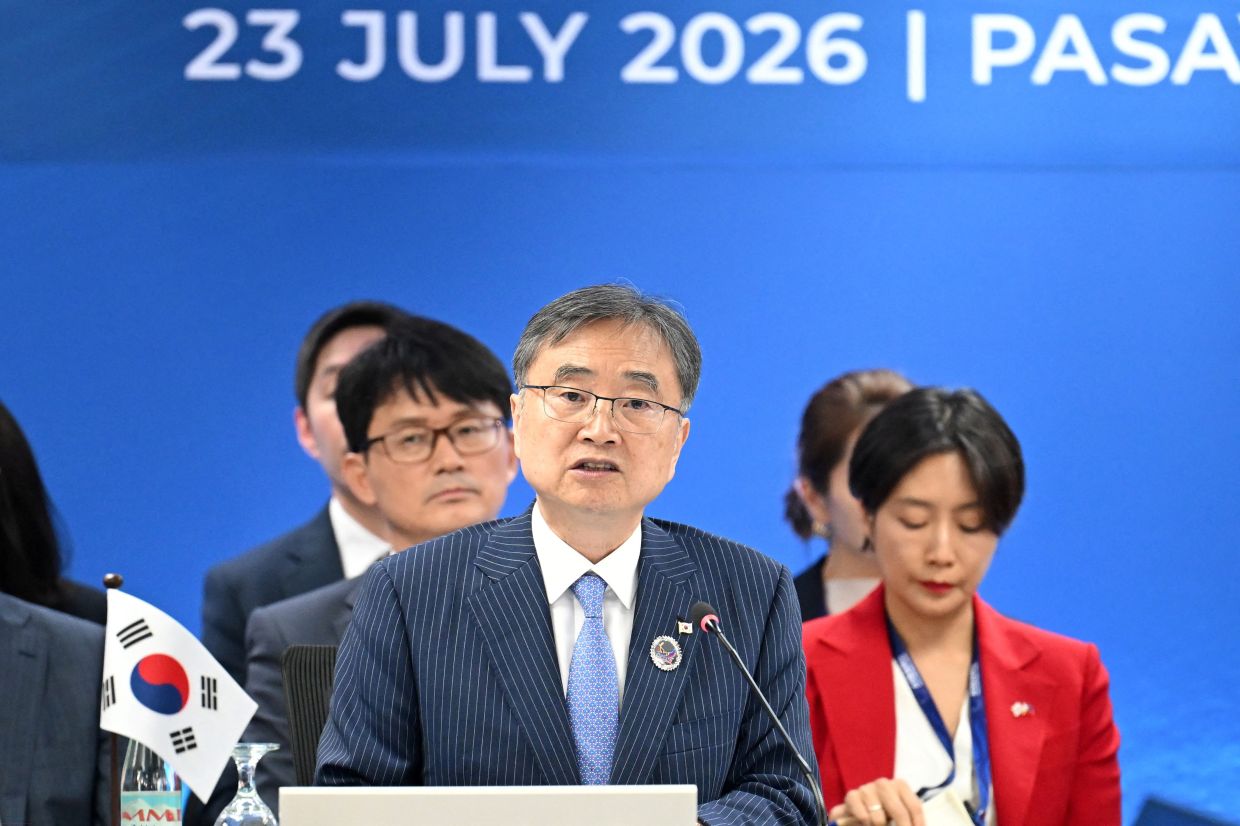
South Korea's government is struggling to present a unified front on North Korea policy, with senior ministers openly contradicting each other this week in a public display of internal discord that observers warn could undermine President Lee Jae Myung's efforts to revive diplomatic contact with Pyongyang. The rift between Foreign Minister Cho Hyun and Unification Minister Chung Dong-young became apparent when Cho characterised Chung's policy proposals as lacking rigour and ministerial consensus, immediately after Chung had outlined an ambitious engagement agenda to the president.
The policy disagreement centred on Chung's proposal to launch four-party talks involving South Korea, North Korea, the United States, and China as a centrepiece of Seoul's diplomatic outreach for the second half of the year. When questioned by reporters, Cho dismissed these ideas as overly abstract and insufficiently vetted across government agencies. Chung retaliated with philosophical counterpunching, telling local media that idealism was precisely what was required to achieve meaningful political change. Neither minister backed down publicly, though both subsequently agreed to coordinate future statements and declined to elaborate further on their positions.
The underlying tension reflects a broader strategic pivot within the Lee administration that has drawn criticism from multiple quarters. Rather than maintaining the "denuclearisation-first" approach that characterised previous conservative governments, Seoul has reoriented its policy around a "peace-first" framework that prioritises dialogue over conditionality. Simultaneously, the administration has appealed to United States President Donald Trump to facilitate a direct summit meeting between American and North Korean leadership as a potential pathway to restart negotiations that have been frozen for years.
This diplomatic realignment represents a departure from the harder line adopted by Lee's immediate predecessor, shifting the balance toward accommodation and away from the pressure-based strategy that had dominated conservative South Korean policymaking. However, the public disagreement between Cho and Chung suggests that this pivot has not been embraced uniformly across the bureaucracy. The Foreign Ministry's scepticism toward Chung's four-party talks proposal appears rooted in concerns about feasibility and the depth of consensus among other government institutions, raising questions about whether Seoul can maintain coordinated messaging even as it attempts to persuade Pyongyang to engage.
Expert analysts caution that such public disagreements carry significant diplomatic costs. According to Lim Eul-chul, a professor at Kyungnam University studying Korean peninsula dynamics, the exposure of internal divisions sends a troubling signal to North Korean decision-makers. Pyongyang, he argued, is likely to interpret such bureaucratic infighting as evidence that any agreements reached with Seoul could be reversed or undermined by shifts in South Korean domestic politics. This perception would substantially weaken Seoul's negotiating position and provide cover for Pyongyang to dismiss conciliatory overtures as temporary gestures lacking durable institutional support.
The timing of the dispute is particularly inopportune given the deteriorating trajectory of inter-Korean relations over the past several years. Since the end of the Covid-19 pandemic, the relationship has entered a sharply negative phase marked by North Korea's formal renunciation of reunification aspirations in 2024 and systematic dismantling of joint economic projects that had symbolised inter-Korean cooperation. Border controls have been tightened dramatically, leading to a collapse in defections from the North. In the first half of 2026, only 63 North Koreans successfully crossed into South Korea, a figure that stands in stark contrast to the 1,047 who made the journey in 2019, illustrating how thoroughly the diplomatic relationship has frozen.
In response to this bleak environment, Seoul has undertaken a series of confidence-building measures intended to demonstrate good faith. These include discontinuing anti-North Korea loudspeaker broadcasts from the demilitarised zone and eliminating other policies that the administration argues could be interpreted as hostile gestures. However, Pyongyang has shown minimal reciprocal engagement, treating many of Seoul's overtures with indifference or outright dismissal. The strategic calculus from the North appears to be that South Korea's domestic political divisions and eagerness for engagement can be exploited without meaningful concessions.
The shift toward engagement has also generated controversy within South Korea's civil society, particularly among human rights advocates who worry that diplomatic pragmatism is eclipsing principled concerns about conditions in the North. Seoul co-sponsored a United Nations resolution on North Korean human rights in the previous year, yet under Lee's administration, such advocacy appears to have been deprioritised as part of a broader effort to avoid provoking Pyongyang. Kim Tae-Hoon, the former president of PSCORE, a human rights organisation focused on North Korea, reported to international media that the shift in Seoul's emphasis has had tangible consequences for civil society organisations, including a significant decline in donor funding and institutional support for rights-based advocacy.
The ministerial clash also reveals deeper uncertainties about how Seoul intends to balance competing objectives: reviving dialogue with Pyongyang while maintaining alliance commitments to Washington, pursuing humanitarian concerns while prioritising diplomatic progress, and sustaining domestic political support for engagement policies across ideological divides. The public nature of the Cho-Chung disagreement suggests that these tensions remain unresolved within the presidential administration, with different ministries advancing divergent strategic visions without clear presidential arbitration.
Looking forward, the divergence between the Foreign and Unification ministries could complicate Seoul's diplomatic flexibility precisely at a moment when the North Korean challenge requires coherent, well-coordinated policy responses. If Pyongyang perceives that Seoul's government is internally divided on fundamental questions of engagement strategy, the North is unlikely to reciprocate diplomatic overtures or enter substantive negotiations. The public airing of disagreement thus carries the risk of becoming a self-fulfilling prophecy, where bureaucratic discord in Seoul becomes the justification for continued intransigence in Pyongyang. Regional observers will be watching closely to see whether Lee's administration can resolve these differences and present a more unified diplomatic front, or whether institutional friction will continue to undermine engagement efforts.

