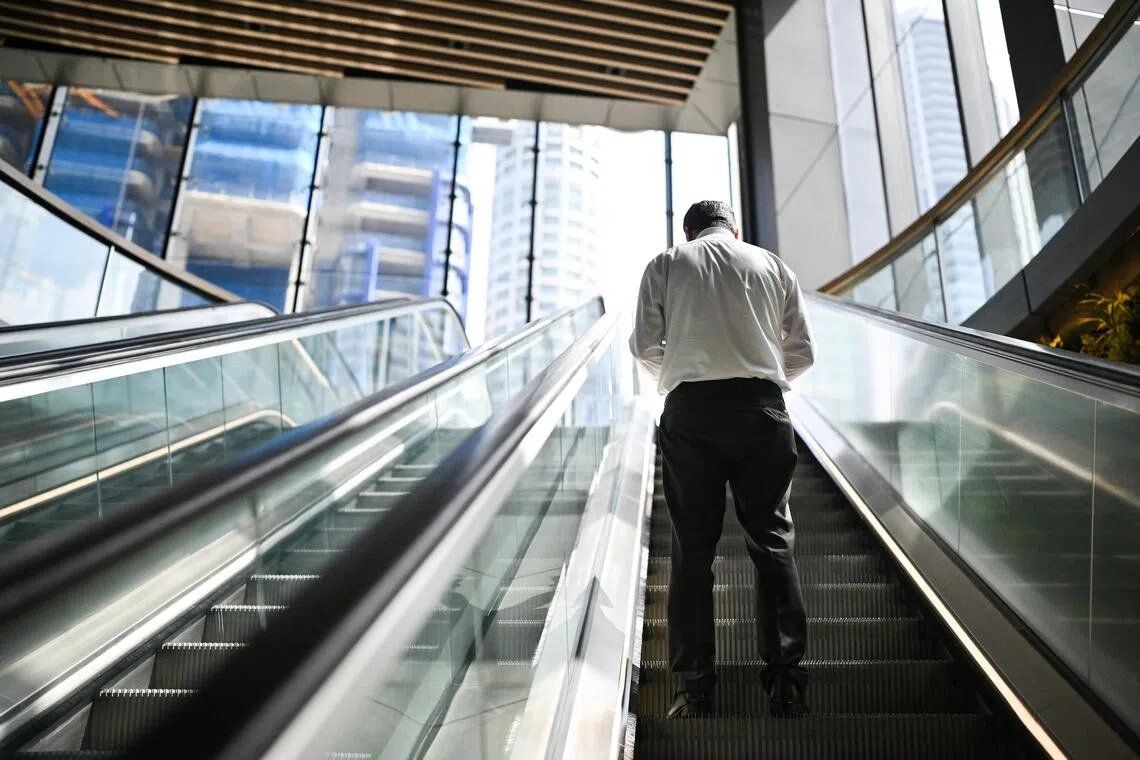
South Koreans face an unexpectedly polarising question that has divided the commuting public into two almost equal camps: should people stand on one side of an escalator to allow others to walk, or should everyone remain stationary across both lines? A government survey of 1,000 adults drawn from seven major urban centres revealed this contentious split, with exactly half favouring the single-side standing approach while the other half argued for two-line stillness. The issue has proven so contentious that it prompted the government to convene a dedicated forum in Seoul last month, where roughly 200 citizens and experts spent hours deliberating the merits and drawbacks of each approach.
The escalator debate touches on fundamental tensions between individual and collective efficiency. Those advocating for one-side standing contend that people in a hurry benefit from the ability to climb the moving steps, saving precious seconds during peak commute times. However, this individualistic advantage masks a broader mathematical reality: when considering total passenger throughput, the two-line approach may actually serve larger numbers of people. Research commissioned to test this hypothesis yielded striking results. An experiment conducted at a crowded British transport hub demonstrated that passenger capacity increased between 25 and 30 per cent when both sides of the escalator remained occupied compared to when one side was left open. A smaller scale test at Guri Station near Seoul produced comparable findings, with 190 passengers using the escalator during a period when both sides were in use, against only 164 when the conventional one-side-standing arrangement was enforced. Yet researchers cautioned against drawing sweeping conclusions from such limited trials.
The safety dimension presents another compelling argument against the walking practice. Sensor-based testing of escalator steps revealed that downward walking generates impact forces equivalent to approximately 2.01 times a person's body weight, while upward walking produces about 1.54 times their weight. Heo Yun-seop, a professor at Korea Lift College, explained that these repeated impacts combined with uneven loading from one-sided standing may accelerate wear on mechanical components and inflate maintenance costs. Although direct evidence linking one-sided standing to escalator breakdowns remains incomplete, the potential for equipment degradation adds weight to the safety case. Furthermore, accident data spanning from 1993 to 2025 indicates that 72.3 per cent of recorded escalator incidents involved user behaviour, with elderly citizens aged 60 and above representing 53.3 per cent of all casualties. This demographic vulnerability has prompted safety experts to question practices that increase the risks for vulnerable groups.
South Korea's shifting relationship with escalator etiquette reveals how confusion emerges when government policy lacks consistency. The authorities initially championed one-side standing beginning in 1998, and the practice gained nationwide momentum around the 2002 World Cup as a courtesy mechanism during the international event. However, as accident reports accumulated and maintenance concerns mounted, officials reversed direction, promoting two-line standing between 2009 and 2014. This back-and-forth approach reflected genuine tensions between competing policy goals, and by 2015 the government essentially retreated from prescriptive guidance altogether. Instead, authorities settled on three basic recommendations: maintain grip on handrails, refrain from walking or running, and respect designated safety lines. This permissive stance may have inadvertently reinforced the very split the government now seeks to resolve, as commuters developed their own preferred practices without official direction.
Jang Gye-ryeon, a public administration researcher at the Korea Institute of Industrial Relations, articulated the core analytical challenge facing policymakers. Rather than treating the question as a binary choice between one line and two lines, Gye-ryeon argued that officials must recognise the contextual nature of efficiency. The relevant question becomes not simply which configuration is superior in absolute terms, but whose efficiency matters in particular circumstances, and at which times and locations. An escalator in a crowded subway station during morning rush hour operates under different constraints than one in an uncrowded shopping mall on a Sunday afternoon. Applying identical rules across such varied settings ignores the dynamic realities of modern transit networks. This insight suggested that a one-size-fits-all policy would likely disappoint multiple stakeholder groups simultaneously.
The August 29 government forum provided a revealing window into how public deliberation influences opinion formation. Before the discussion commenced, survey respondents showed a notable preference for the two-line approach, with 45.9 per cent supporting stationary standing compared to just 13.4 per cent favouring the one-side-open arrangement. However, after several hours of structured debate featuring expert testimony and citizen perspectives, opinion shifted markedly. Support for one-side standing more than doubled to 29.9 per cent, while backing for two-line standing declined to 31.4 per cent. Most strikingly, the largest single group emerged favouring context-dependent rules that would vary according to location and crowd density, attracting 38.1 per cent of participants. This outcome suggested that exposure to competing arguments and evidence moved the public toward more nuanced, situationally aware thinking rather than toward consensus on a uniform standard.
The implications of South Korea's escalator debate extend beyond the narrow technical question of how people should stand. The controversy reflects broader tensions in modern urban societies between individual convenience and collective welfare, between safety and efficiency, and between top-down regulation and voluntary compliance. For Malaysian and Southeast Asian readers, the escalator question resonates particularly in rapidly urbanising societies where mass transit systems are expanding and commuter etiquette remains inconsistently codified. Many cities across the region lack clear guidelines or public education campaigns addressing escalator conduct, leaving commuters to develop informal norms that may inadvertently compromise safety or capacity. South Korea's extended deliberation suggests that simply imposing rules without public buy-in produces shallow compliance, and that citizens respond better to transparent discussion of competing values and trade-offs.
Interior Minister Yun Ho-jung signalled that South Korea's government intends to synthesise insights from the forum into future escalator safety initiatives. The minister acknowledged that citizen input gleaned from the deliberative process would inform policymaking, suggesting a shift toward more participatory governance on public infrastructure questions. This approach contrasts with earlier periods when officials mandated escalator behaviour with limited public consultation. Should the government proceed toward location-specific or circumstance-dependent guidelines, implementation would require careful coordination among operators of different transit systems, clear public communication about varying standards, and sustained monitoring to assess whether context-dependent rules actually improve safety and capacity outcomes.
For countries throughout Southeast Asia grappling with escalating urban populations and expanding metro systems, South Korea's experience offers valuable lessons. The debate demonstrates that apparent technical questions often conceal genuine trade-offs between competing values, and that securing public acceptance for new rules requires transparency about both benefits and limitations. Moreover, the finding that elderly citizens face disproportionate accident risk should prompt regional policymakers to prioritise safety designs and guidelines tailored to demographic vulnerabilities. As Malaysian cities including Kuala Lumpur continue enhancing public transport infrastructure, deliberative forums modelled on South Korea's approach might illuminate local preferences regarding escalator conduct, pedestrian flow, and safety priorities before rules are implemented.

