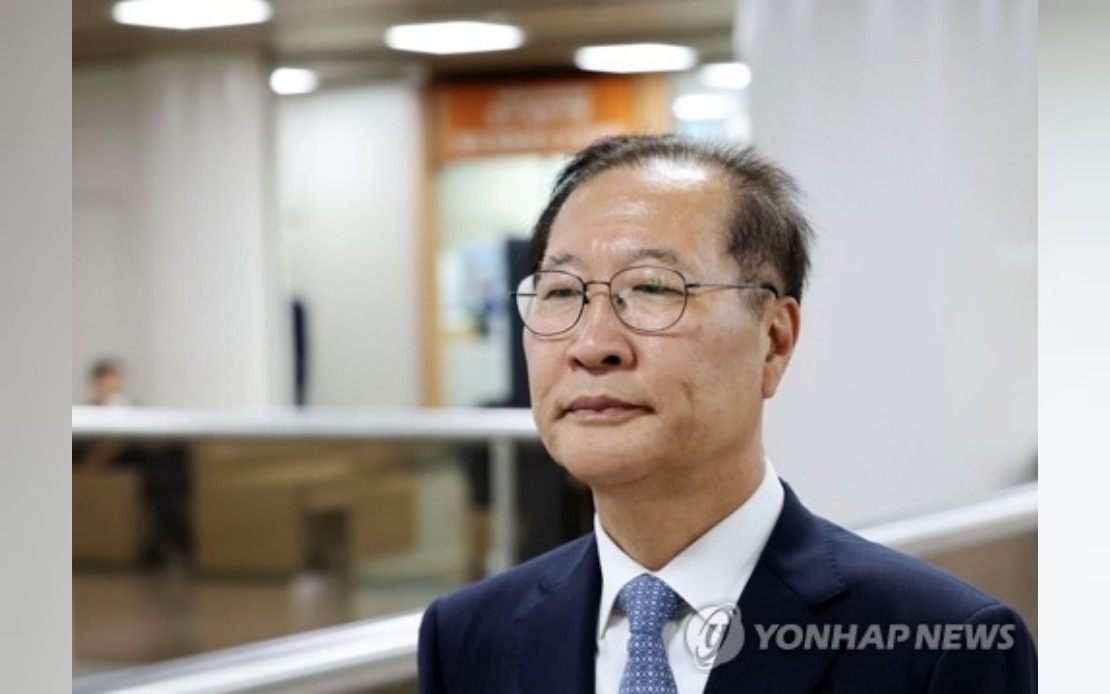
South Korea's judicial system has delivered a significant verdict in the ongoing fallout from President Yoon Suk Yeol's failed martial law declaration, with the Seoul Central District Court sentencing former Justice Minister Park Sung-jae to 25 years imprisonment on Monday. The punishment, which exceeded the 20-year term initially sought by special counsel Cho Eun-suk's investigative team, reflects the court's assessment of Park's culpability in what prosecutors characterised as an attempt to destabilise the constitutional order. The immediate remand of Park into custody underscored judicial concerns about potential evidence tampering, a routine precaution in high-profile political cases that signals the seriousness with which authorities are treating the matter.
The charges against Park centred on his alleged orchestration of a high-level ministry meeting in the immediate aftermath of Yoon's martial law declaration on December 3, 2024. Rather than opposing the unconstitutional move, Park allegedly used his ministerial authority to facilitate logistical preparations that would have enabled the regime's consolidation of power. The court found that Park convened senior officials specifically to assess whether correctional facilities possessed sufficient capacity to detain politicians and prominent figures expected to face arrest under martial law conditions. Beyond this infrastructure review, Park allegedly issued directives to personnel responsible for implementing travel restrictions, effectively mobilising the entire justice apparatus in support of the attempted power grab.
The judicial findings paint a portrait of institutional betrayal. The court emphasised that Park, entrusted with defending constitutional principles as Justice Minister, abandoned this fundamental responsibility when he calculated that the insurrection possessed a reasonable prospect of success. Rather than mounting legal or administrative resistance, Park opted for complicity. This reasoning carries particular weight in South Korean jurisprudence, where officials occupy positions of constitutional guardianship and their defection from democratic norms represents a qualitatively different transgression than popular participation in political upheaval.
Park's conviction aligns him with an expanding cohort of senior government figures implicated in the martial law crisis. Former Prime Minister Han Duck-soo and Defence Minister Kim Yong-hyun have already received convictions on similar charges, establishing a pattern of high-level institutional support for Yoon's attempted constitutional break. This coordinated participation among multiple Cabinet members distinguishes the December incident from isolated acts of individual political adventurism, instead revealing a systematic effort to mobilise state power for an unconstitutional objective.
The trajectory of Yoon himself underscores the severity with which South Korean courts are treating the episode. In February, the former president received a life sentence for orchestrating the martial law declaration, a verdict he is currently appealing. Yet even as Yoon challenges his conviction, the convictions of his subordinates proceed and in some cases exceed prosecutors' initial recommendations. This pattern suggests that the judiciary views institutional complicity as particularly culpable, treating the actions of officials who had the authority and responsibility to resist as more egregious than the nominal leadership role itself.
Notably, the court acquitted Park on separate anti-corruption charges that had been bundled into the indictment. These charges stemmed from allegations that Park had issued inappropriate orders to subordinates in response to a personal request from Yoon's wife, Kim Keon Hee, who sought assistance in accessing details of a prosecution investigation into her own suspected corruption. The court determined that these particular offences fell outside the special counsel's investigative jurisdiction, a technical ruling that nonetheless demonstrates judicial attention to the boundaries of prosecutorial authority even within a context of recognising serious constitutional violations.
For Malaysian and Southeast Asian observers, the Park case illustrates the institutional mechanisms through which democracies respond to executive overreach. Unlike systems where judicial independence remains compromised or where the military and security apparatus operate with minimal civilian oversight, South Korea has demonstrated the capacity to indict, prosecute, and convict senior government officials for attempting to subvert constitutional order. The involvement of a special counsel's team and independent district courts—rather than ad hoc tribunals or military commissions—reflects institutional resilience that many regional neighbours lack.
The case also demonstrates the particular vulnerability of justice and security sector officials during periods of constitutional crisis. Because these officials control the operational machinery through which unconstitutional measures are implemented, their cooperation becomes essential for any attempted coup or emergency power grab. By imposing severe penalties on such officials, South Korean courts are effectively raising the institutional cost of participation in future constitutional violations, potentially encouraging future officeholders to prioritise their legal and professional standing over promises of political reward from an attempted revolutionary movement.
Park's legal team has announced immediate plans to appeal the conviction, arguing that the judgment lacks factual foundation and legal merit. The special counsel's office, by contrast, indicated no intention to seek appellate review, appearing satisfied with both the guilty verdict and the sentence's severity. This prosecutorial confidence in the lower court's reasoning—combined with the absence of pressure for even harsher penalties—suggests a prosecutorial assessment that the verdict adequately addresses the gravity of the offence and its implications for democratic governance.
The broader implications extend beyond personal consequences for individual officials. Each conviction in the martial law affair reaffirms the supremacy of constitutional constraints over executive prerogative, a principle that faces periodic testing across the region. South Korea's willingness to convict high-ranking government officials in civilian courts, without resort to extraordinary measures or retroactive legislation, demonstrates an approach to managing constitutional crises through existing institutional channels rather than revolutionary restructuring.
As these cases proceed through appeal stages and additional trials address remaining defendants, South Korea's handling of the martial law crisis will likely influence how other democracies in the region conceptualise the prosecution of political crimes. The precedent of substantial prison sentences for senior officials who facilitate rather than directly engineer unconstitutional moves suggests that institutional complicity carries consequences comparable to direct leadership responsibility, a doctrine with potential significance for governance standards throughout East and Southeast Asia.