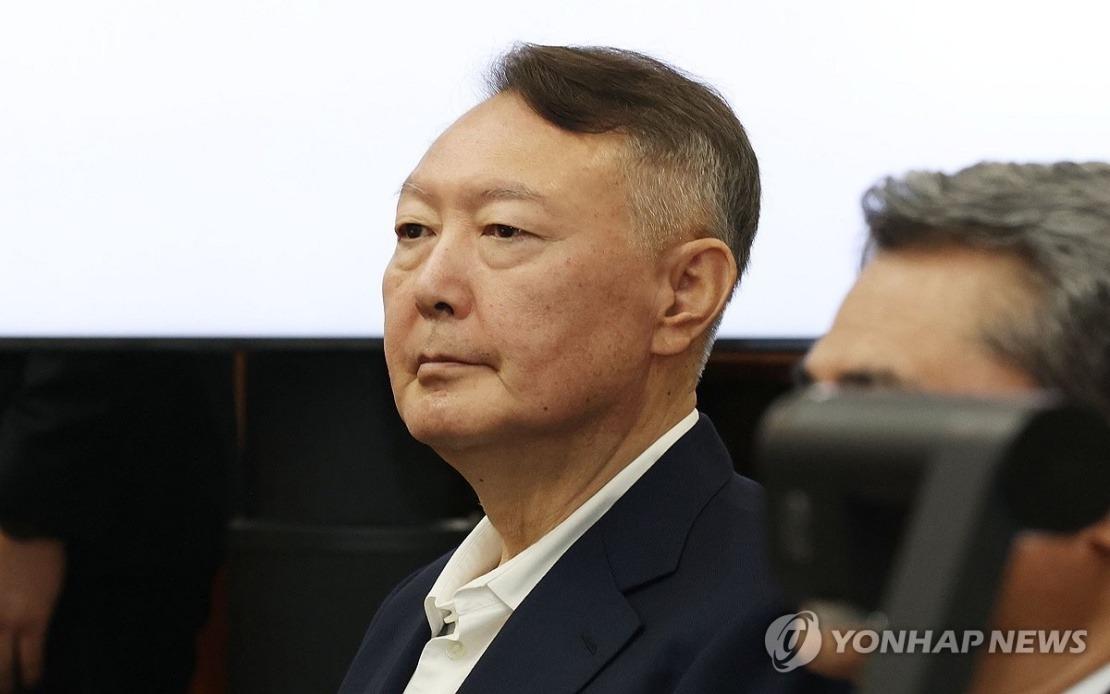
Former South Korean President Yoon Suk Yeol has been convicted and sentenced to two years in prison by the Seoul Central District Court for accepting illegal political funds disguised as complimentary opinion polls. The July 13 ruling represents another serious legal blow to the embattled leader, who faces multiple prosecutions following his failed martial law declaration in 2024. The court's decision to convict Yoon stands in sharp contrast to the acquittal of his wife, former first lady Kim Keon Hee, who faced identical charges in a parallel trial, revealing deep inconsistencies within South Korea's judicial system regarding the treatment of the former presidential couple.
The charges stemmed from Special Counsel Min Joong-ki's investigation into allegations that Yoon colluded with his wife to receive 58 opinion polls valued at approximately 270 million won, equivalent to roughly USD 180,100, without compensation from power broker Myung Tae-kyun. The indictment covered a critical period spanning April 2021 through March 2022, when Yoon was preparing for his presidential campaign. Prosecutors argued this arrangement constituted an illegal political transaction under South Korea's Political Funds Act, as the polls were furnished at no cost while Yoon was in a position to offer political favours in return.
The Seoul Central District Court ultimately recognised that Yoon had indeed received 14 complimentary opinion polls from Myung during the disputed timeframe, though this fell short of the full 58 polls cited in the original indictment. Beyond the two-year custodial sentence, the court ordered Yoon to forfeit 13.96 million won, representing partial recovery of the alleged illegal benefit. This measured approach suggests the judges accepted core elements of the prosecution's case while exercising restraint regarding the full scope of allegations.
Central to the prosecution's argument was the claim that Yoon had promised to support former Representative Kim Young-sun's candidacy for the conservative People Power Party in June 2022 parliamentary by-elections in exchange for receiving the free polls. This quid-pro-quo arrangement, if proven, would constitute a fundamental violation of campaign finance regulations designed to prevent wealthy or influential figures from purchasing political influence. The court accepted this reasoning, viewing the opinion polls not as innocent market research but as disguised political contributions flowing to Yoon's electoral machinery.
The disparity between Yoon's conviction and his wife's acquittal has created serious questions about judicial consistency. In April, the Seoul High Court ruled that Kim Keon Hee could not be convicted because Myung had distributed similar opinion polls to other individuals as well, suggesting no exclusive benefit accrued to her. The special counsel's team has appealed that acquittal, arguing the logic is flawed. This divergence underscores how the same factual scenario—the receipt of free polls from an identical source during an overlapping period—produced opposite outcomes depending on which family member stood trial.
Myung Tae-kyun, the power broker at the heart of the arrangement, received an 18-month prison sentence, slightly less severe than the prosecution's three-year request. The lesser sentence may reflect the court's view that Myung was merely facilitating the transaction rather than orchestrating it, though he clearly profited from his position as intermediary. His dual sentence and Yoon's conviction establish that both parties bore responsibility for circumventing campaign finance laws.
Prosecutors had originally sought a four-year prison term for Yoon, considerably harsher than the two years ultimately imposed. The court's reduction suggests either doubt about portions of the evidence or a desire to preserve some judicial discretion for potentially more severe sentencing in other pending cases. This restraint carries significance for Yoon's broader legal exposure, as prosecutors may now calibrate their sentencing requests in future trials based on judicial preferences demonstrated in this ruling.
Yoon's conviction arrives as he simultaneously faces trial for insurrection following his December 2024 martial law declaration, which lasted only hours before being rescinded amid public and parliamentary opposition. In February, he received a life sentence in connection with that failed coup attempt, though South Korean law permits him to remain free pending appeals of all convictions. The accumulation of serious criminal judgments—spanning campaign finance violations, insurrection, and abuse of presidential power—represents an extraordinary reversal of fortune for a leader who occupied the nation's highest office merely months earlier.
For regional observers including Malaysian policymakers, the Yoon case demonstrates how constitutional democracies can enforce accountability against former leaders through independent judiciaries. However, the inconsistent treatment of Yoon and his wife raises concerns about whether legal processes maintain sufficient fairness and consistency, issues equally relevant to governance across Southeast Asia. The opinion poll scheme itself reflects broader problems with campaign finance transparency that persist across multiple democracies in the region.
The conviction also underscores how campaign finance violations, often treated as technical regulatory breaches, can carry serious criminal penalties when framed as quid-pro-quo corruption. This jurisprudential development suggests South Korean courts are adopting a stricter interpretation of political funds legislation, potentially setting precedent for how similar cases in other jurisdictions might be prosecuted. The special counsel's continued appeals regarding Kim Keon Hee's acquittal suggest this chapter remains unresolved, with possible further judicial developments ahead.
Yoon's sentencing reflects a broader pattern in contemporary democracies where post-presidential accountability has become increasingly common, particularly in cases involving constitutional violations or alleged corruption. Whether through formal prosecution or political mechanisms, former leaders face scrutiny in ways that were once rare. The South Korean precedent carries implications for how other regional democracies might approach similar questions of post-tenure accountability for sitting or recent executives.

