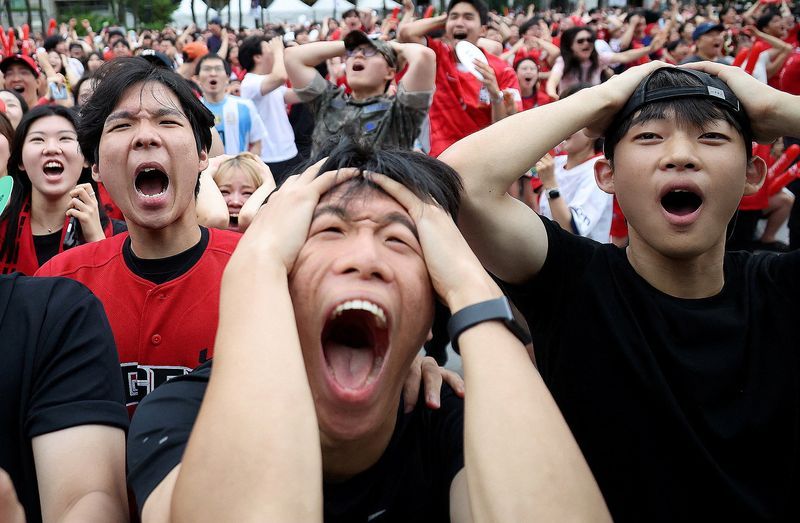
South Korea's president has demanded a comprehensive investigation into the national football team's unexpected early elimination from the World Cup, laying blame squarely on what he characterises as systemic failures in management and personnel selection. President Lee Jae Myung expressed his frustration publicly on Sunday, describing himself as "utterly baffled" by an outcome that contradicted widespread expectations that the squad would comfortably progress from what many observers considered a favourable group stage draw.
The team's elimination followed successive defeats to Mexico and South Africa, results that left South Korea finishing third in Group A. This position proved fatal to their tournament hopes, placing them outside the bracket of eight best third-placed teams that advance to the knockout stages. For a nation where football commands significant public attention and investment, the result represented a considerable embarrassment, particularly given pre-tournament optimism about the squad's potential.
President Lee's intervention reflects how deeply the disappointment has resonated within South Korean political and public circles. In his statement, he explicitly connected the team's failure to what he sees as a broader pattern of appointment decisions that privilege personal networks and loyalty over demonstrated competence. This critique extends beyond football itself, touching on what he frames as a systemic governance issue affecting multiple sectors of the country's public institutions.
At the centre of the controversy stands Coach Hong Myung-bo, whose reappointment to lead the national team in 2024 had already generated considerable debate within Korean media circles. Questions surrounding the transparency and selection criteria for his hiring had surfaced before the World Cup campaign even commenced, with critics alleging that the appointment process lacked the rigorous scrutiny expected for such a prominent position. Hong has consistently denied allegations of favouritism in his selection.
The political dimension of the debate intensified rapidly following the team's exit. A petition calling for Hong's dismissal, filed through South Korea's national assembly website, accumulated the necessary signatures for formal review within days of the disappointing results. Beyond parliamentary action, social media has amplified public discontent, with images circulating widely of South Korean businesses displaying signs explicitly banning the coach from their establishments. This unusual display of public ostracism underscores the intensity of feeling surrounding the perceived failure.
President Lee's broader critique addresses what he identifies as the fundamental problem enabling such appointments: inadequate accountability mechanisms and insufficient oversight of those wielding hiring authority. He contends that the absence of effective checks and monitoring systems creates space for decision-making that conflates private interests with public responsibility. This framing positions the World Cup failure not as an isolated sports disappointment but as symptomatic of governance challenges requiring systemic reform.
In response to the crisis, the president has formally requested that South Korea's Ministry of Culture, Sports and Tourism undertake a thorough examination of the circumstances surrounding the team's performance. This directive extends beyond identifying immediate causes, requiring the ministry to conduct comprehensive analysis and develop preventative measures intended to ensure similar failures do not recur. The involvement of the government ministry signals that the response to the World Cup exit transcends typical sports-related discussions, encompassing questions about institutional competence and management standards more broadly.
For Malaysia and other Southeast Asian nations, South Korea's institutional response to sporting disappointment offers instructive parallels. Like many countries in the region, Malaysia faces ongoing debates about meritocratic versus patronage-based systems in sports administration and other government sectors. South Korea's experience demonstrates how elite sports outcomes can become focal points for broader national conversations about governance standards and accountability, with sports failures potentially accelerating demands for institutional reform that extend far beyond athletic concerns.
The timing of President Lee's intervention also carries political significance within South Korea's domestic context. By positioning himself as champion of meritocracy against what he characterises as an entrenched culture of favouritism, the president potentially seeks to mobilise public sentiment around broader governance and anti-corruption themes. The football team's failure provides him with a concrete, emotionally resonant example through which to articulate these larger concerns.
The incident reveals how sports and politics intersect particularly intensely in East Asian contexts, where national teams carry substantial symbolic weight representing broader national competence and standing. South Korea's response suggests that governments increasingly view sports administration as integral to their broader governance narratives rather than as a purely athletic or entertainment matter. The determination to investigate, reform, and establish accountability mechanisms demonstrates how seriously the country takes the political implications of its teams' international performance.
Looking forward, the investigation will likely scrutinise not only coaching decisions and player selection but also the structural processes governing how future appointments occur within South Korean football administration. The findings could potentially reshape how the country approaches sports management more broadly, with implications for other federations and sporting bodies. Whether the investigation leads to substantive institutional reform or remains largely performative will signal much about South Korea's commitment to meritocratic governance principles versus continuity of existing power structures.

