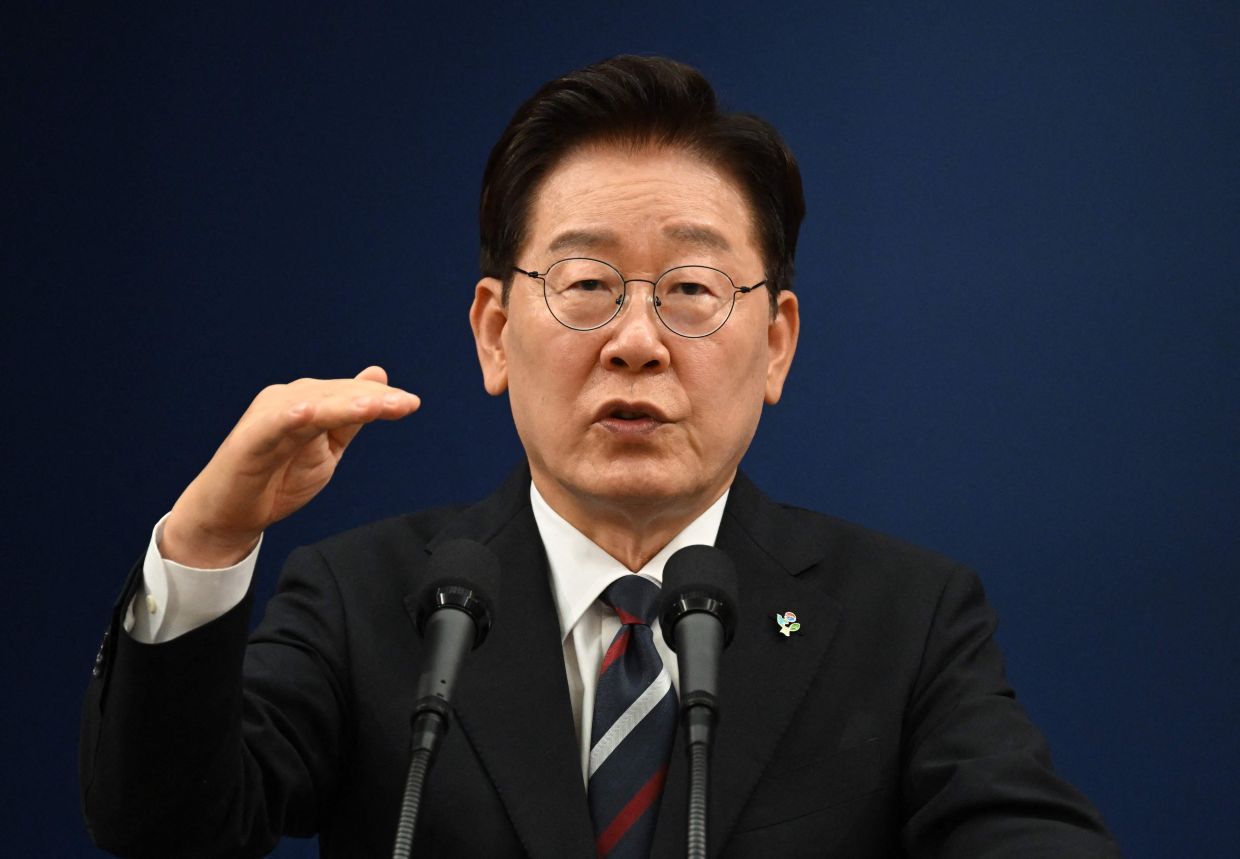
South Korean President Lee Jae Myung has reached a critical political juncture, with his approval rating sinking below the 50 per cent threshold for the first time since his inauguration on June 4, 2025. According to polling data released on June 22 from respected South Korean pollster Realmeter, only 46.7 per cent of respondents approved of his performance, marking the fifth consecutive week of declining support. More significantly, disapproval has now edged ahead of approval for the first time, with negative assessments reaching 49.7 per cent—a turning point that threatens to reshape the political calculus in Seoul during the crucial early months of his presidency.
The trajectory of Lee's declining fortunes has been steep and uninterrupted. Beginning the month of May with a respectable 60.5 per cent approval rating, his support has eroded steadily through successive weeks, falling to 59.3, 59.1, and 55.2 per cent before this week's dramatic drop. The deterioration accelerated sharply in mid-June, suggesting that recent events have had a cumulative and compounding effect on public perception. While the survey's margin of error of plus or minus 2 percentage points means the crossover into negative territory remains statistically tight, the trend itself cannot be dismissed as noise.
Two interconnected crises appear to have triggered this collapse in public confidence. The first stems from serious mismanagement during South Korea's June 3 local elections, when ballot shortages disrupted voting in multiple constituencies and raised uncomfortable questions about electoral administration and competence at the highest levels. This was not a minor logistical hiccup but a substantive failure that touched the legitimacy of democratic processes themselves. The second factor involves mounting tensions within Lee's own Democratic Party of Korea, with faction leaders maneuvering ahead of an August 17 convention to elect a new party chair. These internal struggles, playing out visibly in media coverage, convey an impression of a ruling party more concerned with its own succession battles than with governing effectively.
Regional polling breakdowns reveal the geographic texture of Lee's political weakness. In Daegu and North Gyeongsang Province—traditionally conservative strongholds where presidential candidates would expect durable support—his approval rating has collapsed by nearly 10 percentage points to just 34.6 per cent. The Greater Seoul area, encompassing Incheon, Gyeonggi Province, and the capital itself, shows similar erosion. In Incheon and surrounding Gyeonggi Province, approval dropped 7.6 points to 44.8 per cent, while in Seoul proper it fell to 39.8 per cent. This weakness across both conservative and centrist regions suggests that Lee's difficulties transcend normal partisan polarization and reflect genuine public dissatisfaction with his administration's early performance.
Demographic analysis provides important insight into which voter cohorts are abandoning the presidential boat. Among moderates, approval fell 4.9 percentage points to 47.5 per cent—a significant loss among swing voters who often determine electoral outcomes in South Korea. Support from liberal voters, traditionally Lee's base, remains robust at 80.4 per cent but declined 3.2 points. Even among conservatives, though support predictably remains minimal at 19.8 per cent, the slight further erosion suggests no constituency is immune from the broader downward pressure on presidential popularity.
Comparison to Lee's predecessors provides sobering historical context. Former President Yoon Suk Yeol experienced his approval-disapproval crossover after just six weeks in office—considerably faster than Lee's decline has occurred. However, Park Geun-hye's comparable moment came roughly 16 months into her term, while Moon Jae-in required 19 months before negative views surpassed positive ones. By this measure, Lee's descent into negative territory represents a middle position: faster than some predecessors but not as precipitous as others. Nevertheless, reaching this inflection point within three weeks of June 22 suggests an unusually volatile start to his presidency.
Realmeter pollsters identified specific factors beyond the electoral mismanagement and party infighting that have corroded Lee's support. Growing concerns about widening disparities in asset markets have particularly eroded backing among moderate voters and residents of the greater Seoul metropolitan region, the country's political and economic centre. These anxieties reflect broader concerns about inequality and economic opportunity that resonate strongly in a society where real estate and stock market performance directly affects household wealth. Notably, the polling organization credited some offsetting positive factors, including international perceptions of Lee's European trip and South Korea's Kospi stock index breaking through the psychologically important 9,000-point barrier, suggesting that without these achievements his approval ratings might have deteriorated even further.
The presidential office responded to the polling results with a carefully measured statement, acknowledging the figures while framing them as reflecting public assessment of both economic conditions and government performance more broadly. Officials indicated they would take the numbers seriously, expressing commitment to listening more closely to citizen concerns. This measured tone reflects an understanding that South Korean politics, like elsewhere in East Asia, punishes perceived tone-deafness or arrogance, particularly during a president's honeymoon period when public patience remains relatively high.
Parallel polling on party support reveals a more complex political landscape than presidential approval alone suggests. The ruling Democratic Party of Korea gained 2.1 percentage points to reach 40.1 per cent support, while the main opposition People Power Party slipped 2 percentage points to 42.3 per cent. The narrowing gap reflects a partial rebound for Lee's party following a bipartisan agreement to launch a National Assembly investigation into the election administration failures. This cross-party consensus approach appears to have provided some political cover for the Democratic Party, despite the factional tensions that continue to plague its leadership. However, the ruling party's continued disadvantage relative to the opposition suggests that presidential weakness and party weakness are not identical phenomena—voters may maintain distinct assessments of Lee personally versus the broader Democratic Party coalition.
Age-based analysis reveals particular vulnerability among younger voters whose support forms essential political capital for any government seeking re-election. The main opposition People Power Party experienced dramatic declines in support among voters aged in their 20s, dropping 10.5 percentage points to 48.6 per cent, and among those in their 30s, falling 5.1 points to 47.4 per cent. This exodus of youth from the conservative opposition reflects broader dissatisfaction with the establishment political class across party lines rather than a simple swing toward Lee's Democrats. For Malaysian observers, this phenomenon mirrors patterns seen across Southeast Asia and East Asia more broadly, where younger voters increasingly reject traditional political divides in favour of demanding substantive performance and demonstrable responsiveness to their concerns.
For regional watchers, South Korea's political turbulence carries significance beyond its borders. The country remains a technological and cultural trendsetter across East and Southeast Asia, and instability in Seoul affects regional investment sentiment and the credibility of Seoul's diplomatic initiatives. Moreover, South Korea's experience navigating democratic transitions and presidential crises offers comparative lessons for other Asian democracies navigating similar challenges. Lee Jae Myung's stumbling start underscores how quickly initial optimism about new leadership can evaporate when early performance fails to meet public expectations, particularly when institutional competence appears compromised and internal party divisions become visible to voters.
The coming weeks will prove critical for Lee's political recovery. The August 17 party leadership election may either strengthen his position if a unified Democratic Party emerges, or further weaken it if factional battles consume public attention. Meanwhile, his administration must demonstrate tangible progress on economic concerns—particularly regarding asset market inequality—to rebuild confidence among moderate voters and the Seoul metropolitan population. Whether Lee can reverse this historic negative crossover will depend on his ability to project both competence in governance and unity within his own party, while addressing the substantive public anxieties that have emerged during his presidency's opening chapter.