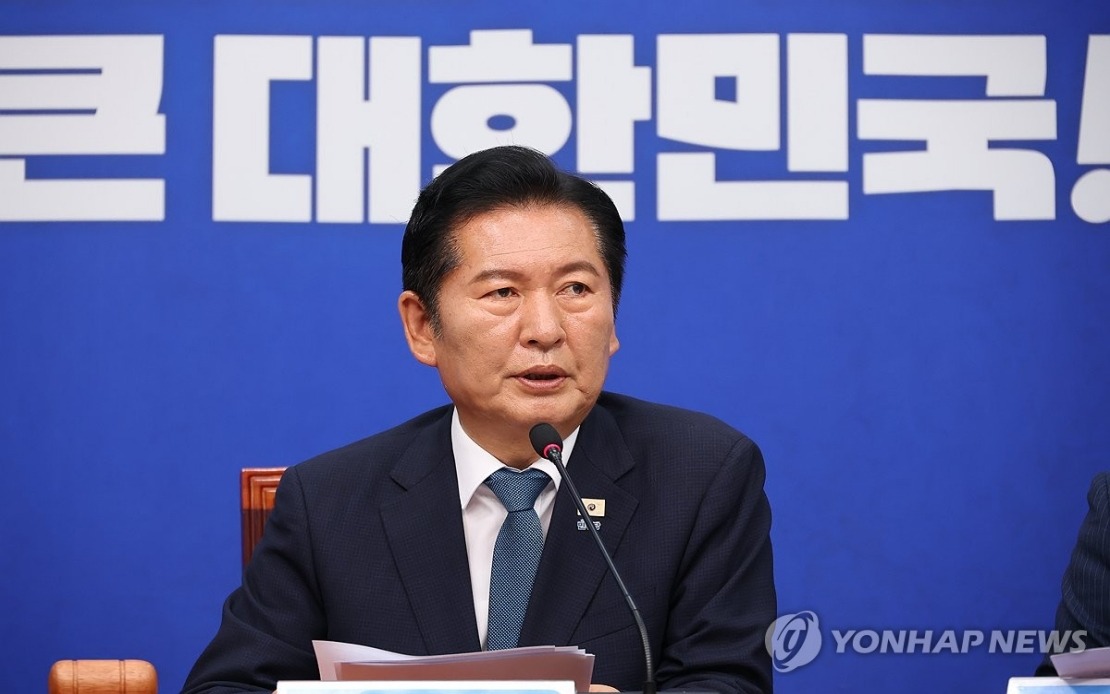
South Korean lawmaker Jung Chung-rae stepped down as chairman of the ruling Democratic Party on Wednesday, a strategic move widely interpreted as preparation for his bid to reclaim the position during the party's national convention scheduled for August 17. The resignation announcement, made during a meeting of the party's supreme council at the National Assembly in Seoul, has set the stage for what promises to be one of the most significant internal battles within South Korea's ruling party in recent years, with implications extending far beyond party politics into the country's broader political landscape.
Jung's carefully worded statement to party leadership reflected the considerable internal tensions that have characterised his tenure. Speaking reflectively about his decision, he acknowledged the personal and professional toll of his position, noting that he had endured what he described as constant turmoil from both within party ranks and from external opposition forces. His remarks underscored the relentless nature of factional disputes that have plagued the Democratic Party, suggesting that his departure, while framed as strategic, also reflects genuine frustration with the party's fractious internal dynamics and competing power centres.
Throughout his time as party chairman, Jung emphasised his unwavering commitment to supporting President Lee Jae Myung's administration, a point he reiterated during his resignation statement. He stressed his efforts to maintain a unified approach between the ruling party, government apparatus, and presidential office, presenting himself as a bridge figure committed to party discipline and coherent governance. This messaging is significant because it positions his potential return to the chairmanship as essential to party stability, framing the upcoming convention as an opportunity to restore cohesive leadership.
However, Jung's narrative of steadfast loyalty masks deeper factional fractures within the Democratic Party. Critics from the pro-Lee faction have increasingly questioned whether Jung prioritises the interests of his own political supporters over alignment with the president's broader agenda. These detractors argue that Jung has oriented party strategy toward appeasing his core constituency rather than pursuing policies that complement Lee's presidential priorities. This friction reflects a common challenge in Korean politics, where personalised power networks often supersede institutional party discipline, creating competing centres of authority within nominally unified political movements.
The leadership vacuum created by Jung's resignation will be temporarily filled by DP floor leader Han Byung-do, who assumes acting party leadership until the August 17 convention. This interim arrangement provides stability while allowing time for candidates to campaign and build their cases before party delegates. The three-month interim period is crucial for manoeuvring among rival camps and determining which candidate can assemble the broadest coalition of support across the party's regional and factional divides.
The upcoming convention is shaping into a three-cornered contest featuring Jung alongside two formidable political rivals. Prime Minister Kim Min-seok enters the race as a heavyweight backed by close ties to President Lee, positioning himself as the administration's preferred candidate. Kim's candidacy represents the establishment faction within the party, drawing on his governmental role and presidential backing. Conversely, Song Young-gil, a former Democratic Party leader, brings considerable political experience and an independent power base, having previously steered the party through earlier turbulent periods.
Song's intentions gained further clarity through recent statements made by DP lawmaker Park Jie-won, who disclosed in a radio interview with CBS that Song has informed the president of his intention to contest the chairmanship. More intriguingly, Song has reportedly explored the possibility of coordinating his candidacy with Kim Min-seok, raising the prospect of a potential merger that could significantly reshape the three-way race. Such a coordination would create a stark divide between the administration-aligned camp and Jung's independent faction, fundamentally altering the convention's dynamics and likely diminishing Jung's chances of recapture.
The factional struggle unfolding within the Democratic Party reflects broader tensions in South Korean politics regarding party governance, presidential authority, and the balance between centralised executive power and internal party democracy. The outcome of the August convention will influence not only party organisational structure but also policy direction and the party's ability to present a united front in legislative proceedings. Party cohesion directly affects the government's capacity to pass legislation and implement policy initiatives, making the leadership transition consequential for Lee's entire presidential agenda.
For Malaysian and Southeast Asian observers, the South Korean political drama illuminates how even established democracies with decades of electoral experience continue grappling with factional politics and leadership succession challenges. The Democratic Party's internal struggles echo similar dynamics observable across Asia's political systems, where personalised leadership networks often prove stronger than institutional party structures. The convention results will demonstrate whether formal democratic mechanisms can successfully mediate between competing power bases or whether informal factional arrangements ultimately determine political outcomes in ruling parties.
Jung's strategy of resigning before seeking re-election follows established patterns in Korean politics, where tactical withdrawals often precede comeback attempts, allowing candidates to reset their political positions and rebuild support. His willingness to relinquish the title temporarily suggests confidence in his grassroots support within the party, even as he acknowledges the mounting pressure from rival factions. The coming months will reveal whether his political calculation proves sound or whether the interim period allows challengers to consolidate sufficient support to block his return permanently.
The democratic process within the ruling party will ultimately determine South Korea's political trajectory over the coming years. The convention represents a moment where party members and delegates exercise genuine influence over leadership selection, theoretically constraining executive overreach and preserving internal party pluralism. However, the extent to which the formal voting process reflects authentic internal opinion or simply ratifies previously negotiated factional agreements remains an open question, one that analysts will closely examine when delegates cast their votes on August 17.