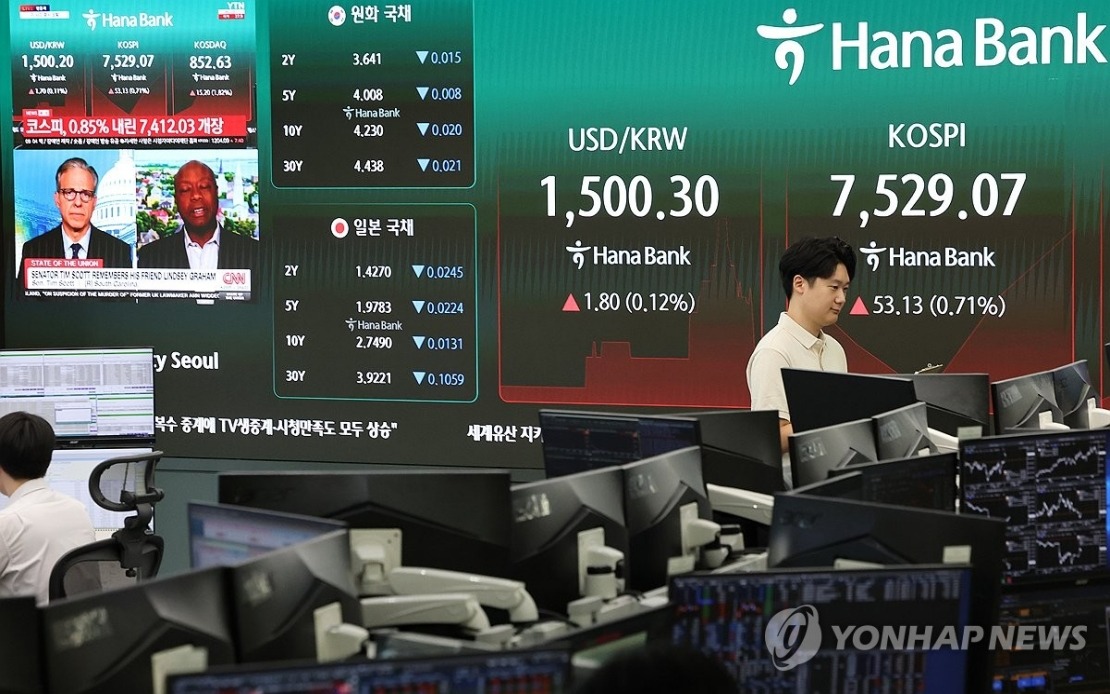
The Korea Exchange activated its marketwide circuit breaker on Monday afternoon following a sharp decline in the benchmark Korea Composite Stock Price Index, marking a dramatic response to mounting investor concerns about regional stability. The automatic trading halt came into effect at around 1:28 p.m. after the KOSPI plummeted more than 8 percent from the previous trading session's closing level, with shares remaining suspended for 20 minutes while market sentiment stabilised.
The dramatic sell-off exposed the vulnerability of Asian equities to geopolitical shocks, particularly when tensions flare in strategically vital regions. In this instance, the trigger was a fresh round of military exchanges between the United States and Iran centred on control and freedom of navigation through the Strait of Hormuz, one of the world's most critical petroleum transport corridors. For an export-dependent economy like South Korea, whose manufacturing sector relies heavily on uninterrupted global trade flows, such disruptions carry immediate and tangible consequences that reverberate through equity valuations.
Circuit breakers represent a critical safeguard mechanism designed into modern financial markets to prevent panic-driven crashes that can cascade across entire economies. When triggered, they enforce a mandatory pause in trading, giving investors time to reassess information, recalibrate risk positions, and prevent herd behaviour from pushing indices into freefall. The 20-minute suspension on Monday served its intended purpose, allowing market participants to digest the latest developments in West Asian tensions before determining whether selling pressure would continue or stabilise.
The frequency with which the Korea Exchange has needed to activate this protective mechanism this year tells a cautionary tale about current market conditions. Monday's halt represented the seventh activation in 2024, indicating that circuit breakers have become a regular feature rather than an exceptional occurrence. This escalating pattern reflects a market environment characterised by elevated volatility, thinly held positions, and a pervasive sense that unexpected shocks could emerge from multiple quarters at short notice.
For Malaysian investors with exposure to South Korean equities or those with regional holdings sensitive to Asian market movements, these episodes warrant close attention. The KOSPI's movements often presage broader regional shifts in risk appetite, particularly for technology and manufacturing stocks that form the backbone of Southeast Asian export economies. When the KOSPI drops sharply, it frequently signals that international investors are reassessing their appetite for emerging market equities across the region, potentially triggering capital flows away from Malaysian and other Southeast Asian exchanges.
The underlying cause of Monday's selloff—tension between the United States and Iran over the Strait of Hormuz—carries profound implications for energy security across Asia. Although Malaysia is not among the world's largest consumers of oil transported through this waterway, any disruption to global petroleum supplies would filter through global commodity markets and ultimately affect energy costs domestically. Elevated energy prices could stoke inflation pressures and complicate monetary policy decisions for regional central banks, including Bank Negara Malaysia.
Circuit breakers operate on the principle that information asymmetries and behavioural factors can temporarily divorce stock prices from fundamental values. By enforcing a pause, these mechanisms allow the market to process new information more rationally and deliberately. However, their repeated activation this year suggests that longer-term structural factors may also be at play, including positioning in derivative markets, algorithm-driven trading strategies, and the concentration of wealth in passive index funds that move in lockstep during market turbulence.
The geopolitical dimension adds particular weight to current market anxieties. Unlike traditional macroeconomic shocks that develop gradually and can be partially anticipated, military escalations in strategically sensitive regions can develop with shocking speed and carry unpredictable consequences. Investors cannot easily hedge against such tail risks, which explains why each fresh headline about US-Iran tensions sends equity markets into defensive mode. This uncertainty premium is now reflected in persistently elevated volatility across Asian bourses.
South Korea's economy, as a major global trader and manufacturer with significant regional supply chain responsibilities, faces compounded risks from geopolitical disruption. A sustained elevation in shipping insurance premiums, delays in freight movements, or actual military interference with vessel traffic would impose real costs on Korean exporters and manufacturing partners throughout Asia. The KOSPI's sensitivity to these developments mirrors the region's broader integration into global supply chains that can be disrupted by events thousands of kilometres away.
Looking ahead, the persistence of circuit breaker activations this year may prompt regulatory review of the thresholds triggering these halts and their efficacy in truly stabilising markets. If disruptions continue at the current pace, market participants and authorities may need to consider whether existing mechanisms remain fit for purpose or require recalibration. For regional investors, the message is clear: heightened vigilance regarding both geopolitical developments and equity market technicals remains essential in this volatile environment.

