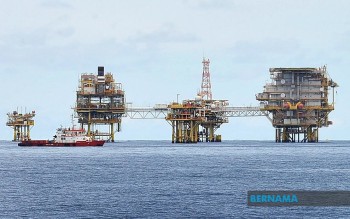
The Asia Pacific offshore sector is showing remarkable resilience in the wake of Middle East tensions, with Southeast Asia positioned to emerge as a particular beneficiary of renewed investment activity. Hong Leong Investment Bank Bhd forecasts that greenfield capital expenditure across the region will climb 12 per cent, pushing total commitments beyond US$100 billion as energy companies recalibrate their development strategies and accelerate new projects previously in the planning stages.
This capital mobilisation reflects a fundamental shift in investor priorities. Rather than retreating from commitment amid regional instability, operators are instead doubling down on establishing new production capabilities. The projection reveals that despite the uncertainties surrounding Middle Eastern oil flows, energy markets have begun pricing in a more optimistic scenario where supply chain diversification becomes essential. Southeast Asia, with its established offshore infrastructure and regulatory frameworks, stands to capture a meaningful share of this redirected investment.
Beyond greenfield projects, existing operations remain an area of sustained focus. South Asia is anticipated to witness a 23 per cent increase in brownfield capital expenditure, while Southeast Asia will see a more modest 3 per cent uplift in spending dedicated to maintaining and enhancing current assets. This dual-track investment pattern demonstrates that companies are simultaneously building for the future whilst ensuring existing facilities can reliably deliver near-term supplies. For Malaysian operators like Petronas and their service partners, this represents a significant window of opportunity to secure contracts across both development and maintenance scopes.
The geopolitical backdrop driving these trends centres on the fragile ceasefire between the United States and Iran. While the signing of their 14-point memorandum of understanding has created space for de-escalation, analysts remain cautious about the durability of the arrangement. Critically, vessel traffic through the Strait of Hormuz—the world's most critical chokepoint—is recovering, though the picture remains opaque. Satellite data reveals that many ships are transiting the strait with their automatic identification systems switched off, suggesting underlying anxiety about the region's stability persists even as surface-level conditions improve.
The energy security dimension looms large in investment calculations. Hong Leong Investment Bank identifies two pivotal themes shaping the sector outlook. First, the possibility that a sustainable resolution on energy security could elevate global inventory reserves to comfortable levels, strengthening the fortunes of pipeline operators and terminal storage providers. The trajectory of strategic petroleum reserves and commercial inventory levels will significantly influence price expectations and investment confidence across the coming years.
Second, and more directly relevant to Malaysia, is the anticipated Petronas capital expenditure upcycle anticipated by 2027. Should the national oil company proceed with a substantial uplift in spending, the domestic oil and gas services and equipment sector stands to capture spillover demand. Companies engaged in upstream field development, installation and commissioning activities, maintenance operations, marine support services, metal fabrication, and pipeline construction would benefit substantially. This prospect has already begun shaping boardroom discussions among regional contractors sizing their capacity for the anticipated surge.
Price forecasts have been moderated in recent weeks as the market absorbs shifting supply-demand dynamics. Hong Leong Investment Bank has revised its 2026 Brent crude projection downward to US$80 per barrel from an earlier US$90 estimate, whilst maintaining its 2025 forecast at US$75 per barrel. These revisions reflect both the gradual restoration of regional supply flows and expectations of normalising global inventory levels. The US Energy Information Administration's June outlook pointed to a sharp drawdown in OECD commercial stocks, with available supply compressed to just 50 days by late 2026—a significant drop from the pre-conflict benchmark above 60 days.
This inventory compression creates a structural floor beneath oil prices in the near term. Until global petroleum flows fully normalise and stocks rebuild beyond the 60-day supply threshold, analysts expect prices to find support around the US$80 mark. Should inventory replenishment extend beyond this timeframe, Brent could maintain levels exceeding US$75 per barrel into early 2027, with energy security considerations providing underlying price support. The calculus reveals that even as immediate geopolitical tensions ease, medium-term structural factors will continue constraining supply flexibility.
Production disruptions in the Strait of Hormuz remain a complicating factor. Total shut-in volumes in the region escalated from 35 per cent of capacity in March 2026 to 45 per cent by May 2026, underscoring how quickly supply vulnerabilities can materialise in this critical region. A prolonged recovery timeline for these facilities would reinforce pricing support and keep the investment environment favourable for new capacity additions. Companies evaluating project economics must therefore assume a persistent risk premium on supply security.
Economic analysts are cautiously optimistic that sustained prices in the US$70-75 per barrel range could prove beneficial across the broader economy. Mohd Sedek Jantan, director of investment strategy at IPPFA Sdn Bhd, points out that stabilised oil costs at these levels would ease energy-related input expenses for businesses whilst improving cost predictability. This would allow companies to plan capital investments with greater confidence and manage working capital more efficiently.
Beyond the corporate sector, moderate oil prices carry macroeconomic significance. Sustained prices around US$70-75 per barrel would moderate cost-push inflationary pressures globally, reducing immediate pressure on central banks to maintain restrictive monetary settings. This flexibility could enable policymakers to calibrate interest rates more supportively, creating conditions conducive to business investment, consumer spending, and broader economic recovery. For Southeast Asian economies heavily dependent on trade and export competitiveness, lower energy costs translate directly into improved margins and stronger export performance.
Market conditions at the time of reporting showed Brent crude trading up 0.90 per cent to US$69.17 per barrel, whilst West Texas Intermediate crude gained 0.94 per cent to US$72.67 per barrel. These levels sit comfortably within analyst expectations and reflect the market's growing confidence in sustained supply adequacy. For Malaysia and other Southeast Asian energy exporters and service providers, the convergence of investment opportunity and price stability creates an extended window to capture market share and build long-term partnerships with international operators.
The trajectory ahead depends significantly on whether the US-Iran understanding holds and whether Middle Eastern production can be gradually restored without fresh disruptions. Should this occur, Southeast Asia will have positioned itself as the preferred investment destination for companies seeking supply security and operational stability. The offshore capex surge anticipated across the region represents more than statistical growth; it signals a structural rebalancing of global energy infrastructure away from concentrating risk in unstable regions.

