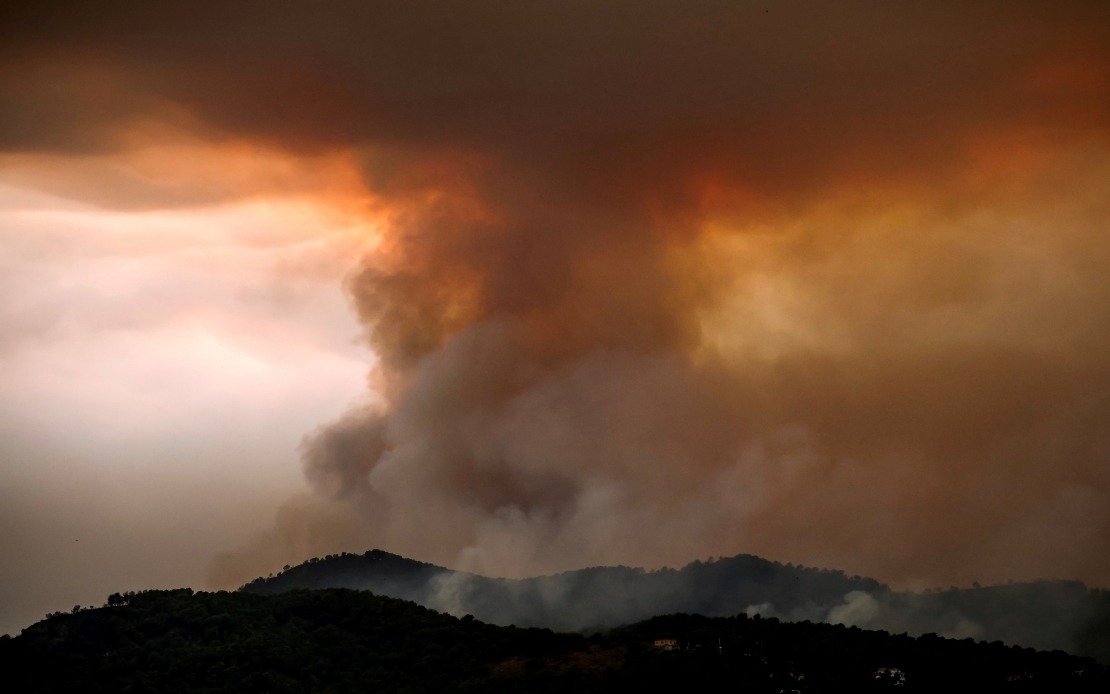
Spain is grappling with an unprecedented wildfire crisis that has overwhelmed emergency services and displaced tens of thousands of residents across its central heartland. The inferno ravaging Avila province has grown into the most extensive recorded blaze in Spanish history, consuming approximately 50,000 hectares by late July, according to government officials. The catastrophe represents a stark escalation in the frequency and severity of wildfires affecting Europe, raising concerns about climate vulnerability across the continent and the adequacy of current firefighting infrastructure to handle such disasters.
The scale of devastation extends far beyond the primary Avila blaze. Ecological Transition Minister Sara Aagesen reported that combined fires affecting the Madrid region alongside the provinces of Avila and Toledo have charred more than 77,000 hectares of land. These three zones represent the epicentre of destruction, though additional blazes have emerged in other regions, demonstrating the widespread nature of the crisis. The simultaneous eruption of multiple fire fronts has created logistical challenges for emergency responders and complicated coordination efforts across different administrative jurisdictions.
Evacuation orders have dramatically reshaped the human geography of central Spain. Nearly 100,000 individuals have been either evacuated or instructed to remain indoors across 46 municipalities, fundamentally disrupting daily life for hundreds of thousands more who face uncertainty about their safety and properties. The geographic dispersion of evacuation zones indicates the fire's sprawling reach, affecting not merely isolated areas but interconnected communities dependent on shared infrastructure and resources. Simultaneously, a separate wildfire in Castellon province, located in Spain's eastern region, has imperilled more than 16,000 people distributed across 18 municipalities, indicating that the crisis has transcended the central regions.
The institutional response has mobilized Spain's entire emergency apparatus. Thousands of firefighters have been deployed alongside the Military Emergency Unit (UME), with firefighting aircraft and helicopters providing aerial support. The coordination between civilian firefighting services and military resources underscores the gravity officials ascribe to containing the blazes. Lieutenant General Francisco Javier Marcos Izquierdo, commanding the UME, provided tactical updates suggesting that separate fire zones in Avila and Madrid remained distinct entities, having touched only along a narrow discontinuous boundary near San Martin de Valdeiglesias. Though firefighters reported successfully preventing further flame propagation between the two zones, the fire perimeter remained incompletely secured, suggesting ongoing vulnerability.
Minister Aagesen characterised the situation as fundamentally complex, noting that emergency crews were simultaneously engaging multiple active fronts requiring independent tactical decisions. Speaking from an advanced command post in Navalcarnero, west of Madrid, she cautioned that additional evacuations might become necessary if the fire behaviour shifted unfavourably. Aagesen also communicated that displaced residents would remain barred from returning until authorities deemed conditions acceptably safe, establishing a potentially extended displacement timeline that could strain resources and community cohesion.
Prime Minister Pedro Sanchez visited the disaster zone to assess conditions firsthand, offering a more optimistic assessment than that provided by his minister. Sanchez acknowledged the extraordinarily complex challenges confronting firefighting teams whilst suggesting that the overall trajectory was shifting positively, with portions of the fires transitioning toward suppression. His framing attempted to balance the severity of the immediate crisis with reassurance about management capability, a delicate rhetorical position necessary for maintaining public confidence during emergencies.
Higher state institutions also demonstrated solidarity with affected populations. King Felipe VI and Queen Letizia travelled to the disaster areas to receive situational briefings from emergency personnel and express institutional support for both the population and frontline workers. Such symbolic presence from the monarchy serves to reinforce the seriousness with which the Spanish state regards the crisis and acknowledges the sacrifices demanded of ordinary citizens and emergency responders alike.
The national context reveals a deepening wildfire trend across Spain. According to the Ecological Transition Ministry, wildfires had already burned 172,453 hectares throughout Spain by July 24, indicating that the Avila catastrophe represents an intensification of an already significant problem. This cumulative figure suggests that multiple concurrent fires are straining resources across the country, potentially overwhelming Spain's firefighting capacity during the critical summer season when temperature and drought conditions favour rapid fire propagation.
For Malaysian and Southeast Asian observers, Spain's wildfire crisis illuminates the escalating vulnerability of Mediterranean and temperate regions to climate-driven disasters. As global temperatures continue rising, regions previously considered stable may experience increasingly severe natural disasters. Spain's situation demonstrates that even wealthy developed nations with advanced emergency services face significant challenges managing unprecedented environmental crises. The implications extend to Southeast Asia, where forest management, rapid urbanisation, and monsoon-dependent agricultural systems create distinct but equally serious wildfire risks. The Spanish experience suggests that regional governments across Asia should critically reassess their disaster preparedness protocols and coordinate cross-border emergency responses.
The political economy of wildfire management also warrants attention. Spain's response mobilises substantial military and civilian resources, yet even such comprehensive deployment appears insufficient to prevent the rapid expansion of the Avila blaze. This reality raises difficult questions about whether current firefighting approaches adequately address the scale of fires now possible under changing climate conditions. Prevention through forest management, controlled burns during safer seasons, and landscape-level planning may prove more cost-effective than attempting to suppress mega-fires once ignited. For Southeast Asian policymakers, this suggests that investing in prevention and landscape restoration may offer superior returns compared to reactive firefighting expenditures.
The humanitarian dimension of the crisis requires sustained attention beyond the immediate emergency phase. Displaced residents face prolonged uncertainty, potential property losses, and the psychological burden of living in disaster zones. Reconstruction will demand significant resources extending across years, not merely weeks. The social cohesion of affected communities may suffer long-term stress as residents struggle with insurance claims, rebuilding decisions, and climate anxiety about future disasters. Spain's institutional response, whilst comprehensive, ultimately represents an attempt to manage consequences rather than address underlying vulnerabilities created by transforming climate patterns and accumulated landscape conditions.

