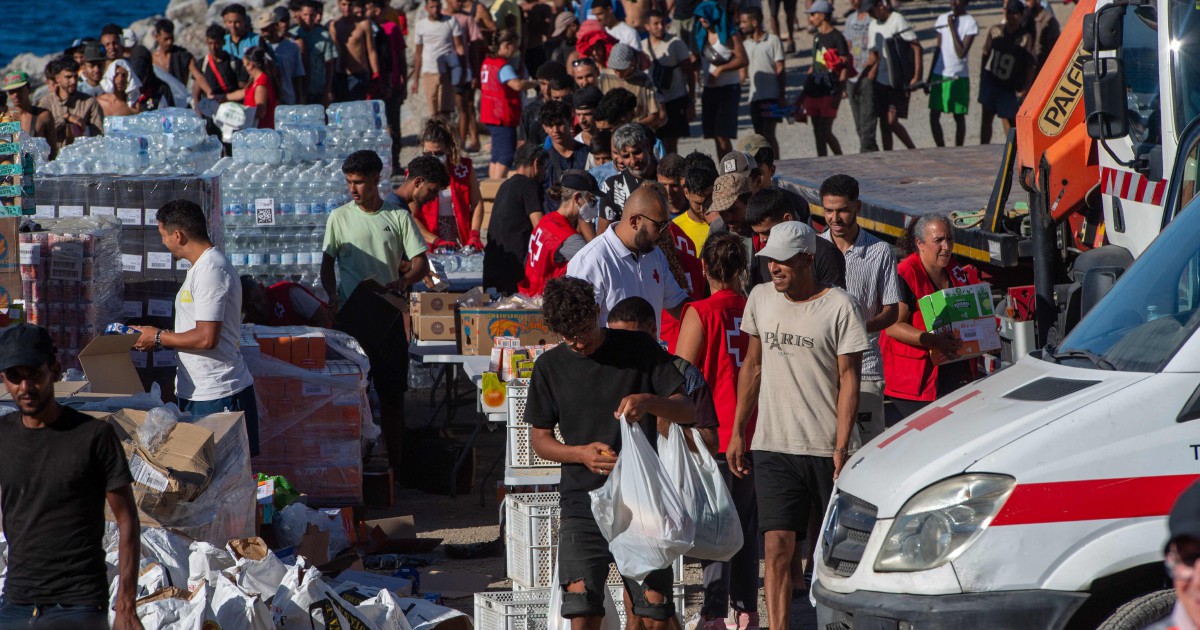
Spanish Prime Minister Pedro Sanchez has attributed the recent migrant crisis in the Spanish enclave of Ceuta to a coordinated disinformation campaign, pointing the finger at Russia and Israel while notably exonerating Morocco of direct involvement in the operation. Speaking on Monday, Sanchez indicated that intelligence assessments had uncovered evidence suggesting these two nations played a role in disseminating false narratives about Spain's migration policies, creating conditions that led to a dramatic influx of migrants into the North African territory.
The Ceuta crisis, which unfolded last month, saw thousands of migrants attempt to enter the Spanish enclave in a compressed timeframe, creating a humanitarian and security challenge for authorities. The surge represented one of the most significant migration incidents affecting Spanish territory in recent years, straining resources and drawing international attention to the porous nature of Spain's maritime borders with Morocco. Sanchez's explanation suggests that strategic actors deliberately weaponized information to destabilise Spain's territorial management and exploit vulnerabilities in border enforcement.
Russia's alleged involvement in the disinformation effort fits a broader pattern of Moscow's documented campaigns to sow discord within Western nations and their strategic interests. By amplifying misleading information about Spain's migration policies, Russian actors would have sought to embarrass the Madrid government, undermine public confidence in state institutions, and potentially fracture Spain's relationship with its North African neighbour. This approach aligns with established Russian tactics of exploiting societal divisions and migration anxieties that resonate particularly strongly across Europe.
Israel's role in the purported campaign appears less straightforward but may reflect tensions stemming from Spain's perceived stance on Palestinian issues and broader Middle Eastern geopolitics. Spanish civil society has been notably vocal on Palestinian rights, and Madrid's positioning on regional conflicts differs from that of some traditional Israeli allies. The allegation suggests that multiple state actors with distinct grievances or strategic objectives may have coordinated or independently pursued complementary information warfare operations targeting Spain.
Crucially, Sanchez's statement that Morocco bore no responsibility for orchestrating the migrant surge offers significant diplomatic relief to the neighbouring kingdom. Historically, Morocco has been suspected or accused of weaponising migration flows at moments of diplomatic tension with Spain, most notably during the 2021 Ceuta crisis when tens of thousands of migrants crossed into the enclave amid Rabat-Madrid tensions. By explicitly clearing Tangier of blame this time, Sanchez appears to prioritise maintaining stable bilateral relations with a critical partner in managing irregular migration across the Mediterranean and the Strait of Gibraltar.
The distinction carries particular weight for Malaysia and other Southeast Asian nations monitoring geopolitical competition. It demonstrates how states increasingly employ disinformation and false narratives about sensitive policy domains—including migration, which affects public sentiment across borders—as instruments of statecraft. The Spanish case illustrates how migration crises, already challenging and politically fraught, become further complicated when hostile actors deliberately amplify misleading claims to maximise disruption.
Sanchez's public acknowledgment of foreign disinformation involvement represents an unusual transparency moment for European governments, which often prefer to handle intelligence matters discretely. By naming Russia and Israel directly, Madrid signals confidence in its intelligence assessment while also seeking to shift domestic blame away from policy failures towards external interference. This rhetorical strategy allows the government to maintain that the crisis stemmed from malign external actors rather than deficiencies in border management or migration policy.
The revelations underscore the vulnerability of migration policy to information warfare, a challenge that extends well beyond Spain. Southeast Asian nations, which face significant irregular migration pressures and increasingly sophisticated disinformation ecosystems, should consider whether similar campaigns might target their own migration governance. The intersection of migration crises and hostile information operations creates particularly volatile circumstances where public anxiety can be weaponised to destabilise governments or stoke conflict with neighbouring states.
For Spain's relationship with Morocco, the exoneration provides diplomatic breathing room despite underlying tensions over Western Sahara, fishing rights, and migration control. Both nations have mutual interests in preventing mass migration surges and maintaining regional stability, even as they contest other issues. Sanchez's framing allows Spain to maintain these cooperative mechanisms without appearing to reward or accommodate Moroccan pressure tactics.
The broader implication of Spain's findings concerns the weaponisation of migration itself as a geopolitical tool. When disinformation actors can amplify or manufacture narratives about open borders or lenient policies, they create conditions that may encourage actual migration attempts, conflating information warfare with material consequences. This dynamic introduces complex causality: were migrants primarily responding to false narratives, or did false narratives merely accelerate pre-existing motivations?
Moving forward, Spain's experience suggests that comprehensive responses to migration crises must incorporate information security alongside border management and humanitarian frameworks. Governments increasingly cannot treat migration policy as merely a logistical or humanitarian challenge; they must simultaneously counter coordinated narratives and identify sources of disinformation designed to exacerbate public anxiety. For Spain, Mexico, and nations across Southeast Asia facing irregular migration, this integrated approach represents an emerging necessity in an era of sophisticated information warfare.

