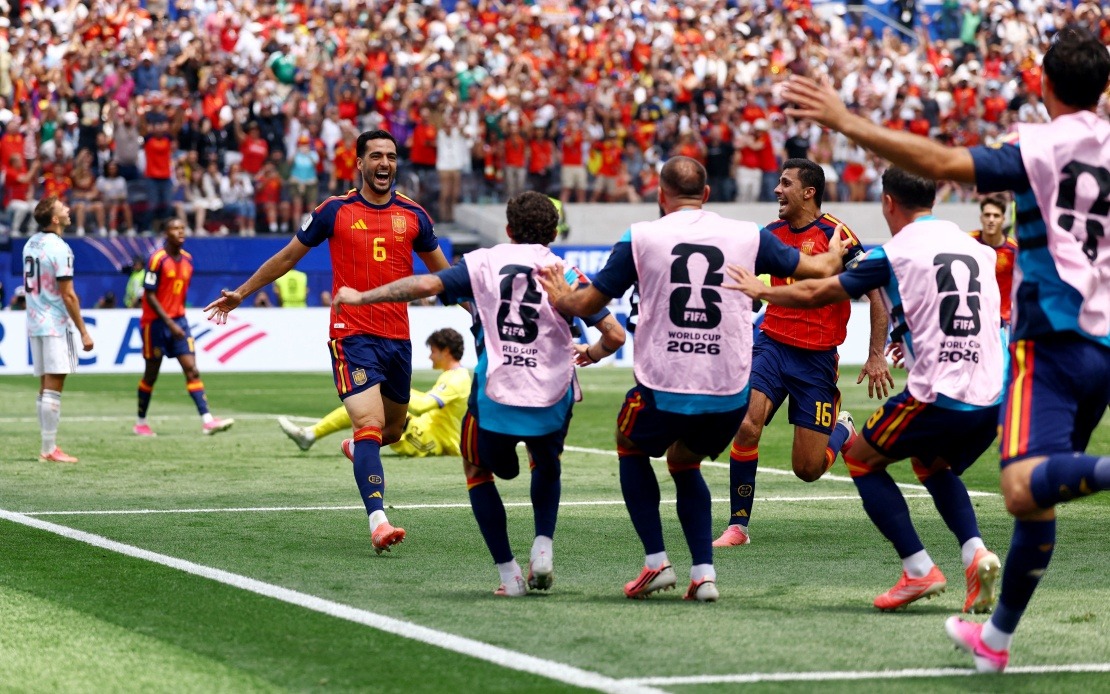
Spain advanced to the World Cup semi-final with a 2-1 victory over Belgium on Friday in Los Angeles County, with substitute Mikel Merino providing the decisive finishing touch in the 88th minute. The European champions will now face France in a high-stakes semi-final near Dallas on Tuesday, repeating their Euro 2024 semi-final encounter which Spain won. This marks another significant step in Spain's quest for their first World Cup title since 2010, positioning them among the tournament's strongest remaining contenders.
Fabián Ruiz opened the scoring for Spain in the 30th minute, establishing an early advantage against a Belgian side already weakened by personnel losses. The early goal reflected Spain's dominance in the match and their superior technical quality on display throughout the opening period. Belgium's response came through Charles De Ketelaere's equaliser, which marked a significant milestone for Spain's goalkeeper Unai Simón, who conceded for the first time after an extraordinary streak of 649 World Cup minutes across two tournaments. This defensive solidity had been a hallmark of Spain's campaign until this point.
Belgium's preparation and team sheet were severely compromised by injury misfortune that undermined their competitive capacity. Captain Youri Tielemans withdrew during the pre-match warm-up with a hamstring complaint, representing a major blow to the midfield's experience and control. This absence compounded the earlier loss of Amadou Onana to a knee ligament injury, depriving Belgium of two midfield anchors essential to their tactical framework. The cumulative effect of these losses left the Belgian side struggling to maintain the midfield dominance typically expected from their squad's quality.
The situation deteriorated further when goalkeeper Thibaut Courtois suffered an injury in the 71st minute, forcing Manchester United's Senne Lammens to enter the game as a replacement. Courtois departed the field visibly distressed, highlighting the emotional toll of the exit. Lammens, operating at an unfamiliar and high-pressure level, would ultimately become instrumental in Spain's winning moment through a critical error. His inexperience in such demanding circumstances became apparent when he spilled a long-range effort from Pau Cubarsi, presenting the opportunity that Merino capitalised upon with clinical precision.
Merino's match-winning contribution arrived from the bench, echoing his impact in Spain's previous knockout encounter against Portugal in the last-16. His ability to deliver in crucial moments off the bench demonstrates his valuable role within this Spanish squad and his capacity to influence matches when fresh. The Arsenal midfielder's 88th-minute finish, struck into the roof of the net, displayed composure and technique befitting a player operating at elite club level. His introduction alongside Nico Williams provided Spain's attack with additional dynamism during the latter stages when Belgium's defensive organisation was collapsing.
France now await Spain in a matchup carrying substantial weight and considerable intrigue. The French are tournament veterans, having won the World Cup in 1998 and 2018, reaching the final four years ago when they finished runners-up to Argentina. Despite their pedigree and previous success in this competition, France recognise that Spain represents their most formidable obstacle remaining in the tournament. La Roja's technical proficiency, possession-based approach, and ability to maintain structure and control throughout matches pose difficulties that earlier opponents have struggled to counter.
The semi-final replay of the Euro 2024 semi-final provides additional narrative dimension to the contest. Spain's victory in that European championship encounter demonstrated their superiority at that juncture, raising questions about whether they can replicate that performance under World Cup conditions. The familiarity between the squads, though potentially advantageous for Spain given their previous success, also allows France to implement counter-strategies developed since their last meeting. Both teams have evolved tactically over the intervening months, suggesting the semi-final will showcase refined approaches rather than repetitions of past encounters.
Spain's comprehensive display against Belgium, despite the opposition's difficulties, underscored their consistency and technical standards throughout the tournament. Their capacity to maintain control, shift the ball efficiently across the pitch, and create decisive moments reflects a squad that has matured collectively. The emphasis on developing attacking opportunities from midfield and orchestrating sustained pressure aligns with Spanish football's established philosophy, executed with contemporary tactical sophistication. This coherent approach has distinguished them from earlier tournament stages through the knockout phases.
The path to the World Cup final now requires Spain to overcome one of football's traditional powerhouses in front of a substantial audience near Dallas. France possesses the experience, individual talent, and tournament pedigree to mount a serious challenge, yet Spain's form, cohesion, and recent success against comparable opponents suggests they represent legitimate contenders for the ultimate prize. The semi-final encounter will determine whether Spain can capture their second World Cup title in what would represent a remarkable achievement for a national team balancing continuity with generational transition.

