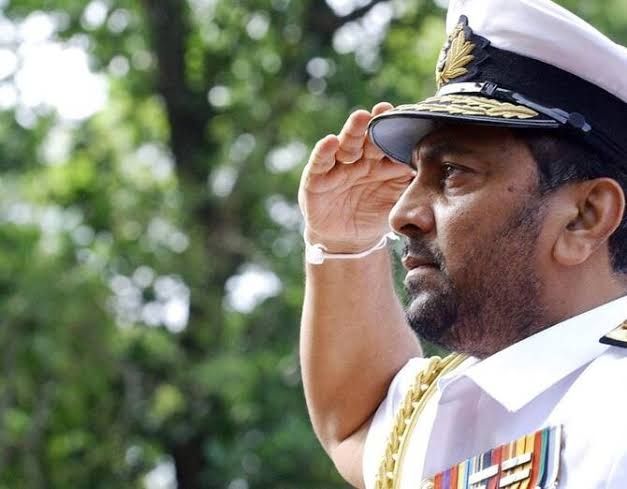
Sri Lanka has moved against Admiral of the Fleet Wasantha Karannagoda, one of the country's most senior retired military figures, over corruption allegations stemming from his role in facilitating preferential military treatment for a former president's family member. The 73-year-old Karannagoda was taken into custody by the Bribery Commission on Friday following accusations that he unlawfully enabled the 2006 navy enlistment of Yoshitha Rajapaksa, the son of former president Mahinda Rajapaksa, despite the younger Rajapaksa lacking the standard qualifications required for such a posting.
Karannagoda's career spanned Sri Lanka's most turbulent decades. He commanded the navy during the final stages of the country's civil conflict with Tamil separatist forces, a position of considerable influence during the 2009 conclusion of the war that had lasted nearly three decades. Following his retirement from active service, Karannagoda received promotion to admiral of the fleet in 2019, a largely ceremonial title that nonetheless underscored his standing within the military establishment. His current arrest marks a dramatic reversal of fortune for an officer who had largely escaped scrutiny during previous administrations.
The charges against Karannagoda extend well beyond mere administrative irregularities in military recruitment procedures. The Bribery Commission's statement explicitly framed his actions as corruption, suggesting that personal favour rather than institutional protocol guided his decision-making. This characterization carries significant weight in Sri Lanka's political climate, where military prerogatives have historically been treated with considerable deference. The case demonstrates a willingness by current authorities to challenge the entrenched position of senior defence figures, a departure from recent political practice.
Yoshitha Rajapaksa, the 38-year-old beneficiary of Karannagoda's alleged assistance, currently remains free on bail while facing his own charges in a separate but related matter. He stands accused of misappropriating public funds to finance training at the Royal Naval College Dartmouth, Britain's prestigious officer training institution. The accusation reveals a pattern of privilege and access that extended beyond simple recruitment into more substantial resource allocation. Yoshitha's detention last month triggered wider investigation into his financial history, uncovering questions about the sources of his wealth accumulated during his father's presidency.
The revival and expansion of legal action against military and political figures reflects the shifting political landscape that emerged following September 2024 elections. President Anura Kumara Dissanayake, who secured office on an explicit platform opposing corruption and impunity, has prioritized the prosecution of long-dormant cases involving the Rajapaksa family and their extensive network of business associates and political allies. This represents a fundamental recalibration of prosecutorial priorities compared to the previous administration, when such cases were actively suppressed.
Karannagoda additionally faces serious accusations beyond the recruitment matter. He has been sanctioned by the British government in March 2025 following allegations of grave human rights violations and alleged extrajudicial killings committed during the final period of the civil war. More specifically, he confronts charges related to his alleged involvement in the deaths of eleven young men killed between 2008 and 2009, crimes that prosecutors claim form part of a broader pattern of unlawful state violence. These particular charges had been formally dropped in October 2021 under the previous administration led by Gotabaya Rajapaksa, Mahinda's younger brother, but have been reinvigorated under the current government's commitment to addressing historical grievances.
The Rajapaksa family's legal exposure extends across multiple generations and encompasses various categories of alleged criminal conduct. Beyond Yoshitha's immediate predicament, other family members and close associates have accumulated pending charges covering diverse offences ranging from financial impropriety to alleged involvement in major security incidents. Most significantly, Gotabaya Rajapaksa himself was subjected to international travel restrictions last month following credible allegations linking him to the 2019 Easter Sunday bombing attacks that claimed 279 lives and wounded hundreds more. The restrictions effectively confine him within Sri Lankan borders pending resolution of those inquiries.
Yoshitha's personal financial situation has become a focal point for investigators examining how members of the Rajapaksa circle accumulated substantial wealth during years of political power. He has struggled to provide satisfactory explanations for his acquisition of residential property, initially attributing the funding to the sale of gemstones supposedly gifted by his paternal grandmother. However, subsequent investigation revealed that his relative could not herself explain the provenance of these precious stones, undermining Yoshitha's account and suggesting potentially unlawful wealth accumulation or money laundering activities.
For Malaysian observers, the Sri Lankan developments carry instructive implications regarding political transitions and accountability mechanisms. The shift from systematic suppression of prosecutions under the previous administration to aggressive pursuit of cases under Dissanayake's government illustrates how electoral change can rapidly alter the trajectory of legal proceedings involving powerful families. Sri Lanka's experience suggests that anticorruption mandates, while electorally popular, require sustained institutional commitment and face considerable resistance from entrenched interests with significant resources. The case also demonstrates the vulnerability of military figures when political protection evaporates, a dynamic with relevance across the Southeast Asian region where military institutions often occupy privileged positions within state structures.

