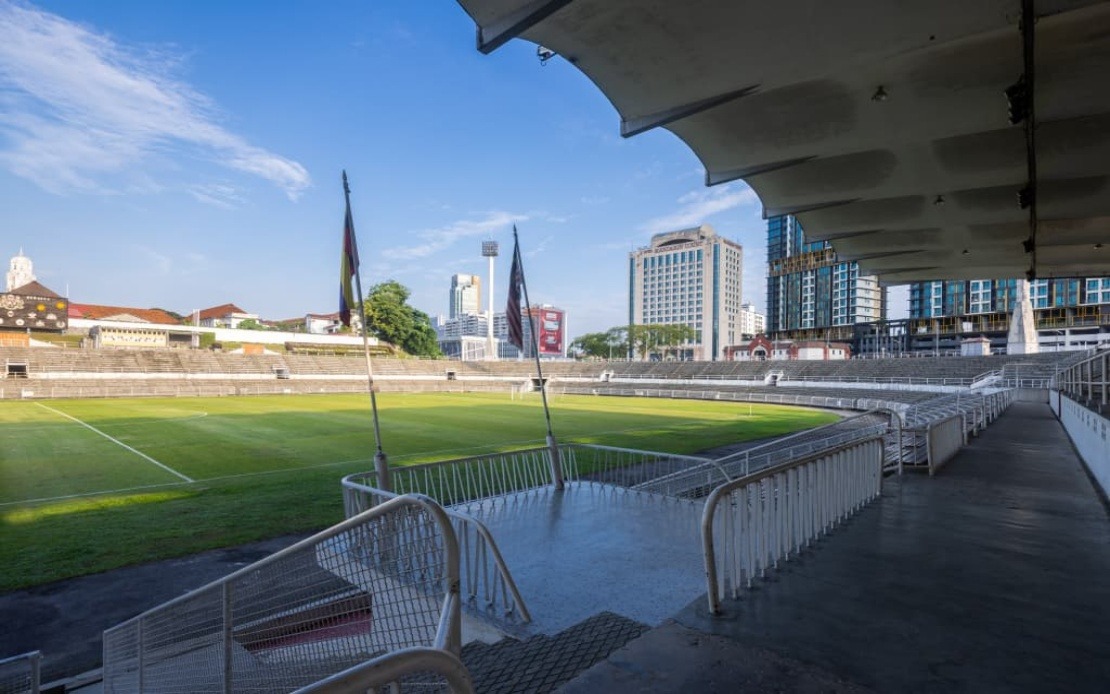
Nearly seven decades have elapsed since Stadium Merdeka witnessed one of Malaysia's most transformative moments—the proclamation of Malaya's independence by the nation's first Prime Minister, Tunku Abdul Rahman Putra Al-Haj. Today, this historic venue continues to stand as a living embodiment of the nation's freedom and identity, surrounded by modern development yet steadfastly preserving the memory of August 31, 1957, when "Merdeka!" rang out seven times across the venue's grounds.
The construction of Stadium Merdeka itself was a rapid undertaking, completed within a single year at a cost of approximately RM2.3 million—a significant investment for Malaya at the time. Its architectural significance extends beyond mere sporting capacity; the stadium served as the physical backdrop to Malaysia's most pivotal constitutional moment, making it far more than a typical athletic facility. The venue's prominence stems not merely from hosting independence celebrations but from embodying the aspirations and determination of a nation breaking free from colonial rule, as Professor Sarjit Singh Gill from Universiti Putra Malaysia's social anthropology programme emphasizes. According to the Chairman of the National Council of Professors' National Unity Cluster, the stadium encapsulates the nation's identity, dignity, and rich heritage in ways that textbooks alone cannot convey.
The historical significance of Stadium Merdeka extends beyond 1957. In 1963, the venue hosted another pivotal event—the proclamation of the Malaysian Federation's formation, effectively marking the end of British colonial administration in Sabah, Sarawak, and Singapore. This second ceremony demonstrated the stadium's continued role as the nation's chosen space for momentous governmental occasions. However, the venue's survival was not guaranteed. During the late 1990s, proposals for redevelopment threatened its existence, yet spirited public opposition combined with government intervention secured its preservation. This struggle to protect the site reflects broader Southeast Asian tensions between modernization pressures and heritage conservation.
The turning point in Stadium Merdeka's preservation came in 2000 when Permodalan Nasional Berhad assumed stewardship of the facility. Under PNB's management, particularly through PNB Merdeka Ventures Sdn Bhd, the organization has pursued a conservation philosophy centered on maintaining the stadium's authenticity while making it accessible to contemporary Malaysians. Datuk Dr Izwan Ibrahim, Chief Executive Officer of PNB Merdeka Ventures, articulates this dual mission: the stadium functions simultaneously as a reminder of historical achievement and as a representation of the aspirations that continue shaping Malaysia's trajectory. This approach recognizes that heritage preservation is not merely about freezing the past in amber but enabling ongoing engagement with it.
Restoration efforts have been meticulous and historically grounded. Conservation works referenced original Public Works Department construction drawings to ensure authenticity, with later architectural additions carefully removed to restore the original 20,000-seat capacity. Specific features including the scoreboard, washroom facilities, intricate mosaic tilework, and the distinctive cantilevered roof underwent detailed restoration to recover the stadium's original character. These technical decisions reflect a commitment to historical accuracy rather than cosmetic modernization, allowing visitors to experience the venue much as it existed during independence celebrations. The stadium's efforts attracted international recognition, receiving the UNESCO Asia-Pacific Heritage Award in 2008 and achieving National Heritage site status in 2009.
Beyond its symbolic value, Stadium Merdeka has evolved into a vibrant community space serving contemporary Malaysia. The refurbished track accommodates recreational runners and fitness enthusiasts, while the venue hosts cultural events that draw significant public attendance. Most notably, the Bazram Merdeka bazaar—a Ramadan celebration marketplace—attracted over 250,000 visitors earlier this year, demonstrating the stadium's capacity to bridge heritage appreciation with modern social engagement. This evolution from exclusively national ceremony venue to accessible community landmark represents a pragmatic approach to keeping heritage sites relevant and financially sustainable.
A particularly strategic focus for PNB involves cultivating younger Malaysians' connection with the stadium. For contemporary youth, 1957 exists primarily as classroom history or inherited family narratives rather than lived memory. Izwan Ibrahim emphasizes that direct experience fundamentally transforms understanding: when young Malaysians physically stand within Stadium Merdeka's confines, the historical abstractions encountered in textbooks crystallize into tangible, emotional comprehension. School visits and organized activities have already demonstrated this principle, with students recording Merdeka-related content and absorbing the venue's historical weight through sensory immersion. This generational engagement strategy acknowledges that heritage preservation depends on continuous transmission of meaning to succeeding populations.
The human dimension of Stadium Merdeka's preservation comes through the experiences of long-serving custodians like Alias Daud, who dedicated 35 years to the facility and spent his final decade caring for the venue under PNB management. For Daud, Stadium Merdeka transcends its function as a workplace, representing instead a profound personal connection to national memory. His observations about visitors—people from diverse backgrounds arriving with distinct stories and memories, often amazed to learn that independence was proclaimed within these specific walls—illuminate how the stadium continues activating emotional responses around Malaysian identity. Particularly during the August national month, government agencies, schools, and universities converge on the venue to commemorate and document the historical narrative, with younger visitors demonstrating particular enthusiasm for learning and photographing the site.
The physical setting of Stadium Merdeka has transformed dramatically. Where once only colonial-era buildings and modest structures surrounded the venue, towering contemporary developments now rise nearby, including the striking Merdeka 118 (Menara Merdeka Maybank). This architectural contrast creates a powerful visual metaphor for Malaysia's journey—the modest but historically momentous stadium dwarfed by symbols of contemporary economic achievement. Yet rather than disappearing into irrelevance amid modern skyscrapers, the stadium's historical weight has paradoxically increased as rapid development renders tangible connections to national founding moments increasingly precious.
Stadium Merdeka's preservation and activation represent instructive models for other Southeast Asian nations grappling with heritage conservation amid development pressures. The venue demonstrates that historical sites need not remain static museum pieces; rather, thoughtful stewardship can sustain their cultural relevance while accommodating contemporary community needs. The stadium functions simultaneously as custodian of August 31, 1957—that singular moment when Malaya's sovereignty crystallized—and as dynamic public space serving modern Malaysian society. This balance between preservation and vitality, between honoring the past and engaging the present, ensures that Stadium Merdeka continues speaking meaningfully to successive generations of Malaysians.
As Malaysia continues its development trajectory, Stadium Merdeka stands as a powerful counterpoint to the relentless march of modernization. The venue embodies the principle that material progress need not erase historical memory; indeed, purposeful heritage preservation can enhance national identity and social cohesion. For Malaysians navigating an increasingly complex contemporary landscape, Stadium Merdeka offers something irreplaceable—a place where one can literally stand where independence was proclaimed, where the spirit of national aspiration remains palpable, and where the values animating Malaysia's founding moment can be directly encountered. In this sense, the stadium's greatest significance may lie not in what it represents about Malaysia's past, but in what it enables for Malaysia's future: a grounded connection to the freedoms previous generations secured.

