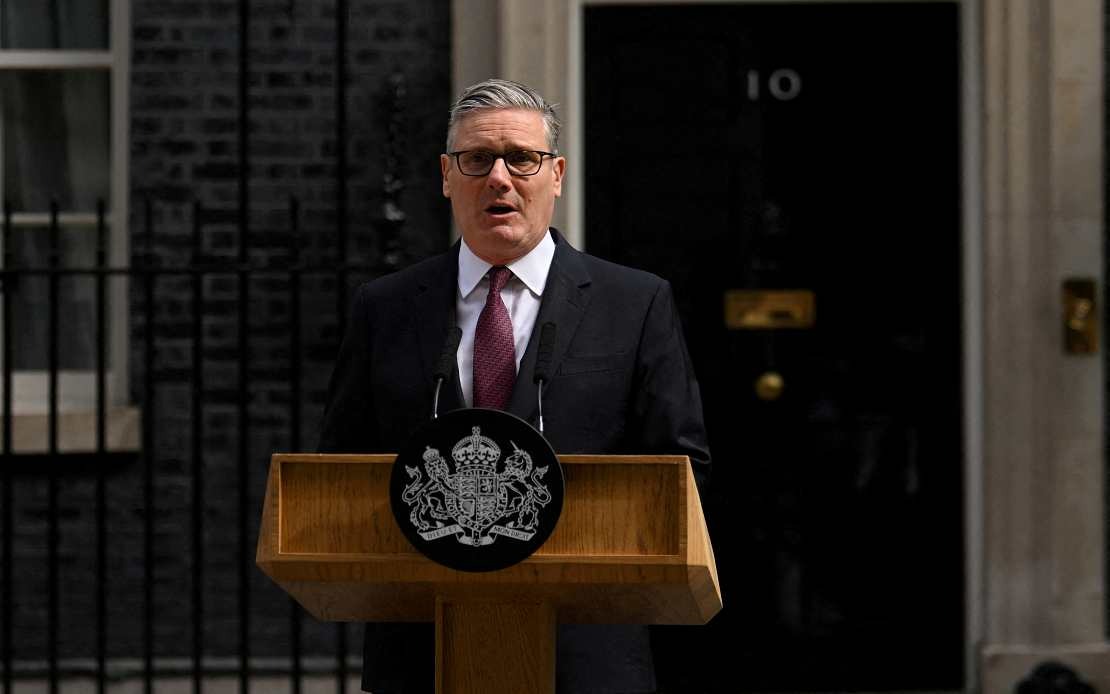
Keir Starmer has delivered his closing address as British Prime Minister, telling gathered supporters and colleagues that his work is finished and that he departs with satisfaction. Speaking at his residence in Downing Street on Monday before formally tendering his resignation to King Charles III, the outgoing leader maintained an upbeat tone whilst acknowledging the conclusion of his tenure leading the United Kingdom's government.
Starmer, accompanied by his wife Victoria and various political associates, expressed confidence in the current state of the nation as he prepares to hand authority to his successor. His remarks centred on the accomplishments achieved during his relatively short spell in Number 10, emphasising that the country has progressed significantly since Labour's electoral triumph last year. The departing prime minister is heading to Buckingham Palace to officially resign his position, a formal constitutional procedure that will clear the path for Andy Burnham to assume leadership.
The timing of Starmer's departure comes after a substantial electoral mandate. He led Labour to a decisive general election victory in 2024, transforming the party's fortunes following what he characterised as a catastrophic defeat five years earlier. During his leadership campaign and subsequent tenure, Starmer focused on repositioning Labour as a viable governing force, moving away from the party's previous direction and building broader appeal amongst British voters. The scale of last year's election victory provided his government with considerable parliamentary authority.
During his two years as prime minister, Starmer has focused on establishing what he frames as a more equitable and robust society. His parting message stressed improvements in national competitiveness and fairness, suggesting that governmental policies have strengthened Britain's position whilst addressing social inequalities. These claims form the backbone of his legacy narrative as he transitions out of office, though his relatively brief tenure means that assessing the full impact of his administration remains an ongoing undertaking.
Andy Burnham, the incoming prime minister, brings extensive experience from his previous roles in government and his tenure as Mayor of Greater Manchester. His ascension marks a generational shift in British political leadership and represents continuity within the Labour party's hold on power. Burnham's appointment follows the established procedure where the monarch invites the leader of the majority party to form a new administration, a constitutional convention that remains unchanged despite broader political transitions.
The transition between Starmer and Burnham unfolds against the backdrop of evolving global challenges and domestic economic conditions that will shape the incoming administration's agenda. Britain continues to navigate complex international relationships whilst addressing persistent domestic concerns around cost of living, healthcare delivery, and public sector reform. The new prime minister will inherit these challenges alongside the advantages of parliamentary control that Labour currently enjoys.
Starmer's reflection on his party's transformation deserves particular attention when considering British political developments. His assertion that he reshaped Labour from a position of significant electoral weakness into a winning force highlights the volatility of modern British politics. The party's recovery from what he terms a historic defeat demonstrates both the capacity for political renewal and the unpredictable nature of electoral contests in democracies with established two-party systems.
For Malaysian and Southeast Asian observers, the British leadership transition offers insights into Westminster governance and democratic succession procedures. Unlike systems in various Asian nations where power transitions occasionally generate constitutional uncertainty or institutional friction, the British process exemplifies orderly transfer mechanisms. The formal resignation to the monarch, the invitation to form a new government, and the acceptance of electoral mandates represent institutional stability that transcends individual political figures.
Burnham's leadership appointment also reflects broader trends in centre-left political movements across developed democracies. Like similar parties across Europe and North America, Labour has sought to recalibrate its messaging and policy direction to maintain electoral viability. This adaptation process, whilst specific to British circumstances, mirrors challenges faced by progressive parties globally in responding to voter preferences and shifting political alignments.
The peaceful handover between Starmer and Burnham reinforces the resilience of British constitutional arrangements, which rely substantially on convention and mutual acceptance of established procedures rather than detailed codification. This system has endured for centuries partly because successive governments respect these unwritten understandings, a principle that continues to guide the current transition despite fundamental changes in party control and individual leadership.
As Burnham assumes office, he confronts policy decisions ranging from economic management and public spending priorities to Britain's international positioning and domestic social reforms. His government's early legislative programme will likely signal priorities and set the tone for its term, with implications extending beyond British shores given the United Kingdom's continued significance in international affairs and its role within various multilateral organisations.

