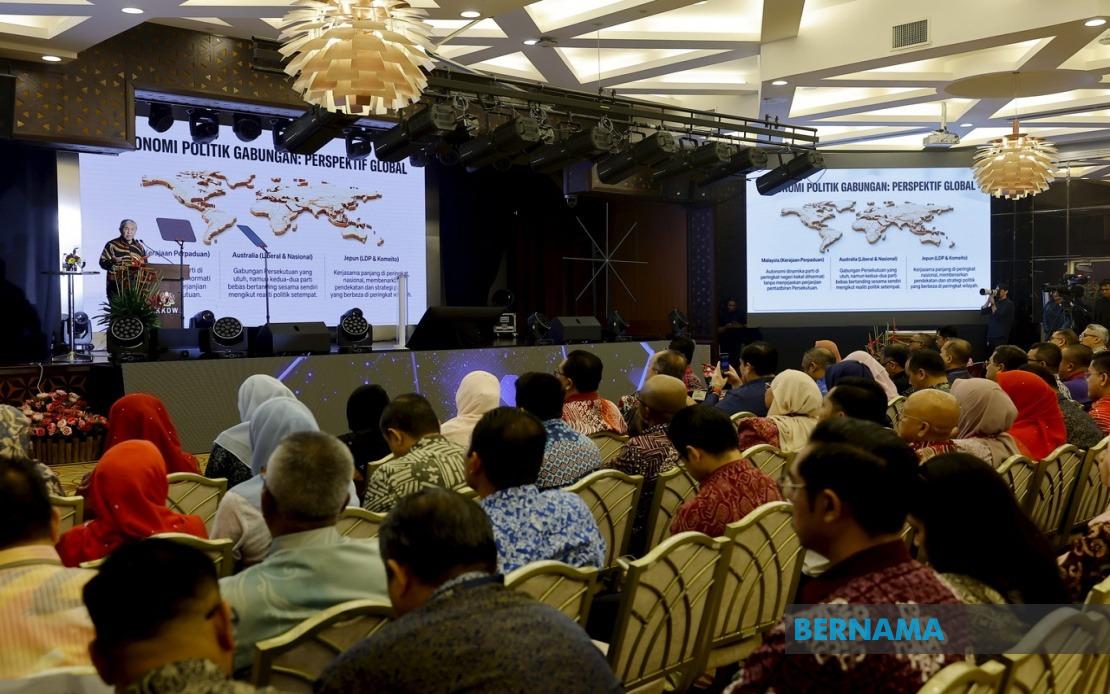
Deputy Prime Minister Datuk Seri Dr Ahmad Zahid Hamidi moved to reassure the nation on Wednesday that Malaysia's federal government would remain on steady ground regardless of shifting political dynamics unfolding across individual states. Speaking at a Rural and Regional Development Ministry assembly in Putrajaya, the Barisan Nasional chairman stressed that the Unity Government framework rests on mutual understanding and a binding agreement that will endure until Parliament is formally dissolved, providing sufficient structural safeguards against instability at the national level.
The assurance comes as Malaysia's political landscape continues to fragment along state lines, particularly following competitive state elections in Johor and Negeri Sembilan where coalition partners have pursued divergent strategies and outcomes. Rather than viewing such local contests as threats to Putrajaya's equilibrium, Zahid positioned them as natural extensions of individual parties' mandates to their supporters. He contended that state-level political manoeuvring neither constitutes a fundamental breach of the federal compact nor signals any intention to undermine the agreed-upon direction of the MADANI Government's national agenda.
Zahid's comments reveal an important distinction in how Malaysia's leadership conceptualises coalition governance. The Unity Government, which brought together previously rival factions following the 2022 general election, operates on a model where participating parties maintain their separate political identities and strategic autonomy while accepting constraints around core federal policy. This arrangement allows coalition members to compete fiercely in state elections, pursue different messaging strategies with their grassroots supporters, and even propose alternative candidates or agendas at subnational level, provided they do not fundamentally challenge the federal government's constitutional authority or legislative programme.
The practical implications for Malaysian policymaking are significant. Zahid explicitly confirmed that regardless of which coalition partners gain or lose ground in state contests, the federal government's administrative machinery will continue functioning without disruption. This continuity becomes particularly important given Malaysia's ambitious portfolio of development projects, institutional reforms, and economic initiatives that require sustained political focus and resource allocation over multiple years. Any suggestion of federal paralysis or coalition collapse following state elections would jeopardise these long-term commitments and potentially unsettle both domestic investors and international observers monitoring political stability.
For Southeast Asian regional analysts, Zahid's statement underscores a maturing approach to coalition management in a diverse, multi-ethnic democracy. Rather than demanding absolute conformity across all governance levels, the Unity Government permits what might be termed "structured pluralism"—a framework where parties surrender autonomy on federal matters while retaining decision-making power in their respective state strongholds. This approach theoretically reduces tensions that might otherwise arise if national coalition partners felt compelled to suppress their regional organisations or suppress internal disagreements.
However, this model carries inherent tensions that Malaysia's political actors must continually manage. Recent elections in Johor and Negeri Sembilan demonstrated how state-level contests can produce outcomes that seemingly contradict the national coalition's composition or messaging priorities. When coalition partners achieve different results in different states, questions inevitably surface about the true stability and coherence of the federal arrangement. Zahid's framing attempts to address such concerns by establishing clear principles: coalition partners may pursue competing electoral strategies at state level, but must respect the parliamentary arithmetic and policy framework established at the federal centre.
The timeframe Zahid referenced—the period until Parliament is dissolved—also warrants examination. This language suggests the Unity Government views itself as a transitional arrangement with a defined endpoint rather than a permanent realignment of Malaysian politics. By anchoring the coalition's durability to parliamentary dissolution rather than indefinite commitment, Zahid implicitly acknowledges that the arrangement could be restructured following the next general election. This framing may reduce pressure on coalition members to suppress internal disagreements, as each party can credibly position itself as maintaining independent political options beyond the current federal arrangement.
For ordinary Malaysians, the practical relevance of Zahid's statement centres on assurance that essential government functions will persist without interruption. Public services, development projects, and policy implementation depend on federal stability. Citizens in states experiencing political transitions can be reasonably confident that national government services and programmes will continue unaffected by local electoral outcomes. This separation between state and federal political dynamics, while intellectually tidy, demands constant vigilance from political leadership to prevent state-level grievances from metastasising into federal disputes.
The broader question implicit in Zahid's remarks concerns whether such two-tier political autonomy can genuinely be sustained indefinitely. Historical experience with coalition governments worldwide suggests that clear institutional boundaries and agreed protocols help, but personal relationships, factional dynamics, and evolving electoral calculations ultimately determine whether coalitions hold. Malaysia's Unity Government will face periodic tests as state elections deliver unexpected results, senior party figures shift positions, or perceived imbalances in ministerial representation or resource allocation accumulate resentment among coalition members.
Zahid's emphasis on honouring the foundational agreement contains strategic wisdom. By repeatedly stressing that coalition stability rests on fidelity to explicit understandings rather than blind loyalty or implicit assumptions, the Deputy Prime Minister frames any future breach as a deliberate choice to violate agreed terms rather than a response to inevitable pressures. This approach provides coalition members with an exit if they choose it, while making such exit costly in political terms by requiring them to justify abandonment of a publicly endorsed agreement.
Looking forward, the strength of Zahid's assurances will ultimately be tested by concrete developments. If state-level political competition produces sharp regional divides that threaten to fragment parliamentary voting patterns, or if particular states experience governance failures that the federal coalition is blamed for tolerating, public confidence in this two-tier model may erode. Conversely, if Malaysia's economy performs robustly and development initiatives progress visibly despite state-level political churn, voters may gradually accept that coalition diversity at state level is compatible with federal stability and competent administration.

