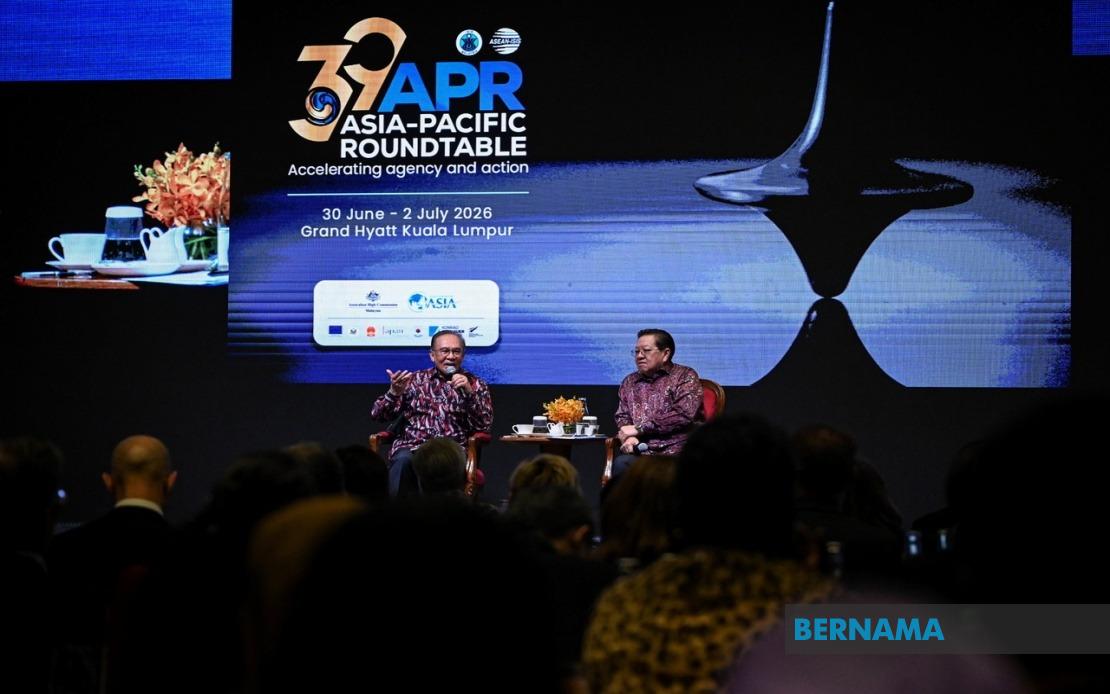
Prime Minister Datuk Seri Anwar Ibrahim has placed domestic institutional reform at the centre of his government's agenda, positioning good governance as the foundation upon which Malaysia's international credibility must rest. Speaking at the 39th Asia-Pacific Roundtable in Kuala Lumpur, Anwar articulated a vision in which the nation's capacity to address internal challenges determines its ability to influence global discourse meaningfully. This framing reflects a strategic recalibration of priorities, signalling to both domestic stakeholders and the international community that Malaysia's influence abroad is contingent upon the strength of its institutions at home.
The Prime Minister outlined a comprehensive governance framework anchored on four interconnected pillars: institutional strengthening, anti-corruption efforts, equitable resource distribution, and universal access to essential services. Anwar stressed that eradicating corruption represents not merely a administrative necessity but a moral imperative that underpins public trust and national resilience. By explicitly linking governance improvements to citizen welfare—particularly in education and healthcare—he positioned reform as directly benefiting ordinary Malaysians rather than serving abstract institutional goals. This emphasis carries particular weight in Southeast Asia, where governance deficits and corruption perception remain persistent obstacles to equitable development.
Centrally, Anwar rejected the notion that global divisions should be understood through the lens of civilizational conflict, instead proposing that many international tensions originate in mutual misunderstanding and prejudicial thinking. Invoking Edward Said, the late Palestinian-American scholar, Anwar reframed contemporary geopolitical friction as a "clash of ignorance" rather than an inevitable collision between fundamentally incompatible worldviews. This intellectual positioning carries significance for Malaysia, a nation navigating complex relationships across multiple strategic spheres while maintaining its identity as a Muslim-majority democracy. By decoupling religious and cultural identity from geopolitical alignment, Anwar attempted to create conceptual space for Malaysia to chart an independent course.
The Prime Minister emphasized that Malaysia's commitment to principled international engagement remains intact, yet he was clear that immediate attention must focus on demonstrating that a Muslim-majority nation can simultaneously champion democratic norms, political moderation, and inclusive governance. This dual message addresses both international audiences concerned about democratic backsliding in the region and domestic constituencies seeking reassurance that Malaysia's Islamic character is compatible with pluralism and democratic practice. The assertion that Malaysia can model an alternative pathway carries implications for other Muslim-majority nations grappling with similar tensions between religious identity and democratic governance.
Anwar's invocation of the MADANI framework reveals an attempt to synthesize technological modernization with humanistic values, rejecting false dichotomies between material progress and social cohesion. By privileging both technological advancement and human dignity within a single governing philosophy, the framework addresses Malaysia's need to remain economically competitive while preserving social fabric that could fray under unchecked globalization and rapid technological change. For Southeast Asian observers, this represents a counterpoint to development models that prioritize growth metrics while bracketing questions of cultural preservation and social justice.
Particular emphasis emerged regarding Malaysia's multiracial, multireligious composition, with Anwar drawing upon the Quranic concept of "li ta'arafu"—often translated as mutual recognition or understanding. Rather than advocating mere tolerance of difference, Anwar elevated the aspiration to genuine comprehension and appreciation of diverse perspectives. This philosophical distinction proves consequential in Malaysian political discourse, where tolerance has sometimes functioned as a ceiling rather than a floor for intercommunal relations. By reframing the national project around deepened mutual understanding, Anwar positioned Malaysia's diversity as a strategic asset rather than a governance challenge requiring careful management.
The Prime Minister's remarks came during an extended question-and-answer format at a prestigious regional forum, affording him opportunity to develop arguments at length rather than through compressed soundbites. This venue choice suggests deliberate engagement with elite regional audiences—academics, policymakers, business leaders—whose interpretations of Malaysian governance trajectories influence regional confidence and investment decisions. The positioning of governance as the primary responsibility simultaneously conveys message to international observers that Malaysia is serious about institutional reform while reassuring domestic constituencies that their immediate needs drive government strategy.
For Malaysian readers, Anwar's emphasis on eradicating corruption and ensuring healthcare and education access connects to lived experience of institutional shortcomings that constrain social mobility and erode public confidence. By explicitly centering these concerns at a high-level international forum, he validated concerns that often remain marginalized in elite policy discourse. The commitment to reduce inequality, while not elaborated with specific metrics or timelines, signals recognition that Malaysia's persistent wage gaps and unequal access to quality services represent fundamental governance failures.
The MADANI framework's emphasis on balance between technological and human values addresses anxieties within Southeast Asia regarding the disruptive potential of rapid digitalization and artificial intelligence. By insisting that advancement must remain tethered to humanistic concerns, Anwar's government articulated a position potentially resonant with other regional governments navigating similar challenges. This stance could prove influential if Malaysia successfully demonstrates that technological progress need not come at the cost of social cohesion or cultural preservation.

