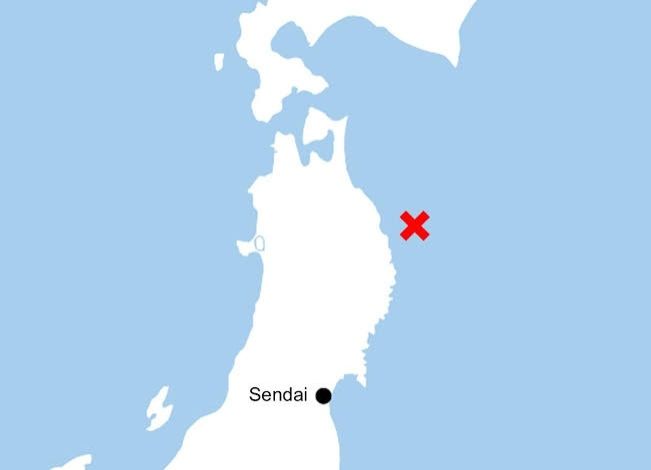
A powerful 7.2-magnitude earthquake jolted northern Japan on Thursday morning, June 25, sending tremors across a vast swath of the country without inflicting the widespread devastation that seismic events can bring to densely populated regions. The undersea quake, centred off Iwate prefecture on the island of Honshu and occurring at 7:30 am local time, registered with sufficient force to rattle kitchen utensils and security equipment across multiple prefectures, yet residents and authorities confirmed that casualties and major structural damage remained absent from preliminary reports.
The Japan Meteorological Agency initially measured the event at 6.9 magnitude before revising the figure upward to 7.2, pinpointing the epicentre at a depth of 44 kilometres beneath the ocean floor. This particular depth proved consequential, as deeper quakes typically dissipate their energy more gradually than shallow tremors, which often produce more violent ground shaking at the surface. The absence of a tsunami warning signalled that scientists found no indication the seismic event had displaced sufficient water to pose coastal hazards, a critical distinction in a nation where tsunami risks frequently accompany major offshore earthquakes.
In Aomori prefecture to the north, where the shaking registered at the upper sixth level on Japan's seven-point Shindo intensity scale, residents experienced the kind of violent ground motion that can disorient people and destabilise unsecured objects. Mutsumi Shimohata, a 61-year-old food processing employee in Hashikami, described how an alert on her smartphone sounded almost instantaneously as the tremor began, underscoring the sophisticated early warning systems Japan has developed since devastating quakes in previous decades. While her home sustained only minor damage—a fallen picture frame—her employer took precautions by ordering staff to remain at home and stand ready after their office's automatic doors malfunctioned and portions of the ceiling gave way.
Television footage captured scenes of cupboards disgorging kitchenware and shelving units spilling merchandise across shop floors, visual reminders of the lateral forces that earthquakes impose on structures. Emergency services fielded multiple distress calls, including reports of at least four incidents requiring response in Hashikami and Hachinohe, with personnel responding to trapped individuals in a lift and malfunctioning doors. A tanker truck overturned during the quake, and certain shinkansen bullet train services experienced temporary suspension as operators implemented safety protocols. A primary school in Hashikami closed temporarily to allow authorities to assess structural integrity and ensure student safety.
Government spokesman Minoru Kihara told the public that no confirmed casualties had been reported at that stage, though officials committed to ongoing monitoring of damage assessments across affected areas. The Nuclear Regulation Authority issued assurances that regional nuclear power stations had registered no abnormalities, a critical concern in a nation still contending with the legacy of the 2011 Fukushima disaster. Prime Minister Sanae Takaichi directed ministries and government agencies to coordinate closely with local authorities and urged residents in heavily shaken areas to remain vigilant for potential aftershocks of comparable magnitude.
Japan's position atop four major tectonic plates along the Pacific Ring of Fire renders the archipelago one of Earth's most seismically volatile regions, accounting for approximately 18 per cent of the world's earthquake activity despite occupying far less than one per cent of the planet's surface area. The 125 million inhabitants experience hundreds of seismic jolts annually, the vast majority causing no significant harm. However, the unpredictability of earthquake location and depth means that damage potential varies considerably, and the nation remains acutely conscious of catastrophic scenarios after the 2011 Tōhoku earthquake and tsunami, which measured 9.0 magnitude and killed or left missing roughly 18,500 people whilst triggering the Fukushima nuclear accident.
This latest seismic event followed a concerning precedent established merely two months earlier, when a 7.7-magnitude quake struck northern Japan on April 20, injuring at least 10 people and shaking tall buildings across Tokyo with sufficient force that authorities subsequently issued a special advisory warning of elevated risk for earthquakes measuring 8.0 or greater. That advisory remained in effect for one week before being withdrawn, illustrating how Japan's scientific and emergency management institutions evaluate and communicate evolving seismic hazards to the public.
The measured response to Thursday's earthquake reflects the institutional maturity Japan has cultivated through decades of earthquake research, engineering innovation, and emergency preparedness drills. Modern building codes, early warning systems that provide seconds of notice before strong shaking arrives, and a culturally ingrained awareness of earthquake safety have substantially reduced casualty rates compared to seismic events of similar magnitude in less prepared nations. Nevertheless, the persistence of seismic activity across the archipelago ensures that preparedness remains an ongoing necessity rather than a periodic concern for Japanese authorities and residents alike.

