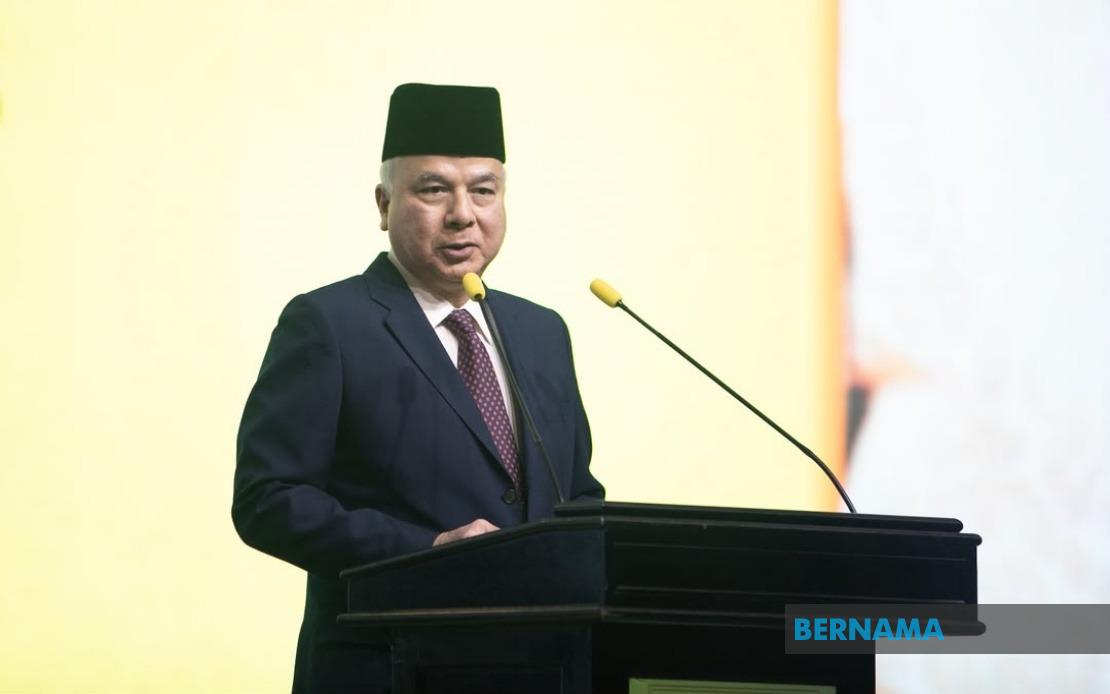
Speaking at the 8th World Conference on Islamic Thought and Civilisation in Ipoh, the Sultan of Perak, Sultan Nazrin Shah, delivered a forthright assessment of what separates successful societies from those that disappoint their citizens. His analysis cuts to the heart of governance debates across Southeast Asia, where resource-rich economies often struggle to convert potential into equitable prosperity. Sultan Nazrin argued that abundance—whether measured in natural wealth, human capital, or cultural heritage—means little without the institutional scaffolding to channel those assets toward collective benefit. This observation resonates particularly in Malaysia, where decades of commodity dependence have sometimes masked institutional weaknesses and governance failures that periodically surface.
The Sultan framed good governance not as an abstract ideal but as a practical matter of coordinating several interdependent systems. Strong institutions must be durable enough to outlast individual leaders, preventing power from becoming personalised and insulating decision-making from the whims of charismatic figures. Transparency in managing public finances reassures citizens that their tax contributions genuinely serve shared interests rather than enriching elites. The rule of law, applied impartially and without exception, ensures that accountability descends upon the powerful while protecting the vulnerable from arbitrary treatment. These three pillars—durability, transparency, and impartial law—form what the Sultan characterised as the foundation upon which citizens can build confidence in their state. For Malaysian policymakers, this framework challenges the tendency toward executive-led governance and demands genuine institutional independence in legislative, judicial, and enforcement spheres.
Crucially, Sultan Nazrin reframed political stability as something fundamentally different from the suppression of disagreement. Many of the world's most stable democracies thrive amid vigorous debate, he noted, precisely because their institutional systems channel conflict through legitimate channels rather than allowing it to spill into extraconstitutional confrontation. The distinction matters enormously for Malaysia, where political turbulence in recent years has sometimes been attributed to excessive competition when the real problem has been the erosion of shared rules governing electoral fairness, judicial independence, and bureaucratic neutrality. When citizens lose faith that elections reflect genuine choice, that courts operate free from political influence, or that civil service positions reward merit rather than patronage, the social contract frays catastrophically. The Sultan identified the poorest and most marginalised citizens as the first victims of such decay—a reminder that governance failures are not merely technical or procedural matters but profoundly moral ones with direct consequences for human welfare.
The Sultan employed the striking metaphor of the budget as a moral document, arguing that expenditure patterns reveal governmental priorities more nakedly than any mission statement. This formulation invites Malaysian readers to examine their own government's allocation decisions and ask whether they reflect genuinely inclusive priorities or merely symbolic gestures. A civil service genuinely serving all citizens regardless of their ethnicity, religion, or political affiliation represents state unity made concrete rather than rhetorical. Leaders who exercise power with humility, who listen before legislating, and who recognise their authority as temporary stewardship rather than personal possession generate far deeper loyalty and national pride than slogans or propaganda campaigns. This sentiment implicitly critiques leadership styles that dominate decision-making, marginalise dissent, and treat public office as personal domain—patterns Southeast Asian democracies must actively resist through institutional strengthening and cultural change.
Transitioning to economic dimensions, Sultan Nazrin argued that development cannot be pursued in isolation, particularly for smaller economies dependent on foreign markets and investment. No nation, regardless of talent or resources, succeeds by autarky, he contended. Trade, investment flows, knowledge exchange, and technological transfer constitute the vital currents enabling modern prosperity. Cooperation across borders, between public and private sectors, and between government and civil society emerges not as optional luxury but as operational necessity for sustainable growth. Economies embracing open trade while simultaneously building resilient, diversified domestic industries outperform those retreating into protectionism or relying excessively on single sectors—a pointed observation for Malaysia, which continues grappling with its dependence on hydrocarbon revenues and should note the caution against narrow specialisation.
Yet the Sultan introduced a critical caveat: cooperation must not become a euphemism for dependency, nor should openness come at the cost of national sovereignty or the capacity for independent strategic choice. This balanced formulation acknowledges genuine tensions in contemporary globalisation—the pull toward integration and specialisation versus the imperative to maintain domestic policy space and avoid vulnerability to external shocks. Among the most sophisticated economies, wisdom lies in managing this tension, welcoming foreign investment and expertise while building local capacity and ensuring critical sectors remain under national control or influence. For Malaysia specifically, this translates into selectivity about which industries to globalise, which to protect, and where to develop indigenous technological and managerial capabilities rather than accepting permanent dependency.
Sultan Nazrin devoted particular attention to Islamic finance, an area where Malaysia has built genuine competitive advantage as a global hub for sukuk issuance, takaful schemes, and Syariah-compliant fund management. Yet, he suggested, the sector remains profoundly underutilised relative to its potential. Islamic finance offers more than mere compliance with prohibitions on riba, he argued; it embodies a distinctive philosophy centring on risk-sharing, asset-backing, and equitable participation in economic returns. This philosophical foundation could position Islamic finance as a transformative tool for cross-border infrastructure investment, small and medium enterprise financing across the Organisation of Islamic Cooperation, and the patient capital necessary for addressing development challenges ranging from water provision to renewable energy deployment. The observation implicitly challenges both Western finance practitioners and Islamic finance operators to move beyond technical compliance toward genuine engagement with the underlying ethical frameworks, potentially unlocking more productive capital flows between developed and developing economies within the Muslim world and beyond.
The Sultan's address carried implications extending well beyond Malaysia. His emphasis on institutional resilience rather than leader-dependence directly addresses governance challenges across Southeast Asia, where concentration of power in executive figures repeatedly generates instability when those leaders depart. His insistence on transparent, rule-governed political competition offers a counternarrative to authoritarian efficiency models that periodically gain currency when democracies appear slow or contentious. His framing of development as requiring both openness and national capacity-building acknowledges legitimate anxieties about sovereignty and dependency in the region while rejecting isolationism as economically self-defeating. For Malaysia particularly, a nation with sophisticated institutions that have nonetheless periodically faltered under political pressure, the Sultan's framework provides intellectual resources for renewal—demanding institutional independence, democratic fairness, inclusive policymaking, and leadership characterised by restraint and service rather than personal aggrandisement.

