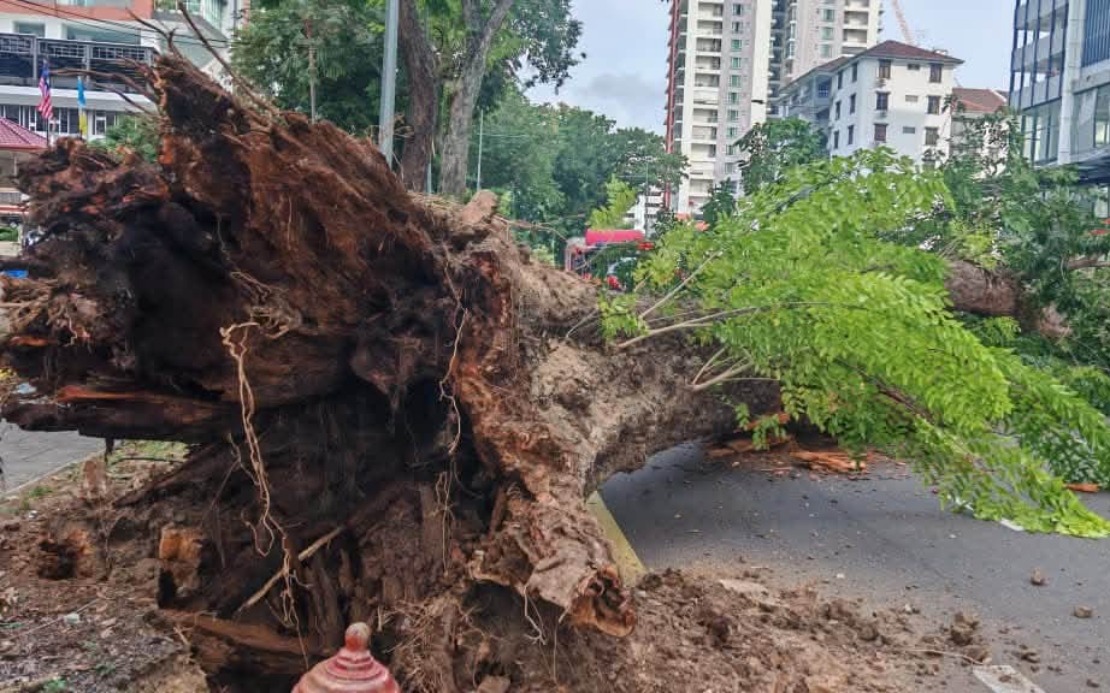
A 90-year-old Angsana tree toppled onto a moving vehicle along Jalan Macalister in George Town on August 9, leaving three occupants injured when their Perodua Ativa sports utility vehicle was struck by the falling timber. The incident occurred at approximately 9 am without preceding reports of severe weather, prompting Penang's municipal government to conduct a detailed investigation into the structural causes of the tree's catastrophic failure.
Penang Municipal Council (MBPP) Mayor Datuk A. Rajendran identified multiple compounding factors in the collapse of the 28-metre-tall Pterocarpus indicus specimen. The tree exhibited approximately 30 per cent root rot penetration and cavity decay accounting for roughly 40 per cent of its base trunk structure. These two primary defects, acting in concert with chronic soil compaction beneath the surrounding pavement and severely restricted rooting space, created conditions that substantially heightened the likelihood of sudden structural failure given the tree's considerable height and weight distribution.
The investigation revealed that municipal maintenance activities, specifically infrastructure upgrading works in the vicinity, had further stressed the compromised specimen. The combination of these human-induced pressures alongside the tree's natural deterioration through fungal and decay processes created a hazardous situation that ultimately proved unsustainable. Rajendran emphasised that the absence of adverse weather conditions at the time of collapse underscored the tree's already precarious structural state, indicating that failure was not a weather-triggered event but rather an inevitable consequence of accumulated internal degradation.
MBPP's response to the incident was swift and methodical. The fallen tree was removed by 9.41 am, with clearance of Jalan Macalister completed by 2.20 pm to restore normal traffic flow. The rapid mobilisation of removal equipment demonstrated the council's emergency preparedness protocols, though questions persist about why earlier intervention had not occurred despite the tree's advanced age and urban location adjacent to a major thoroughfare.
Prior inspection activities had theoretically positioned the council to identify at-risk specimens. A comprehensive 2024 assessment of mature and aged trees along Jalan Macalister resulted in 13 trees being flagged for removal, all of which have subsequently been felled. Additionally, remote sensing analysis conducted in 2023 had categorised the trees along this corridor as being in satisfactory condition with no visible warning indicators, a finding that suggests either the technology's limitations or the possibility that deterioration accelerated more rapidly than anticipated between assessment intervals.
Maintenance work on Jalan Macalister had been performed as recently as January 29 this year, yet this service apparently failed to identify or address the structural deficiencies that ultimately precipitated the tree's collapse. This gap between maintenance activities and the catastrophic failure raises important questions about inspection methodologies and the adequacy of visual assessment protocols for detecting internal decay processes that may not be immediately apparent from external examination.
MBPP's broader tree management efforts reveal the scale of urban arboriculture challenges facing the council. Of 179 high-risk trees approved for removal during the current year, 148 have been felled to date. Over the first nine months of 2024, 247 trees were removed citywide. The variety of reasons for removal—including drainage obstruction, dead wood status, structural lean, development conflicts, infrastructure projects, and pipeline encroachment—illustrates the competing pressures on urban tree stock in a densely developed environment.
A comprehensive 2023 inventory identified 2,535 trees requiring intervention under various risk categories. The breakdown encompassed 45 cases of drainage obstruction, 138 dead specimens, 2,242 trees requiring risk assessment or other categorisation, and 110 linked to development or infrastructure projects. This massive inventory underscores the ongoing tension between retaining mature trees as environmental and amenity assets and managing legitimate safety hazards within densely populated urban corridors.
The collapse has prompted accelerated action by MBPP directed at its appointed contractor. Instructions have been issued to expedite height reduction work and expedite felling of specimens presenting collapse risks along Jalan Macalister, with all decisions informed by certified arborist assessments. This reactive intensification represents a significant shift in the council's tree management pace, driven by the demonstrated consequences of delayed intervention on a major urban route.
For Malaysian municipalities facing similar challenges, the Jalan Macalister incident underscores the complex calculus between heritage preservation and public safety. Urban trees, particularly specimens nine decades old, represent irreplaceable environmental and aesthetic resources. Yet structural failure capable of injuring occupants of motor vehicles or damaging property cannot be tolerated merely for sentimentality. The incident suggests that municipalities require more sophisticated inspection technologies, shorter reassessment cycles for high-risk specimens, and pre-established protocols for rapid intervention on trees presenting demonstrable hazard risks.
The MBPP case also highlights how infrastructure modernisation—road widening, utilities upgrades, and development pressures—inevitably conflicts with the spatial requirements of mature urban trees. The soil compaction and rooting space restriction identified in the Angsana tree's circumstances are universal consequences of intensive urbanisation throughout Southeast Asia's rapidly developing cities. As urban densification accelerates across Malaysia, municipal councils will require enhanced resources and expertise to maintain viable tree populations while managing legitimate public safety concerns.

