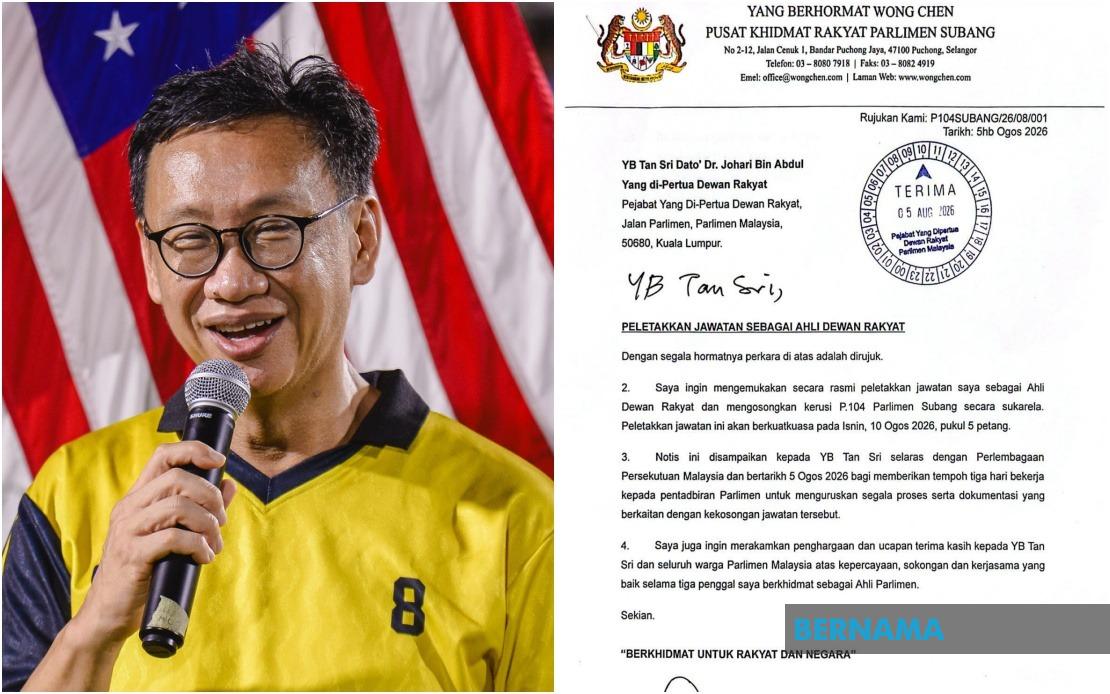
Wong Chen, the long-serving Member of Parliament for Subang, has formally stepped down from his position in the Dewan Rakyat, bringing an end to a parliamentary career spanning three consecutive terms. The resignation took effect at 5:00 pm on August 10, 2026, after Wong submitted his official letter to Speaker Tan Sri Johari Abdul on August 5, providing advance notice to allow Parliament administration adequate time to process the vacancy and prepare for the subsequent by-election process.
In announcing his departure through a Facebook post, Wong Chen expressed appreciation for the opportunity to serve his constituents and for the support he received from parliamentary leadership and staff during his time in office. The advance notification, submitted five days before the effective date, underscores a commitment to orderly parliamentary procedure and reflects Wong's concern for ensuring a smooth transition rather than creating administrative disruption through an abrupt exit.
The resignation was executed in accordance with provisions of the Federal Constitution, which establishes the legal framework for members to voluntarily vacate their seats. Wong's departure from Parliament marks a significant development in Malaysian politics, particularly for Subang, one of the Klang Valley's key constituencies and a region that has witnessed considerable demographic and economic shifts over the past decade. The constituency has emerged as a closely watched battleground in recent electoral cycles, attracting candidates from multiple political formations.
Wong Chen's three-term tenure reflects considerable longevity in Malaysian parliamentary politics, where incumbents frequently face strong challenges from competing parties and shifting voter preferences. His decision to step down voluntarily, rather than contesting another term, suggests a deliberate choice to exit on his own terms rather than face potential electoral uncertainty. For constituents and observers, the timing raises questions about his future political direction and whether he intends to pursue opportunities outside Parliament, including the private sector or civil society engagement.
The announcement that Wong will hold a special press conference on August 11 at 11:00 am indicates his intention to provide detailed explanation for his resignation decision and potentially outline his future plans. Such media engagement allows him to control the narrative around his departure and address public curiosity directly, rather than allowing speculation to dominate media coverage. The conference may also provide insight into whether his resignation reflects personal circumstances, disagreement with his party's direction, or other considerations that prompted this significant career transition.
From an administrative perspective, Wong's vacancy triggers constitutional procedures for holding a by-election in Subang. The Election Commission must schedule this contest within 60 days of the seat becoming vacant, initiating a campaign period that will test the political appetite of various parties to contest the seat. The by-election will provide an early gauge of voter sentiment in the Klang Valley region and may signal broader shifts in electoral dynamics ahead of the next general election.
The removal of his "Yang Berhormat" honorific from all parliamentary signage, billboards, and correspondence beginning next month represents the formal administrative conclusion of his tenure. This procedural step, while routine, symbolises the official end of his parliamentary status and serves as a practical reminder that his legislative authority and parliamentary privileges have terminated. Such measures are standard practice in parliamentary systems and ensure that the public record accurately reflects current office-holders.
Wong Chen's departure arrives at a moment when Malaysian politics continues to experience realignment, with shifting coalitions and evolving voter priorities reshaping electoral competitions across constituencies. Subang, being a metropolitan seat with significant Chinese-majority demographics and middle-class professional populations, holds particular importance for understanding electoral trends in urban Malaysia. His resignation and the subsequent by-election will provide political strategists with valuable data about constituent preferences and the effectiveness of different campaigning approaches in this crucial region.
For Wong personally, his three terms in Parliament represent a substantial contribution to legislative work and constituency service. The extended tenure allowed him to develop expertise in parliamentary procedure, build relationships with fellow legislators, and presumably develop familiarity with his constituents' needs and concerns. His departure, whether planned or prompted by circumstance, concludes a chapter in his public service record and opens possibilities for engagement in other spheres of Malaysian civic life. The press conference will likely clarify whether his resignation represents a complete withdrawal from electoral politics or simply a transition to different forms of public engagement or private endeavour.

