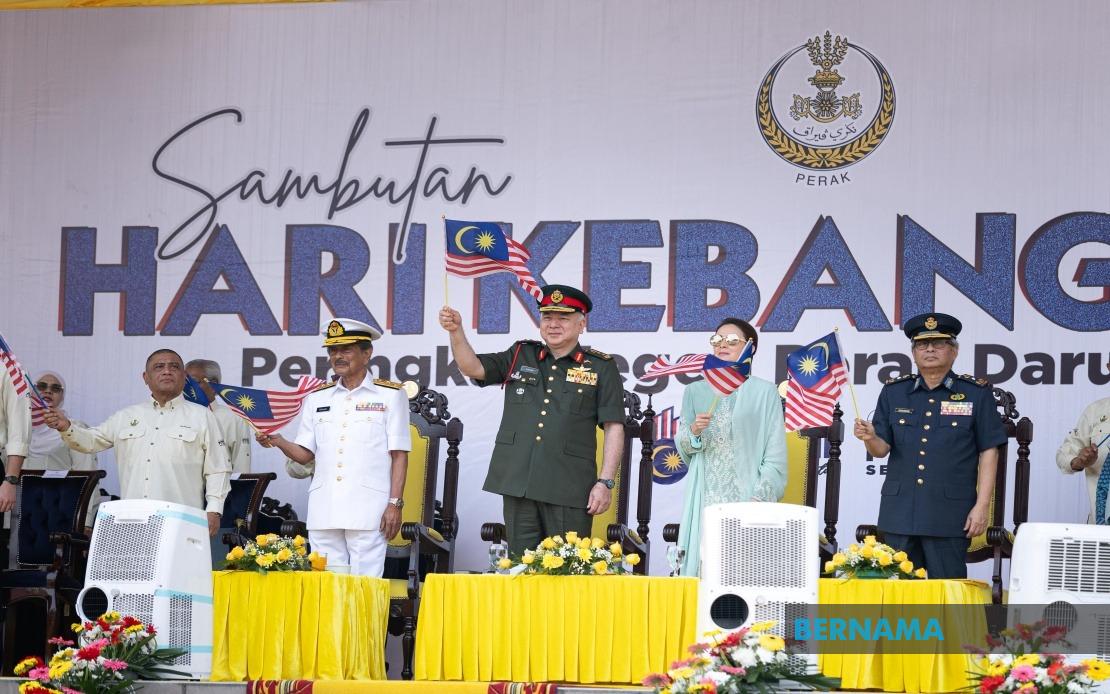
Sultan Nazrin Shah and Raja Permaisuri Tuanku Zara Salim presided over Perak's National Day 2026 Awards Presentation Ceremony at Dewan Bandaran Ipoh on August 31, recognising exceptional service from 11 military and police personnel who have devoted their lives to safeguarding the nation. The ceremony brought together the state's leadership, including Menteri Besar Datuk Seri Saarani Mohamad and senior government officials, underlining the significance accorded to honouring those who bear the burden of national defence.
The 11 recipients comprised a cross-section of Malaysia's security forces: six from the Malaysian Armed Forces, two from the Royal Malaysia Police, and three from the Royal Malaysian Navy. Each honouree walked away with RM1,000 in cash and a certificate of appreciation, modest tokens of a nation's gratitude for sacrifices that often come at tremendous personal cost. The diversity of the recipients reflects the multi-layered approach Malaysia takes to national security, drawing on land-based military capabilities, civilian policing, and maritime defence.
Among the most poignant recognitions was that of Warrant Officer 2 Mohamad Razali Din, whose service during Operation Naga in Banding resulted in a life-altering injury—the amputation of his left leg below the knee after stepping on a landmine. Stories such as his anchor the abstract notion of national defence in concrete human reality, reminding observers that security achievements come measured in permanent physical and psychological transformation for many personnel. His presence at the ceremony symbolised not merely past sacrifice but ongoing commitment despite profound disability.
Equally notable was Warrant Officer 2 Megat Abdullah Megat Othman, who neutralised three communist terrorists during Operation Batu Kawah in Sri Aman, earning recognition through a ceremonial commando knife alongside his certificate. This honour reflects Malaysia's continued acknowledgement of counter-insurgency operations that shaped the nation's early decades and remain historically significant in national consciousness. The specific mention of his operational success underscores how individual bravery and tactical effectiveness form the building blocks of national security narratives.
The remaining military recipients—Staff Sergeant Idris Ismail, Corporal Mokhtar Sulaiman, Lance Corporal Khairul Anuar Abdul Hamid, and Lance Corporal Alias Abd Wahab—represent the backbone of Malaysia's defence establishment: mid-ranking personnel whose consistent professionalism and duty often escape public recognition despite bearing direct responsibility for operational success. The inclusion of these ranks demonstrates a deliberate institutional choice to honour not only the most senior decorated officers but also the countless individuals whose daily work sustains military capability.
From the police service, two retired officers received recognition: Sub-Inspector Omar Jayus and Sergeant Major Abdul Malek Nordin. Their retirement status signals Malaysia's appreciation for past service extending beyond active duty, acknowledging the value of institutional memory and the continuing relevance of those who have transitioned from frontline roles. The Royal Malaysian Navy's contribution was similarly honoured through retired First Admiral Mohamad Imran Abd Hamid, retired Commander Mohd Akhbar Mohd Yusof, and retired Warrant Officer 2 Ahmad Safwi Shaari, reflecting Malaysia's maritime security priorities.
Beyond individual citations, the ceremony provided platform for broader national messaging. Menteri Besar Saarani Mohamad used the occasion to articulate Malaysia's fundamental political challenge: maintaining social cohesion within a deliberately pluralistic society. His address confronted a persistent tension in Malaysian public discourse—the risk that citizens might allow ethnic, religious, or factional identities to supersede shared national belonging.
Saarani emphasised that Malaysia's construction as a nation-state never relied on cultural or religious homogeneity but deliberately embraced diversity as foundational. This framing matters particularly for Southeast Asian audiences observing Malaysia's ongoing management of communal relations. He positioned the state not as a mere administrative apparatus but as a unifying force built on constitutional principles, the Malay language as a common tongue, and the institution of the Rulers as stabilising elements transcending communal boundaries.
Yet his warning about erosion of social bonds carried urgency. Saarani diagnosed a specific pathology afflicting diverse societies: the tendency to categorise fellow citizens through demographic lenses rather than individual humanity. When a neighbour becomes primarily a representative of a particular group rather than a distinct person, he suggested, the invisible threads holding plural societies together begin fraying. This analysis resonates across Southeast Asia, where many nations grapple with managing competing ethnic and religious identities within shared political frameworks.
The Menteri Besar's concern about growing "distance" represents sophisticated political sociology. He warned that as communal categorisation expands, the shared symbols binding the nation—the flag, the Constitution, the national language—risk becoming abstract formalities rather than genuine points of emotional investment and identification. For Malaysian and regional policymakers, his remarks articulated the constant vigilance required to prevent incremental social fracturing.
The National Day ceremony itself functioned as a deliberate counterweight to these divisive tendencies. By honouring security personnel from multiple services and backgrounds, and by situating these recognitions within ceremonial frameworks involving the Sultan, menteri, and state apparatus, the event performed nationhood as shared endeavour transcending individual difference. The award recipients themselves, drawn from various backgrounds, embodied the multiethnic security establishment serving a plural nation.
The awards presentation ceremony also included recognition for winners in National Day parade competitions and beautification contests, extending acknowledgement beyond military and police achievement to civilian participation in national observance. This broadening suggests state understanding that national cohesion requires activation at multiple social levels, not merely security force professionalism.
For Malaysian and Southeast Asian observers, the Perak ceremony encapsulates contemporary national governance challenges. Security and defence remain essential but insufficient foundations for nation-building. Sustained effort maintaining social bonds, managing identity-based tensions, and ensuring that institutional symbols retain genuine meaning require constant cultivation. Sultan Nazrin's presence and formal recognition of these 11 heroes signalled state commitment to honouring sacrifice, while Saarani's reflections acknowledged the political complexity of preserving diverse societies as unified national entities.

